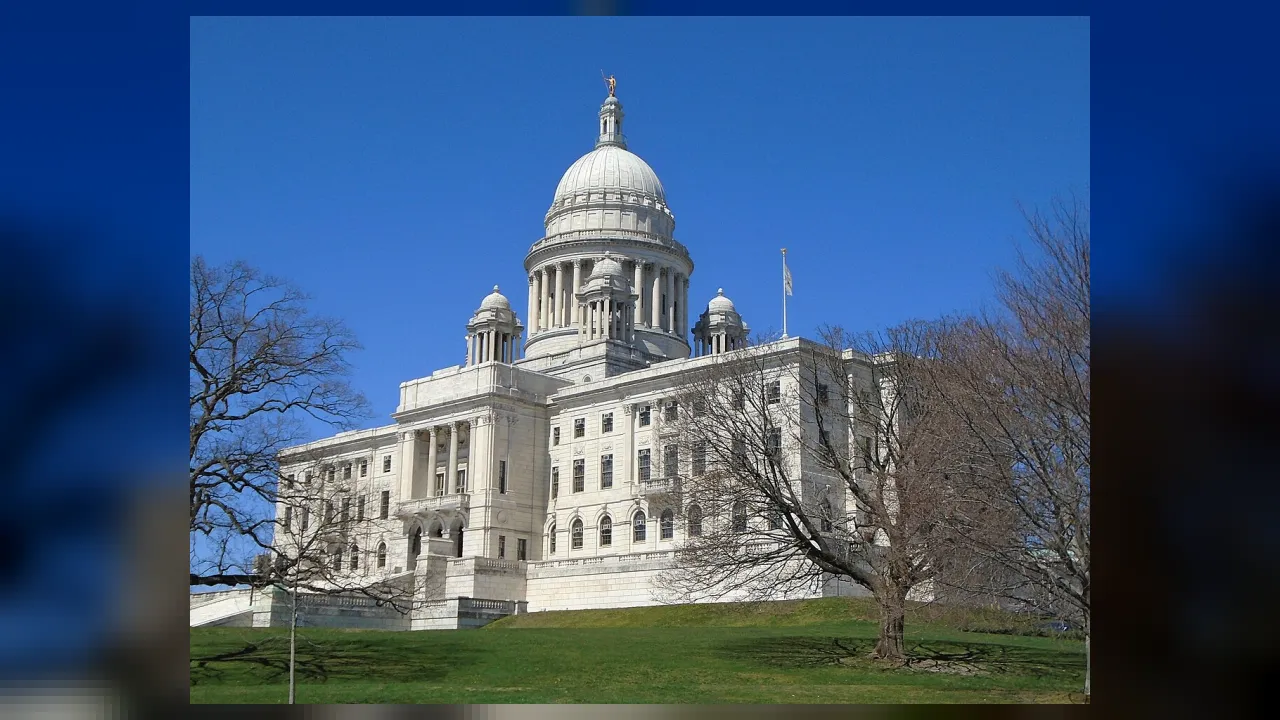
1. What special record does Rhode Island hold among all 50 states?
2. What is Rhode Island's famous nickname?
🤯 Mind-Blowing Fact • Grade 2
No place in Rhode Island is more than thirty minutes by car from the water of the Atlantic Ocean or Narragansett Bay!
✨ Word Sparks (Grade 2 Glossary)
Tap 🔊 to hear
bay
curved body of water sheltered by land
settlement
new town built by early community members
waterwheel
spinning wheel turned by flowing river water
🪝
Why is America's smallest state nicknamed the Ocean State?
1
A Giant Bay Inside a Tiny State
Seagulls call overhead as ferry boats chug past bright lighthouses. Rhode Island is the smallest state in the United States, but water shapes almost every town. Huge Narragansett reaches deep into the land and creates more than four hundred miles of shoreline.
2
A Safe Home for Fair Ideas
Long ago in 1636, a leader named Roger Williams started a called Providence. He promised that neighbors could worship peacefully in their own way. Today, Providence is the busy state capital.
3
Spinning River Wheels
Fast rivers also helped Rhode Island make history. Builders set up in Pawtucket to spin cotton thread inside America's first water-powered factory mill.
1. Which city did Roger Williams found that is still Rhode Island's capital today?
2. How did fast rivers in Pawtucket help change American work?
🤯 Mind-Blowing Fact • Grade 3
Twenty-one historic lighthouses still stand along Rhode Island's bays and islands to guide ships safely past rocky reefs!
✨ Word Sparks (Grade 3 Glossary)
Tap 🔊 to hear
maritime
connected to ships, harbors, and ocean travel
conscience
inner sense of what is right and fair
ratify
vote to officially approve an important agreement
🪝
Why did the tiniest original colony wait the longest to join the new Constitution?
1
Islands, Coves, and Harbor Winds
Imagine standing on a granite cliff while Atlantic breakers roll into Narragansett Bay. Although Rhode Island measures only about forty-eight miles long and thirty-seven miles wide, thirty-plus islands dot its sparkling bay. Fishing boats, sailing ships, and coastal marshes give this New England state a rich character.
2
Roger Williams and Religious Liberty
In 1636, Roger Williams left Massachusetts Bay Colony seeking freedom of . After purchasing land fairly from the Narragansett people, he established Providence as a refuge where citizens could hold different beliefs without punishment by government leaders.
3
Waiting for a Bill of Rights
Rhode Islanders guarded their freedoms fiercely during the Founding Era. They refused to approve the U.S. Constitution right away because they wanted written protections for individual liberties. On May 29, 1790, Rhode Island became the thirteenth state to the Constitution.
4
Slater Mill Sparks New Industry
Just three years later, Samuel Slater opened a water-powered cotton-spinning mill along the Blackstone River in Pawtucket, helping launch America's Industrial Revolution.
1. Why did Rhode Island wait until May 1790 to ratify the U.S. Constitution?
2. Where did Samuel Slater build America's famous early water-powered cotton mill in 1793?
🤯 Mind-Blowing Fact • Grade 4
Rhode Island's 1663 Royal Charter worked so well that the state kept using it as its governing frame until 1843—nearly two centuries later!
✨ Word Sparks (Grade 4 Glossary)
Tap 🔊 to hear
peninsula
strip of land surrounded mostly by water
charter
official written document granting rights and rules
oceanography
scientific study of ocean currents, waves, and life
🪝
How did a colony barely thirty-seven miles wide pioneer both religious liberty and American factory power?
1
Geography Shaped by Ice and Sea
Thousands of years ago, retreating glaciers carved a flooded river valley that became Narragansett Bay, splitting Rhode Island into sheltered harbors, , and islands such as Aquidneck and Block Island. Covering just 1,545 square miles including inland waters, Rhode Island ranks fiftieth in area among U.S. states, yet its intricate inlets create over four hundred miles of tidal coastline.
2
A Lively Experiment in Self-Government
When Roger Williams founded Providence in 1636 on Narragansett homelands, and Anne Hutchinson soon helped settle Portsmouth on Aquidneck Island, they built communities around a bold principle: civil government should not force anyone's religious worship. King Charles II's Royal of 1663 officially called this guarantee of liberty a 'lively experiment,' inspiring later American ideals in the First Amendment.
3
The Thirteenth Star on the Flag
Rhode Island declared independence from Great Britain in May 1776, two months before Congress adopted the Declaration of Independence. Yet after the Revolutionary War, independent-minded farmers and merchants worried a distant federal government might overpower small states. Only after Congress proposed the Bill of Rights did Rhode Island ratify the Constitution on May 29, 1790, completing the original thirteen states.
4
From Textile Mills to Marine Science
In 1793, Samuel Slater and Moses Brown harnessed the Blackstone River at Pawtucket to run mechanized yarn-spinning frames. Today, Rhode Island blends historic craftsmanship with research, shipbuilding, healthcare, and jewelry design centered around Providence and Newport.
1. What phrase in the Royal Charter of 1663 described Rhode Island's guarantee of religious freedom?
2. How did ancient glaciers give tiny Rhode Island over 400 miles of coastline?
🤯 Mind-Blowing Fact • Grade 5
When Rhode Island ratified the U.S. Constitution on May 29, 1790, the vote in its convention was just 34 in favor to 32 opposed—the narrowest ratification margin of any original state!
✨ Word Sparks (Grade 5 Glossary)
Tap 🔊 to hear
estuary
coastal bay where fresh rivers meet ocean tides
dissenter
person who disagrees with official rules or beliefs
allegiance
loyal duty promised to a ruler or nation
🪝
Why did America's smallest state exert an outsized influence on the First Amendment and the Industrial Revolution?
1
Estuarine Geography of the Ocean State
At low tide along Narragansett Bay, salt marshes, granite headlands, and deep-water channels reveal why geography has always steered Rhode Island's destiny. Encompassing only 1,034 square miles of dry land—and 1,545 square miles when coastal waters are included—Rhode Island is New England's largest network disguised as America's smallest state. Aquidneck Island, Conanicut Island, and offshore Block Island shelter natural harbors from Newport north to Providence.
2
Indigenous Homelands and Dissenters' Refuge
Long before European sails appeared, the Narragansett, Wampanoag, and Niantic peoples farmed coastal clearings, harvested quahog clams, and traded shell wampum across southern New England. Banished from Massachusetts in 1636 for defending Indigenous land titles and liberty of conscience, Roger Williams negotiated with Narragansett sachems Canonicus and Miantonomi to found Providence. Fellow including Anne Hutchinson soon established nearby towns, uniting under the 1663 Royal Charter that separated church authority from civil law.
3
Revolutionary Defiance and Constitutional Caution
Maritime merchants and sailors made colonial Rhode Island quick to resist British trade taxes; its legislature renounced to King George III on May 4, 1776, and Newport later hosted French General Rochambeau's allied army before the march to Yorktown. Even so, Rhode Island boycotted the 1787 Constitutional Convention, fearing federal tariffs and the absence of explicit civil liberties. Once James Madison introduced the Bill of Rights in Congress, Rhode Island ratified the Constitution by a narrow 34-to-32 vote on May 29, 1790.
4
Birthplace of Mechanized Manufacturing
Three years after statehood, British-trained mechanic Samuel Slater partnered with Providence Quaker businessman Moses Brown to construct water-driven Arkwright spinning frames at Slater Mill on the Blackstone River. By turning rushing New England waterfalls into mechanical horsepower, Pawtucket sparked precision machine shops, silverworks, and textile villages across the Northeast.
5
Modern Civic and Scientific Legacy
In 2020, voters shortened the state's historic official name—formerly 'State of Rhode Island and Providence Plantations'—simply to 'State of Rhode Island.' Today its universities, marine laboratories, and vibrant capital of Providence continue four centuries of civic debate and coastal innovation.