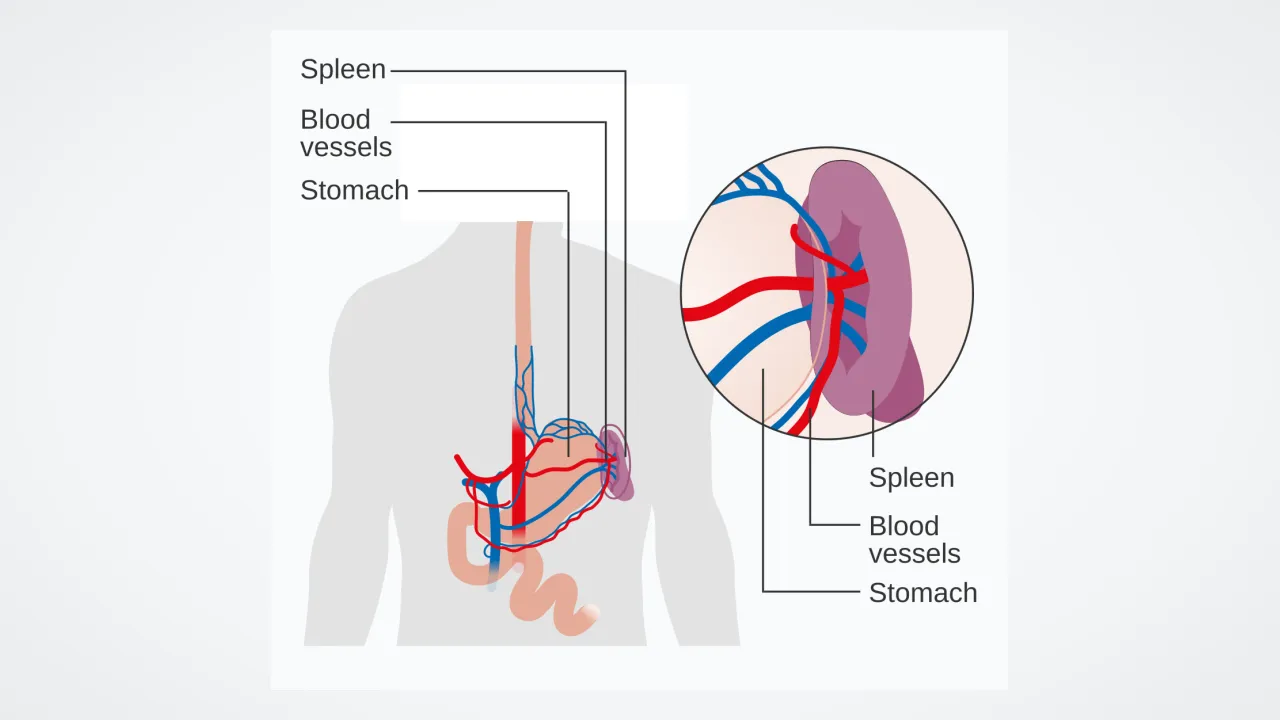
1. Where is your spleen tucked safely inside your body?
2. What two big jobs does your spleen do as blood flows through it?
🤯 Mind-Blowing Fact • Grade 2
Not one drop of iron goes to waste—your spleen carefully saves the iron from worn-out red blood cells and mails it back to your bone marrow to build new ones!
✨ Word Sparks (Grade 2 Glossary)
Tap 🔊 to hear
Iron
Mineral inside red cells that grabs oxygen
Obstacle Course
Path with tight squeezes testing cell flexibility
Ribcage
Curved basket of chest bones shielding organs
🪝
How does your spleen run an obstacle course that only young, bendy blood cells can pass?
1
Largest Lymph Organ
Meet the biggest member of your immune system's lymph family! Nestled next to your stomach on the upper left side, your fist-sized spleen filters every drop of blood in your body again and again throughout the day.
2
The Squeeze Test
Inside the spleen sit ultra-narrow twisty tunnels. Healthy young red blood cells are soft and bendy like tiny jelly doughnuts, so they squeeze right through! Old, stiff cells after four months of work get caught, broken down neatly, and their is shipped back to bone marrow to build fresh cells.
3
Backup Blood Tank
Your spleen also holds an extra cup of blood and healing platelets ready to release whenever your body needs a boost!
1. How does your spleen tell the difference between young red blood cells and worn-out old ones?
2. Where does the spleen send the recycled iron it rescues from old red blood cells?
🤯 Mind-Blowing Fact • Grade 3
Roughly one-third of all the scrape-sealing platelets in your entire body hang out on standby inside your spleen at any moment!
✨ Word Sparks (Grade 3 Glossary)
Tap 🔊 to hear
Red Pulp
Spleen zone filtering blood and storing platelets
White Pulp
Spleen islands packed with immune defender cells
Macrophage
Big cleanup cell gobbling germs and debris
🪝
Why is the inside of your spleen divided into 'red pulp' and 'white pulp' neighborhoods?
1
Two Colors, Two Super Jobs
If you looked inside a spleen under a magnifying lens, you would see deep crimson tissue dotted with tiny pearly islands—almost like sesame seeds inside watermelon! Scientists call these two neighborhoods and , and each handles a totally different job.
2
Red Pulp: Filter and Storage
makes up nearly four-fifths of the spleen. Here, blood trickles through microscopic slits narrower than a cell's own width! Helpful cleanup cells called gobble up stiff 120-day-old red cells, damaged bits, and trapped bacteria, while storing one-third of your body's platelets.
3
White Pulp: Immune Command Post
Those pearly islands of wrap right around incoming arteries and brim with B-cells and T-cells. If a germ ever sneaks into your bloodstream, white pulp sounds the alarm and builds custom antibodies fast!
4
Living Without One
Amazingly, if a spleen is ever injured and removed, your liver and lymph nodes pitch in to cover most of its jobs!
1. What happens inside the 'white pulp' islands of your spleen?
2. If someone has to have an injured spleen removed by a surgeon, which other organs step up to help take over its recycling work?
🤯 Mind-Blowing Fact • Grade 4
In 2018, scientists discovered that traditional Bajau breath-hold ocean divers in Indonesia evolved spleens 50% larger than average—acting like built-in scuba boosters that release extra oxygen-rich red blood cells underwater!
✨ Word Sparks (Grade 4 Glossary)
Tap 🔊 to hear
Dive Reflex
Body response saving oxygen when diving underwater
Senescent
Grown old and worn out over time
Bile
Liver digestive liquid tinted by recycled blood
🪝
How did 'sea nomad' free-divers in Southeast Asia evolve larger spleens that work like biological scuba tanks?
1
The Mammalian Dive Reflex
Wedged beneath your diaphragm under left ribs nine through eleven, your 150-gram spleen filters roughly five percent of your heart's blood output every minute. Yet marine biologists and physiologists uncovered an astonishing bonus superpower: when you hold your breath and plunge your face into cool water, your spleen gently squeezes, injecting a reserve burst of oxygen-packed red blood cells straight into circulation!
2
Bajau Sea Nomads and Genetic Adaptation
For over a thousand years, the Bajau people of Indonesia have free-dived up to 230 feet underwater on a single breath to gather shellfish! In 2018, geneticist Melissa Ilardo used portable ultrasound scanners and discovered that Bajau villagers—even those who never dived—possess spleens fifty percent larger than neighboring land farmers, linked to a natural PDE10A gene variation that boosts oxygen reserves underwater.
3
Micro-Slits and Heme Recycling
Inside the red pulp's splenic cords of Billroth, eight-micrometer erythrocytes must deform through endothelial slits barely one to three micrometers wide! (aged) cells fail this mechanical test and are phagocytosed by resident macrophages: globin proteins break down into reusable amino acids, iron rides transferrin trucks back to red marrow, and leftover heme pigment travels to your liver to become golden digestive .
4
Guarding Against Masked Bacteria
Marginal-zone B-cells lining the border between red and white pulp specialize in spotting 'encapsulated' bacteria wearing slippery sugar coats that fool ordinary immune cells!
1. How does a larger spleen help Bajau free-divers stay underwater longer on a single breath?
2. What happens to the leftover colorful 'heme' part of old red blood cells after your spleen rescues the iron?
🤯 Mind-Blowing Fact • Grade 5
Your spleen can perform microscopic 'cell surgery' called pitting—pinching a tiny speck of debris or a parasite right out of a living red blood cell and resealing the cell unharmed so it keeps carrying oxygen!
Blood flowing out through tissue before re-entering veins
🪝
Why do red blood cells have to abandon closed blood vessels inside the spleen and squeeze through 2-micrometer slits to stay alive?
1
Open Circulation and the Cords of Billroth
Weighing roughly 150 grams in the left hypochondriac quadrant between the gastric fundus and diaphragm, the spleen (Latin lien, Greek splen) is the human body's largest secondary lymphoid organ—uniquely plumbed directly into the systemic bloodstream rather than lymphatic vessels. Remarkably, human splenic red pulp utilizes '': terminal arterioles dump blood straight into reticular meshworks called the , forcing erythrocytes to re-enter venous sinusoids through interendothelial slits measuring just one to two micrometers wide!
2
Culling, Pitting, and Iron Homeostasis
Healthy eight-micrometer biconcave erythrocytes flex effortlessly through those slits, whereas 120-day-old cells with stiffened spectrin membranes become trapped and culled by red-pulp macrophages. Even more delicately, splenic slits perform ''—pinching out nuclear remnants (Howell-Jolly bodies) or intracellular parasites like malaria from inside a red cell and sealing its membrane intact so the rescued cell keeps circulating! Salvaged iron binds ferritin or plasma transferrin for marrow erythropoiesis, while unconjugated bilirubin travels via the splenic and portal veins to the liver.
3
White Pulp Architecture and Marginal Zone Defense
Surrounding central arterioles, periarteriolar lymphoid sheaths (PALS) of T-cells and adjacent B-cell follicles form the white pulp. Bridging red and white pulp sits the marginal zone, populated by specialized IgM+ memory B-cells and macrophages uniquely equipped to opsonize polysaccharide-encapsulated bacteria such as Streptococcus pneumoniae.
4
Fetal Hematopoiesis and Evolutionary Physiology
Before bone marrow matures mid-gestation, the fetal spleen actively manufactures red and white blood cells. In adults, it sequesters thirty percent of total platelets, deploys healing monocytes to injured tissues, and contracts sympathetically during hypoxia—an evolutionary trait amplified by PDE10A selection in Bajau breath-hold divers.
5
From Marcello Malpighi to Spleen-Preserving Medicine
Ancient humoral theorists once blamed the spleen for melancholy moods until Italian microscopist Marcello Malpighi mapped its white lymphoid follicles ('Malpighian corpuscles') in 1666—laying the foundation for modern immunology and today's spleen-preserving surgical care.