🪐 Scale / DiameterStar A: 6.5M mi (10.4M km) • Star B: 3.2M mi (5.2M km) • 18.6 combined solar masses
☄️ Composition & OrbitTwo scorching blue-white stars orbiting just 11 million miles apart every 4.014 days
⚡ Cosmic SparkWhirls so close to its massive partner that mutual gravity stretches both blazing blue stars into egg shapes
🤯 Mind-Blowing Fact • Grade 1
In Latin, the name 'Spica' means an 'ear of wheat' held in the hand of Virgo in the spring harvest sky!
✨ Word Sparks (Grade 1 Glossary)
Tap 🔊 to hear
egg-shaped
Stretched oval instead of a round ball
whirl
To spin around fast in tight circles
wheat
Golden grain crop grown on sunny farms
🪝
What happens when two giant blue stars dance so close that they stretch like eggs?
1
Speed On to a Blue Gem
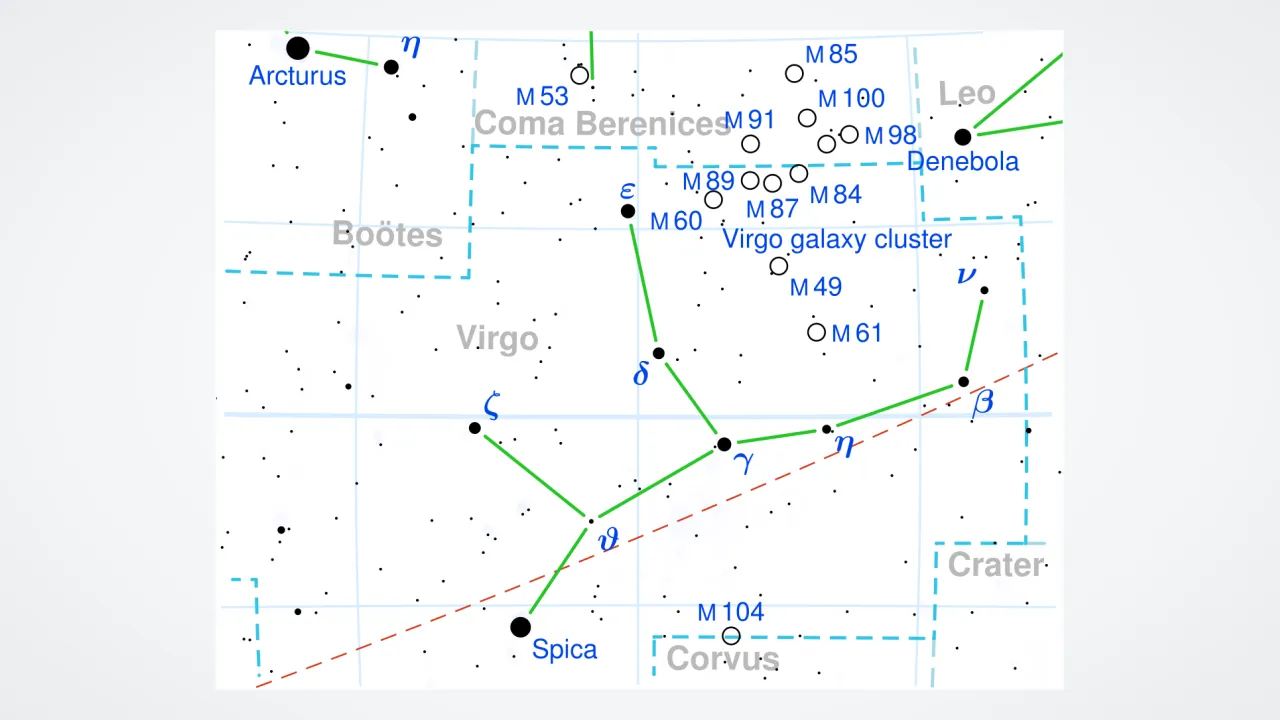
Remember how we curved down the Big Dipper's handle to orange Arcturus? Keep zooming in a straight line and 'speed on to Spica'! Low in the spring sky sparkles a crisp blue-white gem.
2
Two Stars Hiding as One
Even big backyard telescopes see only one bright dot. Yet up close, two giant blue stars around each other every four days!
3
Stretched Like Cosmic Eggs
Strong gravity pulls both close partners into pointy egg shapes as they spin!
1. How many stars are actually whirling close together inside the single bright point of Spica?
2. Why are the two stars of Spica stretched into egg shapes instead of round balls?
🤯 Mind-Blowing Fact • Grade 2
Together, Spica's two sizzling blue stars pump out more than 22,000 times as much light and energy as our yellow Sun!
✨ Word Sparks (Grade 2 Glossary)
Tap 🔊 to hear
Virgo
Large spring star pattern holding bright Spica
equinox
Day in spring or fall with equal day-night
tidal bulge
Gravity stretch pulling close partners into ovals
🪝
How did one spring star help an ancient Greek astronomer discover that Planet Earth wobbles like a top?
1
Arc to Arcturus, Speed on to Spica!
Spring stargazers love a two-step sky map: follow the Big Dipper's curved handle to orange Arcturus, then continue straight south to blue-white Spica in ! Shining 250 light-years away, it ranks sixteenth-brightest in Earth's night sky.
2
Hipparchus Spots Earth's Wobble
Around 130 BCE, Greek astronomer Hipparchus measured Spica's exact spot during a lunar eclipse and compared it with star charts made 150 years earlier. Spica had shifted two degrees relative to the spring —revealing for the first time that spinning Earth slowly wobbles over 26,000 years!
3
Four-Day Football Dance
Up close, Spica's two scorching blue stars circle closer together than Mercury orbits our Sun, finishing a full lap every four days!
1. What major discovery about Planet Earth did Greek astronomer Hipparchus make by measuring Spica around 130 BCE?
2. How close together do the two giant stars of Spica orbit?
🤯 Mind-Blowing Fact • Grade 3
Every two days, Spica brightens by about three percent simply because its two football-shaped stars turn sideways toward Earth and show wider glowing sides!
✨ Word Sparks (Grade 3 Glossary)
Tap 🔊 to hear
ellipsoidal variable
Close star pair brightening as football sides turn
threshold
Minimum starting level required for an event
progenitor
Massive star destined to explode later on
🪝
Why does Spica subtly brighten and dim every two days even though neither star passes in front of the other?
1
Hidden Twin Revealed by Rainbow Shifts
For centuries, nobody suspected Alpha Virginis—250 light-years away in Virgo—was two stars. Then in 1890, German astronomer Hermann Carl Vogel split Spica's starlight into a rainbow spectrum and saw its dark chemical lines sliding rhythmically back and forth every 4.014 days as two stars raced toward and away from Earth!
2
Ellipsoidal Football Stars
Primary star Spica A weighs 11.4 solar masses and sizzles at 45,000°F (25,300 K), while partner Spica B weighs 7.2 solar masses at 37,000°F (20,900 K). Separated by barely twice Spica A's own width, fierce tidal gravity stretches both stars into glowing American footballs—called !
3
Sideways Versus End-On Brightness
Even though their tilted orbit never eclipses from Earth, Spica brightens slightly every two days whenever both football-shaped stars turn broadside toward us, showing more glowing surface area than when pointed end-on!
4
Heavy Enough for a Supernova
Because eleven-solar-mass Spica A tops the eight-solar-mass for core collapse, it is one of the closest future supernova to Earth!
1. How did Hermann Carl Vogel prove in 1890 that Spica was actually two close stars?
2. Why does Spica brighten slightly twice during every four-day orbit without eclipsing?
🤯 Mind-Blowing Fact • Grade 4
Scientists in Narrabri, Australia, rolled two WWII-style searchlight mirrors around a circular railroad track to measure Spica's twin stars using quantum photon clumping!
✨ Word Sparks (Grade 4 Glossary)
Tap 🔊 to hear
intensity interferometer
Mirror pair measuring star width via photon clumping
colliding winds
Shock zone where two stars' winds crash together
Beta Cephei star
Hot blue massive star pulsing every few hours
🪝
How did two mirrors in the Australian outback measure Spica's twin stars using a wild quantum physics trick?
1
Narrabri's Quantum Intensity Interferometer
Separating two stars parked just 0.12 astronomical units apart from 250 light-years away defeated every ordinary telescope of the 1960s. So physicists Robert Hanbury Brown and John Davis rolled two 22-foot mosaic searchlight mirrors along circular railroad tracks in Narrabri, Australia! Using a quantum-optics breakthrough called an —correlating photon arrival clumps rather than fragile light waves—they resolved Spica's 4-day dance in 1966–1970, directly measuring both stars' sizes, orbit tilt, and 250-light-year distance!
2
Colliding Winds Blasting X-Rays
Blazing at 25,300 kelvins (Spica A, 20,500 solar luminosities) and 20,900 kelvins (Spica B, 2,280 solar luminosities), both massive B-type stars hurl fierce supersonic winds outward. Right down the middle of the 11-million-mile gap between them, those two winds slam head-on, shock-heating plasma until Spica glows steadily in X-rays!
3
Tidal Wobbles and Beta Cephei Pulses
Adding to its ellipsoidal brightness wave, primary star Spica A is a rapidly rotating Beta Cephei variable whose outer layers throb in and out every 4.2 hours! Meanwhile, slightly oval 4-day tidal tugs force their egg-shaped orbit itself to rotate full circle—called apsidal precession—every 139 years.
4
Safe Neighbor Supernova
Only ~12.5 million years old, 11.4-solar-mass Spica A is leaving the main sequence now; millions of years from today it will explode harmlessly ten times beyond Earth's danger radius!
1. What produces X-rays inside the tight 11-million-mile space between Spica A and Spica B?
2. Roughly how fast does primary star Spica A pulse as a Beta Cephei variable?
🤯 Mind-Blowing Fact • Grade 5
Nicolaus Copernicus personally built wooden sighting instruments in Poland in the early 1500s to measure Spica's exact sky position while writing his book placing the Sun at the center of our Solar System!
✨ Word Sparks (Grade 5 Glossary)
Tap 🔊 to hear
apsidal precession
Slow rotation of an oval orbit's long axis
Roche lobe
Teardrop gravity boundary around close binary star
How has Alpha Virginis anchored twenty-one centuries of discovery—from Hipparchus's precession of the equinoxes to Hanbury Brown-Twiss quantum interferometry and tidal asteroseismology?
1
Hipparchus, Copernicus, and Ecliptic Calibration
Positioned just two degrees south of the ecliptic at apparent visual magnitude +0.97 (~250 light-years / 77 parsecs in Virgo), Alpha Virginis—Latin Spica Virginis, 'Virgo's Ear of Wheat'—has served as a fundamental astrometric fiducial since antiquity. Around 129 BCE, Greek astronomer Hipparchus measured Spica's celestial longitude during lunar eclipses and compared it against 3rd-century BCE records by Timocharis of Alexandria. Finding Spica had shifted two degrees eastward from the autumnal equinox without changing ecliptic latitude, Hipparchus discovered Earth's 25,772-year lunisolar axial precession! Sixteen centuries later, Nicolaus Copernicus built bespoke triquetrum sightings of Spica at Frombork to calibrate precession in De revolutionibus.
2
Spectroscopic Discovery and Narrabri Intensity Interferometry
In 1890, Potsdam astrophysicist Hermann Carl Vogel detected double-lined Doppler shifts oscillating every 4.0145 days—making Spica one of the earliest spectroscopic binaries ever discovered. Between 1966 and 1970, Robert Hanbury Brown and collaborators at Narrabri Stellar Intensity Interferometer exploited quantum Hanbury Brown-Twiss photon bunching across baselines up to 188 meters to resolve the sub-milliarcsecond binary directly—determining orbital inclination (~65°), semimajor axis (0.12 AU / 18 million km), component radii (7.47 and 3.74 solar radii), and independent geometric distance without relying on parallax!
3
Ellipsoidal Distortion, Gravity Darkening, and Apsidal Motion
Mutual tidal forces across their slightly eccentric (e ≈ 0.13) four-day orbit stretch B1III-IV subgiant Spica A (11.43 solar masses, 25,300 K, ~20,500 solar luminosities) and B2V main-sequence Spica B (7.21 solar masses, 20,900 K, ~2,280 solar luminosities) into triaxial Roche-lobe ellipsoids. Non-eclipsing ellipsoidal cross-section changes plus mutual reflection and gravity darkening drive a 0.03-magnitude double-wave light curve per orbit while rotating the line of apsides every ~139 years—directly probing deep stellar interior mass concentration.
4
Tidally Excited Pulsations and Kappa-Mechanism Iron Opacity
MOST space photometry and high-cadence spectroscopy revealed that Spica A's 4.17-hour Beta Cephei pulsations—driven by the iron-group opacity '' near 200,000 K—interact dynamically with dynamic tides raised during each 4-day periastron passage!
5
Nearest Core-Collapse Candidate alongside Ionized H II Halo
Flooding surrounding Virgo space with Lyman-continuum ultraviolet photons to ionize a vast, faint 18-degree H II region around itself, 12.5-million-year-old Spica A stands above the ~8-solar-mass core-collapse threshold—poised millions of years hence for a brilliant, biosphere-safe Type II supernova.