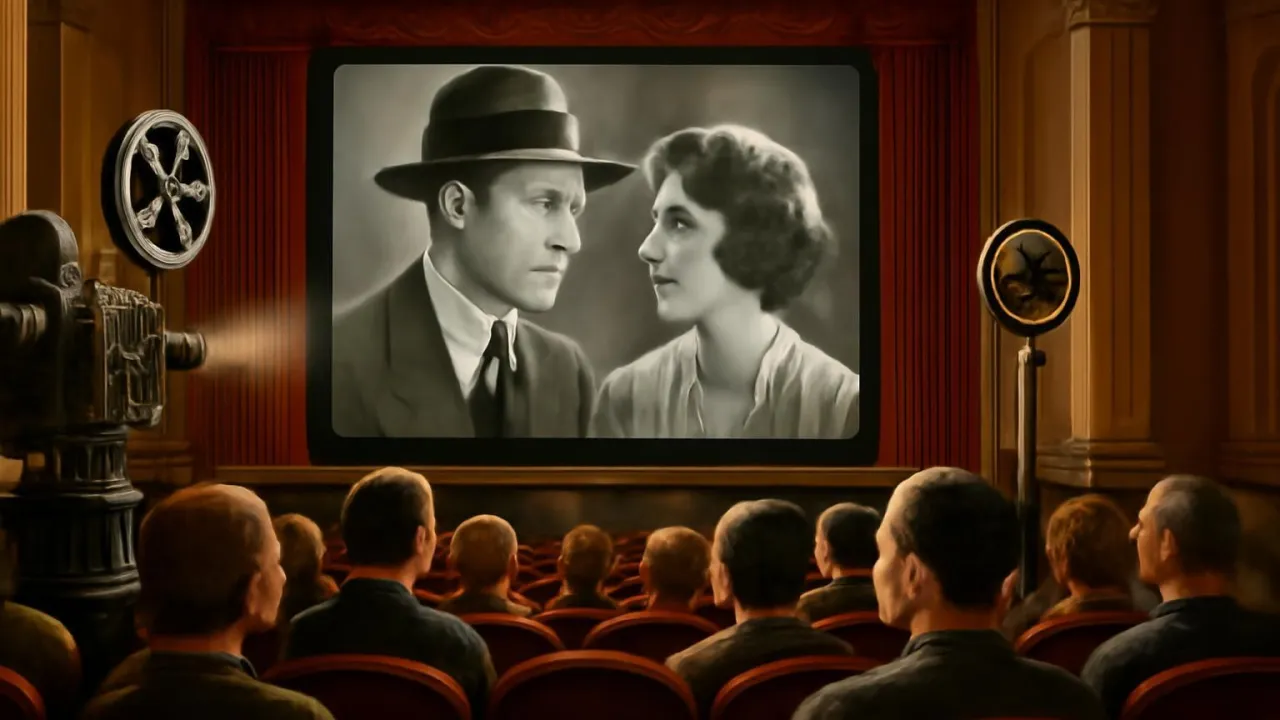
People lined up around the block to hear the first talkie movies.
✨ Word Sparks (Grade 2 Glossary)
Tap 🔊 to hear
projector
A machine that shows movies
pattern
A design or shape that repeats
audience
The people who watch and listen
🪝
Can you imagine hearing your favorite movie character sing?
1
Silent Movies to Talking Films
At first, movies were silent and had no voices. People read words on the screen, and music played in the theater. Then, inventors found a way to add sound to film.
2
How Did They Make Movies Talk?
A machine called a microphone recorded actors' voices. The voices were saved on the film as of light. When the film played, a turned the patterns back into sound.
3
Why Were Talkies Special?
Talkies let people hear singing, laughter, and real talking. loved hearing stories with real voices. Movies became even more fun and exciting for everyone.
The first talkies used light and sound together on the same film strip!
✨ Word Sparks (Grade 3 Glossary)
Tap 🔊 to hear
vibration
A fast back-and-forth movement
synchronized
Happening at the same time
sensor
A tool that detects things
🪝
What would it feel like to hear a movie actor’s real voice for the first time?
1
A World Without Movie Voices
Before talkies, movies were silent and used written words called 'intertitles.' Musicians played live music to add feeling. Audiences watched moving pictures but never heard the actors' real voices.
2
Inventing the Talking Picture
Engineers used microphones to capture actors’ voices as . These vibrations were turned into patterns of light on the film strip. When the film ran through a projector, a special read the patterns and played the sound in sync with the picture.
3
The First Sound Film Sensation
In 1927, 'The Jazz Singer' amazed crowds by letting them hear singing and speaking on screen. This new technology was called ' sound.' It quickly changed how movies were made and enjoyed.
4
How Talkies Changed the World
Talkies made stories more exciting and real by adding voices and music. Actors had to learn to speak clearly for microphones. Movie theaters became places where people could laugh, cry, and sing along together.
Optical sound recording let movies share music and voices in perfect time with the picture.
✨ Word Sparks (Grade 4 Glossary)
Tap 🔊 to hear
optical
About light or seeing
composer
Someone who writes music
engineer
A person who designs things
🪝
Imagine sitting in a dark theater when, suddenly, the movie characters begin to speak and sing—how would you react?
1
From Silent Screens to Sound Waves
Before the late 1920s, all movies were silent, and live musicians or sound effects artists performed in theaters to make films exciting. Audiences read intertitles to understand what characters were saying, but they never heard an actor’s real voice. The invention of 'talkies' transformed the movie experience by synchronizing sound with moving pictures, making stories feel much more real.
2
The Science Behind Talking Pictures
used microphones to capture the vibrations of actors’ voices and convert them into electrical signals. These signals were then recorded as patterns of light along the edge of the film strip, a process called ' sound recording.' When the film played, a projector’s light passed through these patterns, and a sensor converted them back into sound, perfectly matching the images on screen.
3
A Night at the First Talkie
In 1927, 'The Jazz Singer' premiered, and audiences were amazed to hear singing and spoken words coming from the screen. This breakthrough marked the beginning of the 'sound era' in Hollywood, leading to rapid changes in filmmaking techniques and the popularity of musicals and comedies.
4
How Talkies Changed Entertainment Everywhere
Talkies quickly spread around the world, making movies more popular and accessible to people of all ages. Actors had to adjust their performances for microphones, and new jobs were created for sound and . The invention of sound film not only changed how stories were told but also helped connect cultures by sharing voices and music across the globe.
1. How did optical sound recording work in talkies?
2. What new jobs did talkies create?
🤯 Mind-Blowing Fact • Grade 5
By 1929, over 95% of American theaters had converted to sound film projection.
✨ Word Sparks (Grade 5 Glossary)
Tap 🔊 to hear
photoelectric cell
A sensor that turns light into electricity
synchronization
Making things happen at the same time
diction
How clearly someone speaks words
🪝
What if you could travel back to 1927 and witness the moment when movies first spoke—how would that change your view of storytelling?
1
The Silent Era’s Limitations and the Race for Sound
For decades, filmgoers relied on live musicians and intertitles to bring silent movies to life, but the absence of synchronized voices limited storytelling possibilities. By the 1920s, inventors and engineers worldwide were experimenting with ways to unite sound and moving images, sparking a technological race between American, German, and British studios. The breakthrough came when Warner Bros. adopted the Vitaphone and later the Movietone system, allowing sound to be recorded directly onto the film strip for the first time.
2
Engineering the First Synchronized Sound Films
The key to sound film technology was the optical soundtrack—sound waves were converted into electrical signals, then transformed into variable light patterns by a device called a 'light valve.' These patterns ran along the edge of the film and, during projection, a detected changes in light intensity, converting them back into electrical signals and finally into amplified sound. This precise was critical, as even a fraction-of-a-second delay would break the illusion of talking pictures.
3
‘The Jazz Singer’ and the Dawn of the Talkies
On October 6, 1927, 'The Jazz Singer' premiered in New York City, featuring Al Jolson’s voice and songs. Audiences were astonished by the direct connection between what they saw and what they heard, and the film’s success triggered a rapid industry-wide shift to sound. Within two years, nearly all major studios had converted to producing talkies, and silent films quickly became obsolete.
4
Cultural and Global Impact of Sound Film
The arrival of talkies revolutionized not only filmmaking but also global culture, as movies could now share languages, music, and authentic performances across continents. Actors with strong voices became international stars, while those with heavy accents or weak sometimes struggled. The need for new skills led to the rise of sound engineers, dialogue coaches, and composers, permanently transforming the film industry’s workforce and creative process.
5
Lasting Legacy and Scientific Principles
The science behind talkies—wave conversion, optical recording, and precise —remains foundational to modern audiovisual technology. Today’s digital soundtracks still rely on the principle of encoding sound information alongside images for seamless playback. The invention of sound film not only made movies more immersive but also paved the way for television, music videos, and global multimedia storytelling, leaving a lasting legacy on how we experience entertainment.