🌌 COSMOS
🔭 Peculiar Spiral / Lenticular Galaxy • Messier 104 (NGC 4594)
VA Science SOL 1.6, 4.5, 4.6 (Solar System, Stars & Space Exploration)
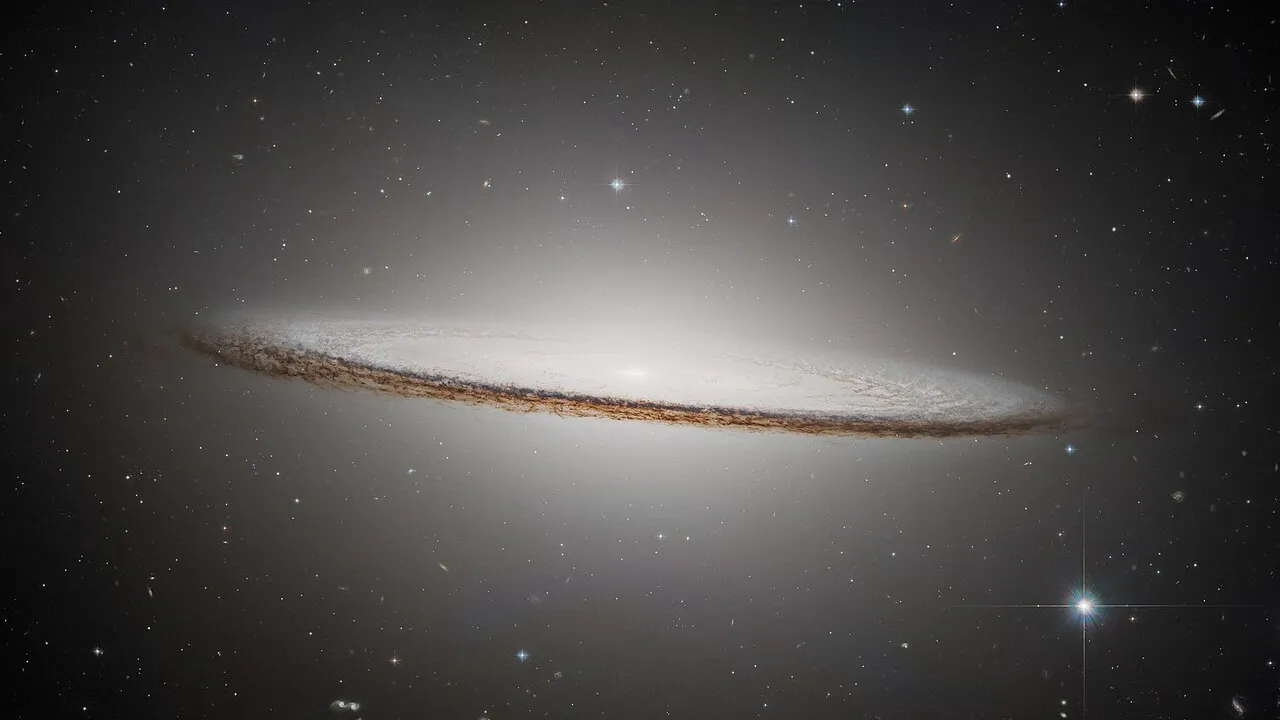
Sombrero Galaxy
The Wide-Brimmed Hat Made of Starlight
Grade 4 • Expanding • 207 words
🌌 Cosmic Location & DistanceVirgo–Corvus Border • 31 million light-years from Earth
🪐 Scale / Diameter50,000 light-years (294 quadrillion mi / 473 quadrillion km) wide • 800 billion solar masses
☄️ Composition & OrbitGlowing bulge of ancient stars, thick dark dust ring & 2,000 globular clusters
⚡ Cosmic SparkHosts a billion-sun supermassive black hole wrapped inside a razor-sharp ring of cosmic dust
🤯 Mind-Blowing Fact • Grade 1
Nearly 2,000 sparkling star balls called globular clusters buzz around the Sombrero Galaxy like cosmic fireflies!
✨ Word Sparks (Grade 1 Glossary)
Tap 🔊 to hear
brim
The wide flat edge sticking out around a hat
cosmic dust
Tiny grains of rock and soot floating in space
dome
A rounded top shaped like half a ball
🪝
Can a giant city of stars look just like a wide-brimmed hat?
1
A Hat Floating in Space
Tilt your head and peek through a big telescope! Out in deep space floats a bright star island shaped like a wide-brimmed Mexican hat. That is how the Sombrero Galaxy got its fun name.
2
A Dark Dusty Brim
A thick dark band wraps around its middle like a hat . That dark ring is made of cool space dust and gas. Millions of new stars hide inside the dusty ring.
3
A Glowing Golden Crown
Above and below the dark shines a huge white-gold . Billions of older stars pack together to make the hat's tall crown glow!
1. Why did astronomers name this galaxy the Sombrero Galaxy?
2. What makes the dark band around the middle of the Sombrero Galaxy?
🤯 Mind-Blowing Fact • Grade 2
Our Milky Way has about 150 globular star clusters, while the Sombrero Galaxy has nearly 2,000—more than ten times as many!
✨ Word Sparks (Grade 2 Glossary)
Tap 🔊 to hear
edge-on
Seen from the thin side instead of the top
bulge
A round, crowded swelling of stars in the middle
halo
A wide sphere of stars surrounding a galaxy
🪝
Why does this famous galaxy have a crisp dark stripe slicing right across its middle?
1
Viewed Almost From the Side
Imagine holding a shiny dinner plate nearly level with your eyes so you see its thin edge! From Earth, we view the Sombrero Galaxy almost , tilted by just six degrees. That sideways angle lets us see its flat disk and tall round at the exact same time.
2
Inside the Dusty Ring
A dramatic dark lane traces the outer edge of the flat disk like the brim of a sun hat. Cold hydrogen gas and soot-like dust swirl inside this ring, quietly building nurseries for young stars.
3
Swarms of Star Clusters
Rising above and below the dusty disk is a giant lantern of ancient stars. Around that bright , about two thousand tight star balls called globular clusters orbit like bees around a hive!
1. How is the Sombrero Galaxy tilted from Earth's point of view?
2. About how many globular star clusters orbit inside the Sombrero Galaxy's halo?
🤯 Mind-Blowing Fact • Grade 3
When the James Webb Space Telescope observed the Sombrero Galaxy in mid-infrared light, its huge central star bulge vanished and its dusty outer ring glowed like a bullseye target!
✨ Word Sparks (Grade 3 Glossary)
Tap 🔊 to hear
elliptical
Shaped like a smooth oval or rounded egg
supermassive
Holding millions or billions of times our Sun's mass
equator
An imaginary line circling right around the middle
🪝
What happens when a galaxy looks like two different galaxy types blended into one?
1
A Cosmic Puzzle on Virgo's Border
Thirty-one million light-years away, along the border of the constellations Virgo and Corvus, shines Messier 104—better known as the Sombrero Galaxy. Measuring 50,000 light-years across, it spans roughly half the width of our Milky Way yet packs in about 800 billion suns' worth of mass!
2
Half Spiral, Half Football
For decades, astronomers debated how to classify Messier 104. Its thin, flat disk of gas and dust looks like a classic spiral galaxy, while its enormous, rounded central bulge looks like a giant galaxy shaped like a glowing football.
3
The Symmetrical Dust Brim
Tilted just six degrees north of its from our vantage point, the Sombrero displays a remarkably smooth ring of cold dust and hydrogen gas. Most of the galaxy's cool star-making fuel is locked inside this dark outer brim.
4
A Heavyweight Black Hole Heart
Deep inside the brilliant core sits one of the heaviest black holes ever measured in our cosmic neighborhood, weighing roughly one billion times the mass of our Sun!
1. Why has classifying the Sombrero Galaxy puzzled astronomers?
2. Roughly how massive is the supermassive black hole at the Sombrero Galaxy's center?
🤯 Mind-Blowing Fact • Grade 4
In 1912, astronomer Vesto Slipher measured light from the Sombrero Galaxy racing away at over 620 miles (1,000 km) per second—one of the earliest clues that our entire universe is expanding!
✨ Word Sparks (Grade 4 Glossary)
Tap 🔊 to hear
wavelength
Distance between wave peaks that determines light's type
opaque
Blocking light completely so nothing shines through
quasar
Fiercely glowing galactic core powered by feeding black hole
🪝
Why did the Sombrero Galaxy's famous hat crown disappear when the James Webb Space Telescope looked at it?
1
Two Views of One Extraordinary Galaxy
Look at Hubble Space Telescope photos of Messier 104, and an incandescent white dome of ancient stars dominates the frame, sliced horizontally by an dark dust lane. Yet when the James Webb Space Telescope aimed its Mid-Infrared Instrument at the exact same target 31 million light-years away, the towering crown of stars faded into a tiny pinpoint! Instead, the dusty outer brim lit up in clumpy, glowing knots like an archery bullseye.
2
Why Different Wavelengths Tell Different Stories
This dramatic transformation happens because cool, aging stars inside the Sombrero's central bulge emit mostly visible and near-infrared light, which mid-infrared detectors largely ignore. Meanwhile, carbon-rich dust molecules called polycyclic aromatic hydrocarbons inside the outer ring absorb starlight and re-radiate warm mid-infrared glow, turning a dark shadow into a luminous ring.
3
Clues to a Violent Ancient Past
Spanning 50,000 light-years across on the southern edge of the Virgo region, Messier 104 holds clues to ancient galactic collisions. Astronomers studying metal-rich stars scattered through its vast halo suspect the Sombrero swallowed one or more massive galaxies billions of years ago, puffing up its enormous bulge while leaving a calm outer disk.
4
A Quiet Billion-Solar-Mass Giant
At the core lurks a billion-solar-mass supermassive black hole. Surprisingly, despite its immense gravity, this monster snacks only lightly on trickling gas, shining as a gentle low-luminosity active nucleus rather than a blazing .
1. Why did the Sombrero Galaxy's huge central star bulge fade away in James Webb's mid-infrared image?
2. What early discovery by Vesto Slipher in 1912 involved the Sombrero Galaxy?
🤯 Mind-Blowing Fact • Grade 5
Even though its outer dust ring spans tens of thousands of light-years, the Sombrero Galaxy births less than one Sun's worth of new stars per year—slower than our Milky Way!
✨ Word Sparks (Grade 5 Glossary)
Tap 🔊 to hear
spectrograph
Instrument splitting light into rainbows to measure motion
morphology
The structural shape and form of an object
galactic merger
Collision where two galaxies combine into one system
🪝
How did a 'hat-shaped' galaxy help prove the universe is expanding while hiding a billion-sun black hole inside a fossil merger?
1
A Belated Entry Into Messier's Catalog
In May 1781, French astronomer Pierre Méchain spotted a bright, spindle-shaped glow near the border of Virgo and Corvus and mentioned it in a letter. Charles Messier penciled notes about the object into his personal copy of his nebula catalog, yet Messier 104 was not officially added until 1921, when Camille Flammarion uncovered Messier's handwritten annotations. Nine years earlier, in 1912, American astronomer Vesto Slipher at Lowell Observatory split the Sombrero Galaxy's starlight through a and measured an astonishing recession velocity of roughly 1,000 kilometers per second—foundational evidence that 'spiral nebulae' lay far beyond the Milky Way inside an expanding cosmos.
2
Hybrid Morphology: Disk Within an Elliptical Halo
Positioned approximately 31 million light-years away and spanning 50,000 light-years in diameter, NGC 4594 defies tidy classification. Long cataloged as an unbarred Sa spiral viewed just six degrees north of edge-on, deep infrared observations from the Spitzer and Hubble telescopes showed that its colossal stellar spheroid and rich swarm of nearly 2,000 globular clusters closely resemble a giant elliptical galaxy containing an embedded, razor-flat disk.
3
Chemical Fingerprints of Ancient Galactic Cannibalism
How could an undisturbed, symmetrical dust ring survive inside a violently puffed-up elliptical halo? Hubble measurements resolved individual stars in the Sombrero's outer halo and found surprisingly high concentrations of heavy elements—'metals' forged in generations of stars—indicating a major wet merger between two massive galaxies more than three billion years ago, after which leftover gas settled back into a smooth planar disk.
4
Mid-Infrared Bullseye and Star-Formation Rate
In 2024, the James Webb Space Telescope's MIRI camera resolved the outer dust ring into intricate, clumpy filaments of polycyclic aromatic hydrocarbons. Despite holding abundant dust, this ring converts gas into new stars lazily—producing less than one solar mass of new stars per year.
5
The Dormant Billion-Sun Engine
Stellar orbital speeds plunging around the core betray a supermassive black hole of roughly one billion solar masses. Yet X-ray and radio observations show this colossus feeds via a radiatively inefficient inflow, whispering softly rather than roaring.