1. What language did young Sojourner Truth grow up speaking first in New York?
2. What does the name 'Sojourner' mean?
🤯 Mind-Blowing Fact • Grade 2
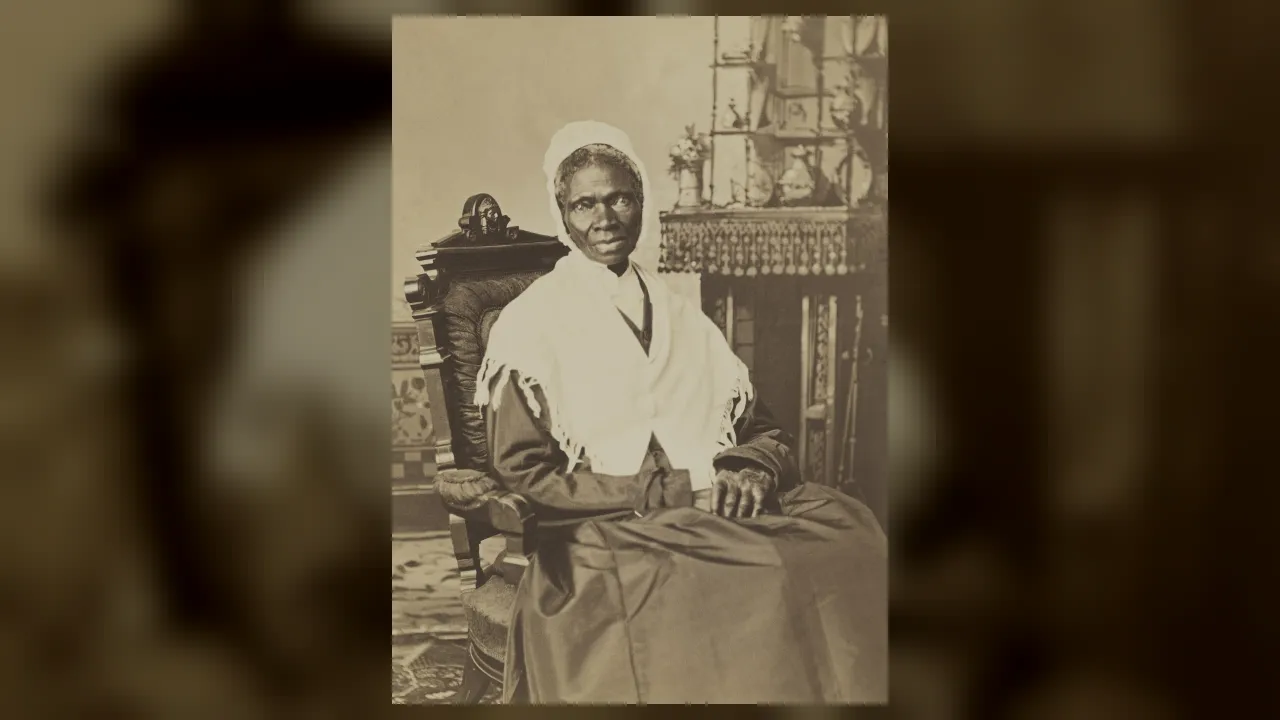
To support herself on lecture tours, Sojourner Truth sold printed portrait cards of herself bearing the wise caption: 'I sell the shadow to support the substance!'
✨ Word Sparks (Grade 2 Glossary)
Tap 🔊 to hear
lawsuit
A case brought before a court judge
dictate
To speak words aloud for someone writing
emancipation
Setting enslaved people free by law
🪝
How did an enslaved mother who could not read or write become the first Black woman to win a lawsuit against a white man in U.S. court?
1
Winning Back Her Son in Court
Picture walking up courthouse steps in Kingston, New York, in 1827 with unshakable determination! Born Isabella Baumfree, she had walked away to freedom with her infant daughter in 1826, one year before New York ended slavery. When she learned her five-year-old son Peter had been illegally sold south to Alabama, she went to court with Quaker helpers—and won Peter back!
2
Speaking Without Notes
In 1843, Isabella took the name Sojourner Truth and set out walking across states. Though never taught to read, she dictated her life story and delivered unforgettable speeches against slavery and for women's rights, including a famous 1851 talk in Akron, Ohio.
3
Wartime Helper in Virginia
During the Civil War, she helped newly freed families at Freedman's Village in Arlington, Virginia, and met President Abraham Lincoln!
1. Why did Isabella Baumfree go to court in New York in 1827–1828?
2. Where in Virginia did Sojourner Truth teach and assist newly freed families during and after the Civil War?
🤯 Mind-Blowing Fact • Grade 3
In 2009, a bronze bust of Sojourner Truth was unveiled in Emancipation Hall at the U.S. Capitol Visitor Center—making her the first African American woman honored with a statue in the Capitol!
✨ Word Sparks (Grade 3 Glossary)
Tap 🔊 to hear
resonant
Deep, clear, and echoing richly across rooms
memoir
A book telling someone's own real life
desegregate
To end unfair rules separating people
🪝
What happened in Akron, Ohio, in 1851 when a six-foot-tall speaker rose from the back pew and hushed a noisy hall?
1
From Ulster County to Freedom
Listen to a deep, singing voice filling a packed New England lecture hall in 1850! Born Isabella Baumfree around 1797 in Ulster County, New York, she grew up enslaved on a Dutch-speaking farm. After her enslaver broke a promise to free her ahead of New York's 1827 emancipation law, Isabella refused to run in secret at night—instead walking calmly away in autumn daylight with her baby Sophia to the home of friendly neighbors Isaac and Maria Van Wagenen.
2
Landmark Court Victory and New Name
Discovering that her five-year-old son Peter had been sold illegally out of New York to Alabama, she petitioned a grand jury with Quaker aid and became in 1828 one of the very first Black women in America to win a court case against a white man. On June 1, 1843, she adopted the name Sojourner Truth and began traveling nationwide.
3
Electrifying Akron in 1851
At the May 1851 Women's Rights Convention in Akron, Ohio, hecklers claimed women were too weak to vote. Rising in her plain gray dress and white sunbonnet, Sojourner pointed to her own decades of plowing fields, harvesting crops, and enduring sorrow—proving women deserved full equal rights!
4
Desegregating Streetcars in Washington, D.C.
During the 1860s, while counseling freed families in Arlington, Virginia, and visiting President Lincoln, Sojourner boldly rode horse-drawn Washington streetcars and won a test case integrating the city's transit cars!
1. How did Sojourner Truth fund her travels and buy her home in Battle Creek, Michigan?
2. What public transportation victory did Sojourner Truth win in Washington, D.C., in 1865?
🤯 Mind-Blowing Fact • Grade 4
In 1997, NASA named its Mars Pathfinder robotic rover 'Sojourner' after a twelve-year-old Connecticut student won a worldwide essay contest explaining how Sojourner Truth charted new paths as a fearless traveler!
✨ Word Sparks (Grade 4 Glossary)
Tap 🔊 to hear
pulpit
A raised platform for speaking in church
copyright
Legal ownership protecting a creator's published work
integration
Opening public places equally to all people
🪝
Why did Sojourner Truth insist that abolishing slavery and winning women's voting rights were two halves of the very same fight for human liberty?
1
Dutch-Speaking Roots and Legal Triumph
Step inside a crowded Universalist church in Akron, Ohio, on May 29, 1851, where six-foot-tall Sojourner Truth steps calmly to the and silences jeering critics with wit, Scripture, and lived truth. Born Isabella Baumfree around 1797 in Swartekill, Ulster County, New York, she spoke only Low Dutch until sold away from her parents at age nine—a heartbreaking separation she never forgot. Walking to freedom with her infant daughter Sophia in late 1826, she learned New York law forbade selling enslaved residents out of state and successfully sued in Ulster County court in 1828 to recover her five-year-old son Peter from Alabama.
2
Connecting Abolition and Women's Rights
Adopting the chosen name Sojourner Truth in 1843, she joined an egalitarian community in Northampton, Massachusetts, where she met abolitionists William Lloyd Garrison and Frederick Douglass. Dictating The Narrative of Sojourner Truth (1850) because slavery had denied her literacy, she spoke across dozens of states. At Akron in 1851—first reported accurately that June by abolitionist editor Marius Robinson before Frances Dana Gage published a famous popularized dialect version twelve years later—Truth dismantled claims of female fragility by testifying to her own physical strength, intellect, and equal humanity before God.
3
Arlington's Freedman's Village and White House Visit
Settling near Battle Creek, Michigan, Truth recruited African American soldiers for the Union during the Civil War, including her own grandson in the 54th Massachusetts Infantry. Traveling to Washington, D.C., in October 1864 to meet President Abraham Lincoln, she stayed to serve the National Freedmen's Relief Association at Freedman's Village in Arlington, Virginia—teaching domestic skills, defending mothers against kidnappers, and winning an 1865 assault case that enforced streetcar across the nation's capital.
4
Voting Attempt in 1872
In November 1872—the exact same election in which Susan B. Anthony cast a ballot in New York—seventy-five-year-old Sojourner Truth walked into her Battle Creek, Michigan, polling booth demanding her constitutional right to vote!
1. Why do historians compare two different newspaper reports—from 1851 and 1863—when studying Sojourner Truth's famous Akron speech?
2. What civic action did Sojourner Truth take in Battle Creek, Michigan, during the presidential election of November 1872?
🤯 Mind-Blowing Fact • Grade 5
Unlike almost any other nineteenth-century reformer, Sojourner Truth registered legal federal copyright in her own name on her portrait photographs so every penny of sales supported her civil rights missions!
✨ Word Sparks (Grade 5 Glossary)
Tap 🔊 to hear
carte-de-visite
Small collectible card photograph from the 1860s
extemporaneous
Spoken powerfully in the moment without script
prescient
Wise foresight seeing future outcomes clearly
🪝
How did Sojourner Truth pioneer intersectional civic advocacy—uniting emancipation, equal transit, land opportunity, and universal suffrage—while carefully controlling her own public image?
1
Hudson Valley Bondage and Precedent-Setting Litigation
Examine an 1864 albumen photograph preserved in the Library of Congress: seated beside knitting needles and an open book in dignified Victorian dress, Sojourner Truth gazes directly into the lens above her copyrighted motto, 'I Sell the Shadow to Support the Substance.' Born Isabella Baumfree circa 1797 in Hurley, Ulster County, New York, she spoke Low Dutch until sold away from her parents at age nine for $100 alongside a flock of sheep. When John Dumont reneged on his pledge to emancipate her a year prior to New York's July 4, 1827 statutory abolition deadline, Isabella walked away at dawn in late 1826 carrying her infant daughter Sophia to Quaker abolitionists Isaac and Maria Van Wagenen. Learning Dumont had illegally sold her five-year-old son Peter across state lines into Alabama slavery, she petitioned the Ulster County Court with Quaker legal backing—prevailing in 1828 as one of the earliest Black women in American jurisprudence to triumph over a white defendant.
2
Itinerant Ministry, Northampton, and the 1851 Akron Address
Experiencing a profound spiritual calling on June 1, 1843 (Pentecost), she legally adopted the name Sojourner Truth and walked eastward across Long Island and Connecticut. Joining the utopian Northampton Association of Education and Industry in Massachusetts, she collaborated with William Lloyd Garrison, Wendell Phillips, and Frederick Douglass, dictating her 1850 Narrative to Olive Gilbert on credit so she could purchase a home outright. At the May 29, 1851 Ohio Women's Rights Convention in Akron, Truth delivered an masterpiece linking racial and gender justice. While Frances Dana Gage's 1863 reminiscence popularized the refrain 'Ain't I a Woman?' in southern dialect, contemporary June 1851 notes transcribed by Truth's friend Marius Robinson in the Anti-Slavery Bugle capture her crisp northern, Dutch-inflected declaration: 'I am a woman's rights. I have as much muscle as any man, and can do as much work as any man.'
3
Arlington's Freedman's Village and D.C. Streetcar Desegregation
Relocating to Battle Creek, Michigan, Truth rallied recruits for the 54th Massachusetts and 1st Michigan Colored Infantry during the Civil War. Received by President Abraham Lincoln at the White House in October 1864, she served at Freedman's Village in Arlington, Virginia, counseling newly emancipated families. When Washington streetcar conductors refused Black passengers despite an 1865 congressional ban, sixty-eight-year-old Truth held her ground aboard a streetcar, had an abusive conductor prosecuted, and desegregated capital transit.
4
Postwar Land Petitions and Universal Suffrage
Addressing the American Equal Rights Association in May 1867 during debates over the 15th Amendment, Truth warned that enfranchising Black men while excluding Black women would leave freedwomen vulnerable, insisting both win the ballot together. In the 1870s, she circulated national petitions urging Congress to set aside western public lands for Black homesteads and attempted to cast a ballot in Battle Creek in November 1872.
5
Visual Sovereignty and Capitol Commemoration
By registering federal copyrights in her own name for her portraits, Truth protected her visual dignity and financial independence—culminating in 2009 when Artis Lane's bronze bust in Emancipation Hall made her the first African American woman sculpted in the U.S. Capitol.