👷 CAREERS
💼 Earth Science, Pedology & Agricultural Conservation
VA Economics, Civics & Career Readiness SOL K.8, 1.8, 2.8, 3.9
Soil Scientist
Exploring the Living World Beneath Our Feet
Grade 5 • Advanced • 292 words
🧭 Career FieldAgriculture, Environmental Science & Geology
🛠️ Key Tools & SkillsSoil auger, Munsell color chart, pH meter, microscopes, and field maps
🏢 WorkplaceFarm fields, forests, wetlands, construction sites, and testing laboratories
⚡ Everyday Impact SparkKeeping Earth's living topsoil healthy so crops grow and rainwater stays clean
🤯 Mind-Blowing Fact • Grade 1
A single teaspoon of rich, healthy garden soil contains more microscopic living organisms than there are people on Earth!
✨ Word Sparks (Grade 1 Glossary)
Tap 🔊 to hear
topsoil
Rich upper layer where plant roots grow
clay
Smooth, sticky soil made of tiny bits
microbe
A living thing too tiny to see
🪝
Did you know one scoop of healthy soil holds millions of tiny living helpers?
1
Digging Into Earth
Crunch! A shiny metal scoop twists down into the meadow ground. Up comes dark, rich earth! A soil scientist rubs a pinch between two fingers to feel it.
2
Sand, Clay, and Worms
Soil is much more than plain dirt. It mixes sand, , water, air, and decayed leaves. Wiggling earthworms and tiny keep it full of life!
3
Helping Plants Grow
Soil scientists test farm and garden earth. They help farmers grow healthy carrots, corn, and berries while keeping streams clean!
1. Why does a soil scientist rub a pinch of soil between two fingers?
2. Which underground creatures help keep soil healthy and full of air?
🤯 Mind-Blowing Fact • Grade 2
Every U.S. state has an official state soil—Virginia's is Pamunkey soil, famous for fertile river terraces farmed for thousands of years!
✨ Word Sparks (Grade 2 Glossary)
Tap 🔊 to hear
auger
A spiral tool that bores into ground
horizon
A distinct layer inside underground soil
nutrient
Natural food that helps plants grow strong
🪝
Why do soils come in stripes of red, yellow, chocolate brown, and gray?
1
Reading Underground Layers
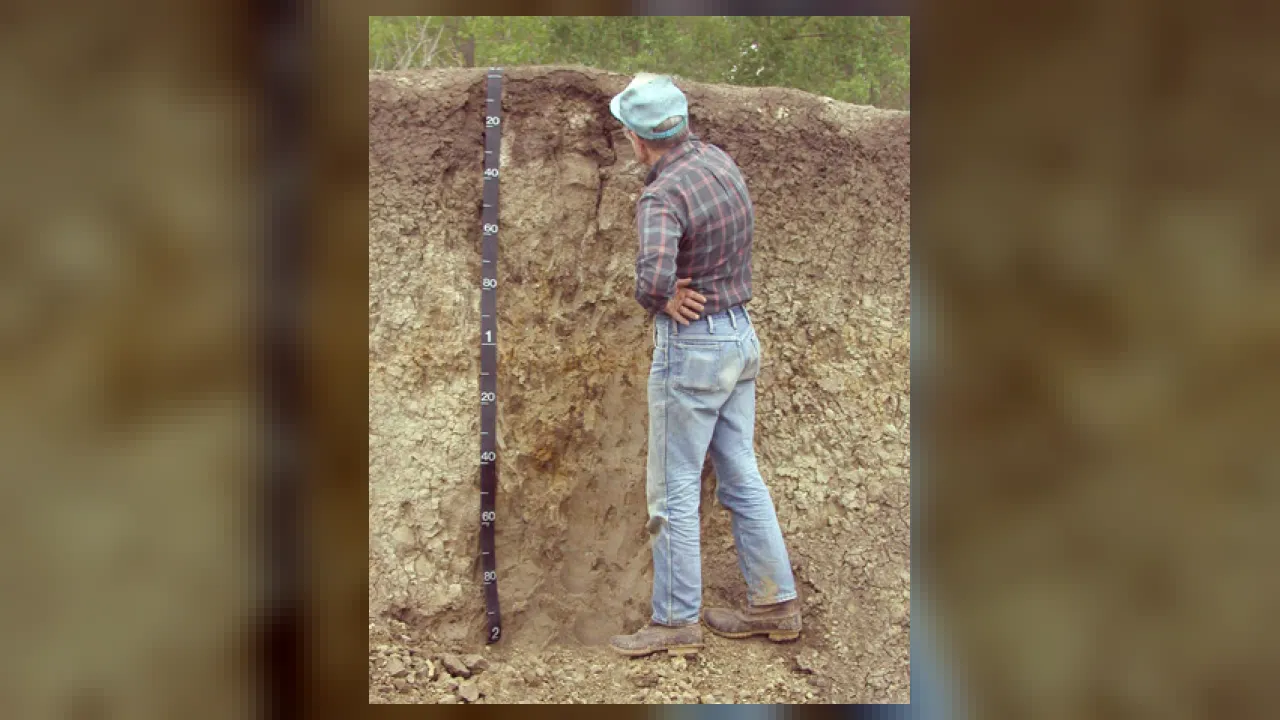
Imagine slicing into the ground like a tall layer cake! When soil scientists dig a test pit or pull up a tube of earth with a hand , they see colorful layers called . Dark brown topsoil sits on top, while rusty red or pale clay waits deeper down.
2
Matching Colors and Nutrients
In the field, scientists hold damp clods beside a special color guidebook to discover which minerals and decayed plants are inside. Back at the lab, they test so farmers know just what crops need.
3
Stopping Soil From Washing Away
Nature takes hundreds of years to make just one inch of topsoil! Soil scientists help communities plant cover roots that stop wind and rain from washing precious earth away.
1. What do soil scientists call the stacked layers of earth underground?
2. Why is protecting topsoil from washing away in rainstorms so important?
🤯 Mind-Blowing Fact • Grade 3
Rusty orange-red soils in the southeastern United States get their bright color from iron minerals oxidizing in air—just like rusty iron metal!
✨ Word Sparks (Grade 3 Glossary)
Tap 🔊 to hear
loam
Balanced soil mixing sand, silt, and clay
silt
Smooth, flour-soft mineral bits in soil
erosion
Wearing away of soil by wind or water
🪝
How can a soil scientist tell whether land is safe for a tall building, a wetland park, or a pumpkin farm?
1
Pulling Up a Core Sample
Twist, twist, pull! Out of a grassy hillside slides a three-foot cylinder of earth inside a hollow steel tube. By reading that core sample, a soil scientist uncovers thousands of years of natural history—from ancient river floods to mineral-rich bedrock.
2
The Perfect Recipe: Loam
Soil mineral grains come in three main sizes: gritty sand, silky , and microscopic sticky clay. Pure sand drains water too fast, while pure clay holds puddles tightly. Soil scientists help growers balance organic compost with minerals to encourage crumbly , where roots get both water and air.
3
Testing Before Bridges and Homes Rise
Before engineers pave highways, lay railroad tracks, or build multi-story schools, soil scientists check whether underground clay swells when rainy or shrinks when dry so heavy concrete foundations never tilt or crack.
4
Nature's Giant Water Filter
Healthy soils also act like giant underground sponges, soaking up rushing storm runoff, slowing down creek floods, and filtering rainwater cleanly before it reaches drinking wells, rivers, and coastal bays.
1. Why do plants grow especially well in crumbly loam soil?
2. Why do builders consult a soil scientist before constructing a school or bridge?
🤯 Mind-Blowing Fact • Grade 4
During a 1935 Senate hearing in Washington, D.C., soil pioneer Hugh Hammond Bennett pointed out the Capitol window at an arriving Dust Bowl cloud from 1,500 miles away, convincing Congress to create the Soil Conservation Service!
✨ Word Sparks (Grade 4 Glossary)
Tap 🔊 to hear
pedologist
Scientist studying how natural soils form
sediment
Loose bits of soil carried by water
bioremediation
Using microbes and plants to clean pollution
🪝
How did catastrophic 1930s dust storms inspire modern soil scientists to transform American farming and conservation?
1
Lessons From Black Blizzards
In the 1930s, years of deep plowing combined with severe drought stripped protective prairie grasses across the Great Plains, whipping millions of tons of dry topsoil into towering Dust Bowl clouds that darkened skies all the way to Washington, D.C. Pioneering soil scientist Hugh Hammond Bennett championed urgent conservation methods across the country, proving to citizens and lawmakers that fertile living soil is an irreplaceable national treasure.
2
Decoding the Soil Profile
—scientists who study how soils form and map across landscapes—examine vertical soil profiles divided into O, A, B, and C horizons down to solid bedrock. Using standardized Munsell color books and digital chemical pH meters, they measure soil acidity alongside essential plant macronutrients like nitrogen, phosphorus, potassium, and calcium.
3
Protecting Watersheds Like the Chesapeake Bay
When excess farm fertilizer or loose muddy washes off bare winter fields, streams turn murky and underwater bay grasses lose sunlight. Soil scientists partner closely with Virginia and mid-Atlantic farmers to plant winter rye and clover cover crops, design contour no-till fields, and grow streamside forest buffers whose deep roots lock topsoil firmly in place.
4
Healing Polluted Ground
Environmental soil scientists also restore old factory lots and mine lands through —recruiting hungry specialized soil microbes, fungi, and deep-rooted prairie plants to break down or safely trap harmful chemicals so communities can enjoy clean parks again.
1. How do winter cover crops and streamside buffers help watersheds like the Chesapeake Bay?
2. What is a soil scientist using when they compare damp earth to a Munsell book?
🤯 Mind-Blowing Fact • Grade 5
Earth's soils hold more than three times as much carbon as the entire atmosphere and four times as much as all living plants and trees combined!
✨ Word Sparks (Grade 5 Glossary)
Tap 🔊 to hear
pedogenesis
Natural process of soil forming over time
humus
Dark, stable organic matter enriching mature soil
regolith
Loose rocky dust blanketing planets or moons
🪝
Why do climate researchers, Mars rover engineers, and agronomists all rely on the discoveries of soil scientists?
1
Earth's Thin Critical Zone
Kneeling inside a freshly excavated six-foot soil pit, a certified soil scientist traces ancient root channels where infiltrating rainwater, atmospheric gases, weathered bedrock minerals, and billions of microorganisms intersect. Earth-system researchers call this life-sustaining skin stretching from tree canopies down to groundwater aquifers the 'Critical Zone'—and although fertile arable topsoil averages less than twelve inches deep globally, it produces roughly 95 percent of humanity's food supply.
2
Five Interacting Factors of Pedogenesis
Pioneering Russian scientist Vasily Dokuchaev and American soil chemist Hans Jenny demonstrated that every distinct soil order on Earth develops through five interacting variables: parent rock material, regional climate, slope topography, biological organisms, and geologic time. Over thousands of years, weak natural acids in rainwater chemically weather solid granite, basalt, or limestone into microscopic layered clay platelets carrying tiny negative electrical charges.
3
Soil Chemistry and Cation Exchange Capacity
Those negatively charged clay crystals and dark organic surfaces act like microscopic nutrient magnets! Through a chemical property called cation exchange capacity (CEC), fertile soils hold positively charged calcium, magnesium, ammonium, and potassium ions tightly enough that heavy rainstorms don't leach them away, yet loosely enough for fine plant root hairs to trade hydrogen ions for dinner.
4
Underground Carbon Vaults and Regenerative Farming
Globally, Earth's soils store more than 2,500 billion metric tons of organic and mineral carbon—more than three times as much carbon as the entire atmosphere combined! Soil scientists measure how regenerative farming practices like multi-species cover cropping, rotational grazing, composting, and minimal tillage help underground mycorrhizal fungal networks lock carbon into stable while boosting drought resilience.
5
From Wetland Delineation to Extraterrestrial Regolith
Whether mapping grey hydric wetland soils across Virginia's coastal marshes to guide flood protection, engineering lightweight green-roof substrates for urban skyscrapers, or mixing simulated iron-rich Martian at space research centers to test how future astronauts might grow leafy crops beyond Earth, soil scientists steward our planet's living foundation.