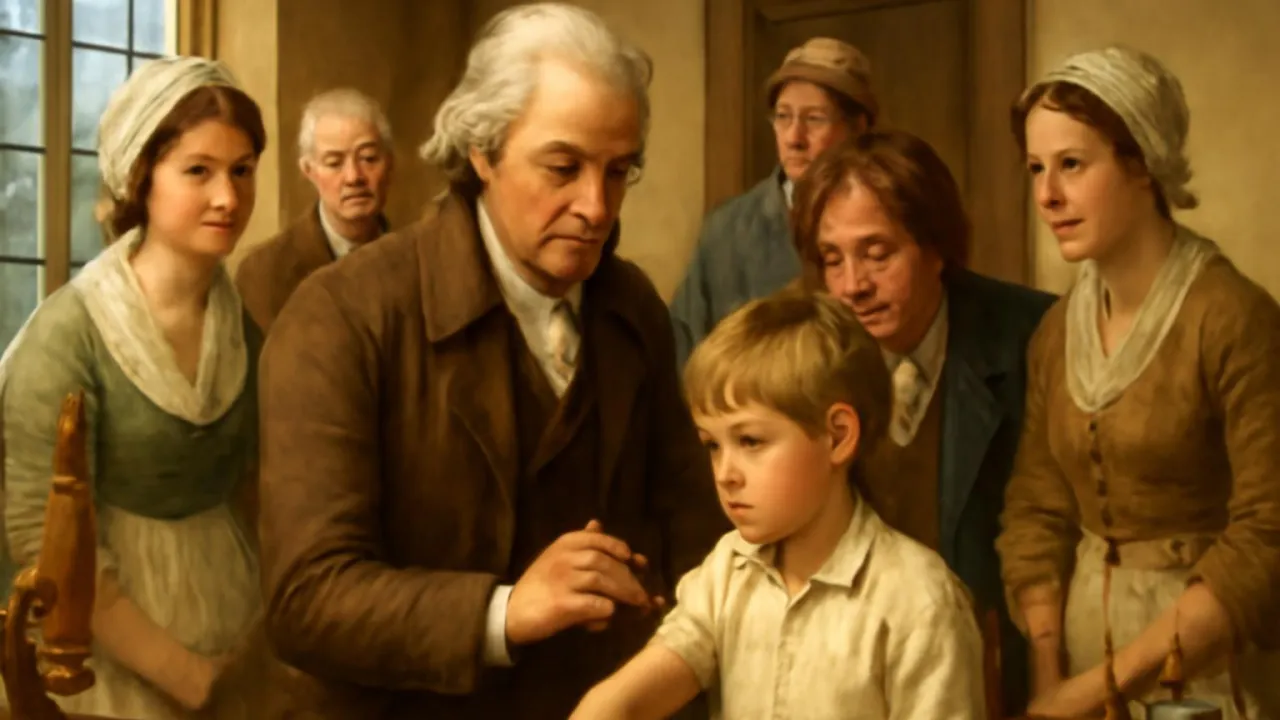
Before vaccines, smallpox could leave scars or even cause blindness in survivors.
✨ Word Sparks (Grade 2 Glossary)
Tap 🔊 to hear
smallpox
A very dangerous sickness from long ago
cowpox
A mild sickness from cows
protect
To keep safe from harm
🪝
Have you ever wondered how a little shot could save millions of lives?
1
The Doctor’s Discovery
Edward Jenner noticed that milkmaids who caught did not get , even when they were near sick people. He wondered if cowpox could others, so he tried it on a young boy named James. James got a little sick, but he never caught smallpox, even when Jenner tested him again.
2
How the Vaccine Works
The vaccine uses a weak virus called . It teaches your body to fight off , so you do not get sick from it. Your immune system remembers the cowpox and is ready to stop the real smallpox virus if it comes.
3
A World Without Smallpox
Thanks to this invention, is gone today, and people no longer fear it. Vaccines now keep many people safe from other diseases, too, like measles and polio. Getting vaccines helps you, your family, and your whole community.
Edward Jenner’s smallpox vaccine saved more lives than any other medical invention in history.
✨ Word Sparks (Grade 3 Glossary)
Tap 🔊 to hear
immunity
When your body can fight off sickness
prototype
The first try at a new invention
eradicated
Completely wiped out everywhere
🪝
Imagine a world where one tiny shot could stop a deadly disease forever—how did that happen?
1
Jenner’s Surprising Experiment
In 1796, Edward Jenner noticed milkmaids with cowpox never caught smallpox. He carefully took fluid from a cowpox blister and scratched it into a boy’s arm. The boy got a mild illness, but then he was immune to smallpox.
2
How Vaccines Train the Body
The vaccine used a harmless virus to create . When the body meets the real smallpox virus, it remembers and fights back quickly. This process is called immunization, and it protects people from getting sick.
3
The End of Smallpox
Smallpox was once a global threat, causing fevers and rashes everywhere. After many years of vaccination, the World Health Organization declared smallpox in 1980. This was a huge victory for science and public health.
4
A New Era for Medicine
Jenner’s invention inspired vaccines for many other diseases. Today, scientists use and careful testing to make safe vaccines. Vaccines help protect millions of people around the world every year.
1. What did the smallpox vaccine teach the body to do?
2. What does 'immunization' mean?
🤯 Mind-Blowing Fact • Grade 4
The word 'vaccine' comes from 'vacca,' the Latin word for cow, because of Jenner’s use of cowpox.
✨ Word Sparks (Grade 4 Glossary)
Tap 🔊 to hear
antibodies
Proteins that help fight germs in your body
inoculation
Putting a tiny bit of virus in the body safely
surveillance
Carefully watching for signs of disease
🪝
What if one scientific idea could stop a deadly disease from ever returning—how did it happen with smallpox?
1
A Historic Experiment in Immunology
In the late 1700s, Edward Jenner observed that milkmaids who had caught cowpox, a mild disease, never seemed to catch smallpox, which was deadly. Jenner hypothesized that exposure to cowpox could provide immunity against smallpox, so he conducted a bold experiment by inoculating a young boy with material from a cowpox sore. The boy developed a mild illness but did not contract smallpox, proving Jenner’s theory correct.
2
The Science Behind Vaccination
Vaccines work by introducing a harmless or weakened virus to the body, prompting the immune system to create . These antibodies recognize and destroy the real virus if it ever enters the body. Jenner’s smallpox vaccine was the first prototype of this concept, launching the field of immunology and saving countless lives.
3
Global Eradication of Smallpox
Smallpox once caused widespread suffering, but mass vaccination campaigns across continents changed history. The World Health Organization led a global effort, using and ring vaccination strategies to stop outbreaks. In 1980, smallpox was officially declared eradicated, marking the first time humans eliminated a disease.
4
The Vaccine’s Lasting Legacy
Jenner’s invention inspired the development of vaccines for diseases like measles, polio, and influenza. Today, scientists use advanced technology to design vaccines that are safe and effective for all ages. The smallpox vaccine’s success demonstrated the power of scientific innovation to protect entire populations.
1. How did the World Health Organization help fight smallpox?
2. What does the word 'vaccine' mean?
🤯 Mind-Blowing Fact • Grade 5
Smallpox is the only infectious disease ever eradicated by human effort, thanks to Jenner’s vaccine and global teamwork.
✨ Word Sparks (Grade 5 Glossary)
Tap 🔊 to hear
immunology
The science of how our bodies fight disease
antigen
A tiny part of a germ that starts immunity
eradication
Completely getting rid of a disease everywhere
🪝
Could a single medical breakthrough truly erase a deadly disease from the planet—what made the smallpox vaccine so revolutionary?
1
A Turning Point in Medical History
In 1796, Edward Jenner, an English country doctor, noticed that milkmaids who contracted cowpox—a mild, non-lethal illness—never developed smallpox, which was a devastating and often fatal disease. Driven by this observation, Jenner hypothesized that exposure to cowpox could provide immunity to smallpox. He tested his theory by inoculating James Phipps, an eight-year-old boy, with pus from a cowpox sore, and later exposed him to smallpox. The boy did not get sick, confirming Jenner’s hypothesis and launching the era of modern vaccination.
2
Immunological Principles and Mechanisms
The smallpox vaccine works by introducing the cowpox virus (Vaccinia) into the body, which is similar enough to smallpox to trigger an immune response without causing the deadly disease. This process stimulates the production of antibodies and memory cells, enabling the immune system to recognize and neutralize the smallpox virus upon future exposure. Jenner’s method was the first scientific application of immunological memory, a core concept in that underpins all modern vaccines.
3
Quantitative Impact and Global Eradication
Before vaccination, smallpox killed an estimated 300–500 million people worldwide in the 20th century alone. Mass vaccination campaigns, led by the World Health Organization from 1967 to 1977, used surveillance, rapid response, and ring vaccination strategies to contain outbreaks. By 1980, smallpox became the first—and so far only—human disease to be completely eradicated, saving millions of lives and transforming global public health.
4
Evolution of Vaccine Science
Jenner’s pioneering work inspired the development of vaccines for diseases such as polio, measles, and influenza. Modern vaccines use advanced biotechnology, including recombinant DNA, mRNA, and synthetic , to safely mimic pathogens and train the immune system. Vaccine development now involves rigorous clinical trials, careful monitoring for side effects, and global cooperation to ensure safety and effectiveness.
5
The Enduring Legacy of the Smallpox Vaccine
The smallpox vaccine not only eradicated a deadly disease but also demonstrated the power of scientific innovation and international collaboration. Its success proved that coordinated public health efforts, combined with advances in , can overcome even the most feared diseases. Today, the principles established by Jenner continue to guide scientists and doctors in the fight against emerging infectious diseases worldwide.