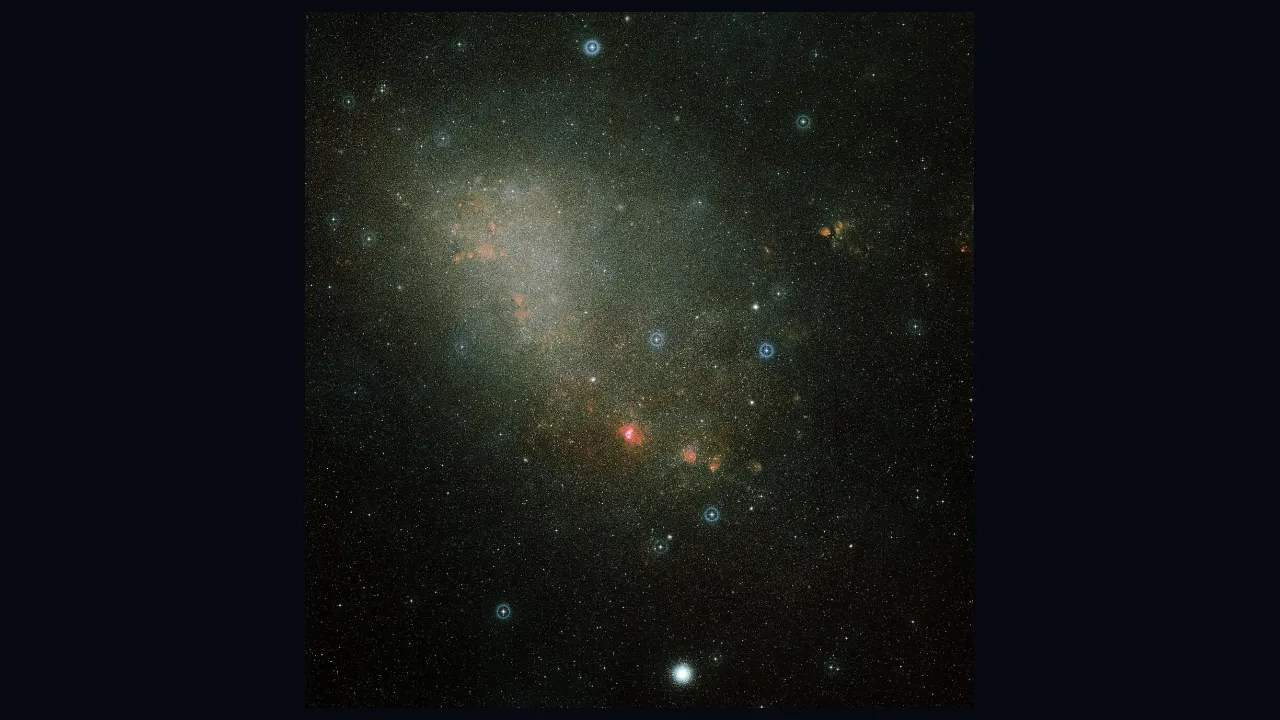
⚡ Cosmic SparkBlinking stars inside this little galaxy taught humanity how to measure distances across the cosmos
🤯 Mind-Blowing Fact • Grade 1
Even though it has 'Small' in its name, it would take a beam of light nearly 19,000 years to cross from one side to the other!
✨ Word Sparks (Grade 1 Glossary)
Tap 🔊 to hear
pulse
To grow brighter and dimmer in a steady beat
light-year
Distance light travels in one whole year
stargazer
A person who watches stars in the night sky
🪝
Can a tiny misty smudge in the night sky hold hundreds of millions of suns?
1
Little Sister in the Sky
Look up into the dark southern sky right beside the Large Magellanic Cloud! Nearby floats a second soft, silvery glow. Astronomers call this starry island the Small Magellanic Cloud.
2
Stretched Like Taffy
Instead of spinning in a neat circle, this little galaxy looks stretched out like warm taffy! Bigger neighbor galaxies pull on its stars with gravity.
3
Blinking Star Lighthouses
Inside its gas clouds, special stars brighter and dimmer like steady heartbeats. Those blinking stars help scientists measure how big space really is!
1. Why does the Small Magellanic Cloud look stretched out instead of round?
2. How did special blinking stars inside the Small Magellanic Cloud help scientists?
🤯 Mind-Blowing Fact • Grade 2
Henrietta Swan Leavitt identified 1,777 blinking variable stars inside the Magellanic Clouds by examining tiny dots on glass plates with a magnifying lens!
✨ Word Sparks (Grade 2 Glossary)
Tap 🔊 to hear
variable star
A star whose brightness changes over time
bridge
A connecting stream of gas between two galaxies
yardstick
A handy tool or rule for measuring distance
🪝
How did one sharp-eyed astronomer use a small southern galaxy to unlock the size of the universe?
1
A Glowing Neighbor in Tucana
Gaze toward the constellation of Tucana the Toucan in the southern sky, and you will see a pale patch resembling a detached piece of our Milky Way. Roughly 200,000 light-years away drifts the Small Magellanic Cloud, one of the farthest objects humans can spot with unaided eyes.
2
Linked by a Bridge of Gas
This dwarf irregular galaxy travels through space alongside its bigger cousin, the Large Magellanic Cloud. An invisible ribbon of hydrogen gas called the Magellanic connects the two galaxies like a cosmic jump rope!
3
Henrietta Leavitt's Big Breakthrough
In 1912, astronomer Henrietta Swan Leavitt studied glass photo plates of blinking stars inside the Small Magellanic Cloud. She discovered that brighter pulsing stars blink more slowly, giving astronomers a to measure distant galaxies!
1. What connects the Small Magellanic Cloud to the Large Magellanic Cloud?
2. What pattern did Henrietta Swan Leavitt discover in the Small Magellanic Cloud's pulsing stars?
🤯 Mind-Blowing Fact • Grade 3
New radio astronomy studies suggest the Small Magellanic Cloud might really be two distinct mini-galaxies parked one behind the other from Earth's point of view!
✨ Word Sparks (Grade 3 Glossary)
Tap 🔊 to hear
Cepheid
Pulsing supergiant star used to measure space distances
heavy elements
Atoms heavier than helium made inside stars
line of sight
Straight path from an observer's eyes to an object
🪝
What if one blurry galaxy in the sky is actually two star clouds lined up one behind the other?
1
A Cosmic Tadpole 200,000 Light-Years Away
Sprawling nearly 19,000 light-years across the southern constellations Tucana and Hydrus, the Small Magellanic Cloud (NGC 292) holds several hundred million stars. Repeated gravitational collisions with the Large Magellanic Cloud and the Milky Way warped its stars into a cigar-like bar with an extended 'wing' stretching eastward.
2
Why Cepheid Stars Worked Like Magic Here
When Henrietta Swan Leavitt studied variable stars in the Small Magellanic Cloud at Harvard Observatory in 1912, she realized every star in that galaxy lay at roughly the same distance from Earth. That meant a Cepheid that looked brighter truly was brighter—proving her famous cosmic distance law!
3
Pristine Chemistry Like the Early Universe
Stars and nebulae inside the SMC contain only one-fifth as many —like carbon, oxygen, and iron—as our Sun. Astronomers study star cluster NGC 346 inside it to learn how stars formed when the universe was young.
4
One Galaxy or Two?
Recent radio telescope maps of gas motion uncovered a startling twist: the Small Magellanic Cloud may actually be two separate star-forming clouds lined up along our , separated by about 16,000 light-years!
1. Why was the Small Magellanic Cloud ideal for Henrietta Leavitt's discovery?
2. What surprising discovery did recent radio maps suggest about the Small Magellanic Cloud?
🤯 Mind-Blowing Fact • Grade 4
James Webb Space Telescope observations of cluster NGC 346 inside the Small Magellanic Cloud proved that rocky planet-forming disks could survive even in the metal-poor early universe!
✨ Word Sparks (Grade 4 Glossary)
Tap 🔊 to hear
intrinsic brightness
How bright a star truly shines up close
protoplanetary disk
Swirling ring of gas and dust building planets
parallax
Apparent shift of nearby stars as Earth orbits
🪝
How can planets still form inside a galaxy lacking most of the rocky ingredients found in our Solar System?
1
Torn by Tidal Encounters
About 200,000 light-years from Earth in Tucana, NGC 292—the Small Magellanic Cloud—bears the battle scars of cosmic encounters. Roughly 200 million years ago, it passed perilously close to its heavier partner, the Large Magellanic Cloud. Tidal forces ripped billions of solar masses of neutral hydrogen from both galaxies, weaving the 75,000-light-year Magellanic Bridge between them and flinging out the vast Magellanic Stream.
2
Leavitt's Law and Expanding Horizons
Before 1912, astronomers could only measure distances to nearby stars using geometry. By cataloging 25 Cepheid variables inside the SMC whose pulsation periods scaled cleanly with , Henrietta Swan Leavitt handed Edwin Hubble the exact key he later used in Andromeda to prove the universe teems with external galaxies.
3
Planet-Building Puzzle in NGC 346
Because the SMC holds just 20 percent of the Sun's heavy-element content, theorists predicted dusty planet-forming disks around its newborn stars would evaporate quickly under harsh starlight. Yet when the James Webb Space Telescope zoomed into SMC star cluster NGC 346, it found long-lived rocky disks thriving around stars up to 30 million years old!
4
Double Trouble Along Our Sightline
Using the Australian Square Kilometre Array Pathfinder (ASKAP), astronomers tracked cold hydrogen clouds and young stars moving at two distinct speeds—strong evidence that tidal forces split the SMC into two overlapping bodies.
1. What happened roughly 200 million years ago between the Small and Large Magellanic Clouds?
2. Why were astronomers amazed to find long-lived planet-forming disks in SMC cluster NGC 346?
🤯 Mind-Blowing Fact • Grade 5
In 2008, the International Astronomical Union officially renamed the Cepheid period-luminosity rule the 'Leavitt Law' to honor Henrietta Swan Leavitt's breakthrough inside the Small Magellanic Cloud!
✨ Word Sparks (Grade 5 Glossary)
Tap 🔊 to hear
Leavitt Law
Rule linking a Cepheid star's pulse speed to brightness
protostar
Very young star still gathering gas from its cloud
X-ray binary
Star pair where compact remnant pulls glowing hot gas
🪝
How did glass photographic plates of a metal-poor dwarf galaxy unlock extragalactic cosmology—and reveal a hidden twin behind itself?
1
Southern Sky Landmark and Tidal Wreckage
Known for millennia to Indigenous peoples of the Southern Hemisphere—including the Maori of Aotearoa and Aboriginal Australians—and charted scientifically by Johann Bayer as Nubecula Minor in 1603, the Small Magellanic Cloud (NGC 292) lies roughly 200,000 light-years away across Tucana and Hydrus. Containing approximately 6.5 billion solar masses within an elongated 18,900-light-year body, this dwarf irregular galaxy has been severely distorted by repeated gravitational interactions with the Large Magellanic Cloud and the Milky Way.
2
Henrietta Swan Leavitt and the Period-Luminosity Law
Working as a Harvard Observatory 'computer' analyzing photographic plates from Peru's Boyden Station, Henrietta Swan Leavitt published a landmark 1912 paper on 25 Cepheid variables in the SMC. Because the galaxy's depth was small compared to its distance from Earth, apparent magnitudes directly mirrored absolute luminosities, revealing a tight logarithmic relation between pulsation period and intrinsic luminosity—now honored internationally as the .
3
A Proxy for Cosmic Noon and Dawn
Possessing a metallicity roughly one-fifth solar (Z ≈ 0.004), the SMC serves as our closest observational laboratory for conditions prevailing ~10 billion years ago during 'cosmic noon.' Within its brightest H II complex, NGC 346, Hubble and James Webb spectrographs discovered that low-mass retain gas-rich accretion disks for 20 to 30 million years—ten times longer than nearby Milky Way counterparts—likely because weaker radiation pressure from scarce dust fails to disperse the gas.
4
High-Mass X-Ray Binaries
Recent bursts of tidal star formation also endowed the SMC with an unusually dense population of high-mass X-ray binaries—pairs where a neutron star or black hole feasts on stellar winds from an OB companion star.
5
Two Galaxies Masquerading as One
High-resolution 21-centimeter hydrogen surveys with ASKAP combined with Gaia stellar proper motions revealed two chemically and kinematically distinct stellar-gas components separated along our sightline by ~16,000 light-years, indicating tidal disruption practically cleaved the SMC in two.