1. Which softer mud rock turns into hard slate when squeezed underground?
2. Why does slate make such great roof shingles for houses?
🤯 Mind-Blowing Fact • Grade 2
Underneath the green felt cloth of every championship pool and billiards table sits a heavy, perfectly flat slab of real quarried slate!
✨ Word Sparks (Grade 2 Glossary)
Tap 🔊 to hear
mica
A shiny mineral formed of paper-thin flat flakes
quarry
An open pit where workers cut building stone
tablet
A small flat slab used for writing
🪝
How can crumbly gray shale turn into stone strong enough for school blackboards and castle roofs?
1
Mountain Vise Underground
Imagine pressing a stack of soft clay pancakes inside a warm waffle iron! When continents push together to build mountains, buried layers of shale get squeezed and gently heated. Tiny clay bits turn into microscopic flakes that lock tightly together.
2
Laser-Flat Splitting
Because every tiny flake lines up facing the exact same way, a skilled stoneworker can tap a chisel on the edge of a slate block and split off thin, ruler-flat sheets!
3
Colors Beyond Charcoal Gray
Most slate is blue-gray or charcoal black, yet different minerals inside the original mud can create sea-green, rusty red, or royal purple slate!
1. Why can stoneworkers split slate into such smooth, flat sheets?
2. What hides right underneath the green cloth of a championship pool table to keep balls rolling straight?
🤯 Mind-Blowing Fact • Grade 3
Buckingham County's Arvonia slate in Virginia is so durable that original slate shingles installed over 150 years ago still keep historic roofs completely dry today!
✨ Word Sparks (Grade 3 Glossary)
Tap 🔊 to hear
foliation
Parallel layering of flat minerals from metamorphic pressure
slaty cleavage
Clean splitting of slate along aligned microscopic micas
low-grade
Formed under relatively mild metamorphic heat and pressure
🪝
What does 'wiping the slate clean' have to do with Earth's metamorphic rock cycle?
1
First Step on the Metamorphic Ladder
Slate represents metamorphism—the gentle opening chapter of mountain baking! At temperatures around 200 to 350 degrees Celsius, shale's soft clay minerals recrystallize into tiny, invisible flakes of muscovite mica and chlorite. Tap shale and it sounds dull ('thud'); tap metamorphic slate and its tightly bound crystals ring ('clink')!
2
Foliation and Slaty Cleavage
Geologists call the parallel alignment of flat minerals inside a squeezed metamorphic rock . When tectonic plates push horizontally like a vise, new mica flakes grow standing upright—perpendicular to the squeeze! That produces , allowing slate to split along brand-new flat planes that can even cross right over old mud layers.
3
Virginia's World-Famous Arvonia Slate
In Buckingham County right in Virginia's central Piedmont, quarries at Arvonia have produced sparkling blue-black slate since the 1720s—roofing Thomas Jefferson's University of Virginia buildings and the Smithsonian Castle!
4
Origin of an Everyday Phrase
Shopkeepers and students once erased chalk marks from slate boards with a damp cloth to start fresh—giving us the saying 'a clean slate'!
1. In which direction do new microscopic mica flakes line up when tectonic forces squeeze shale into slate?
2. Where in Virginia has world-famous roofing slate been quarried for roughly three centuries?
🤯 Mind-Blowing Fact • Grade 4
Geologists proved the exact ocean age of Virginia's Arvonia Slate by finding 450-million-year-old trilobite fossils still preserved—though gently stretched—inside the metamorphic rock!
✨ Word Sparks (Grade 4 Glossary)
Tap 🔊 to hear
differential stress
Unequal tectonic squeezing stronger from one direction
chlorite
Greenish platy mineral common in low-grade metamorphic rocks
phyllite
Silky metamorphic rock one step hotter than slate
🪝
How can a piece of slate show ancient ocean mud stripes running one way, yet split cleanly in a totally different direction?
1
Bedding Planes Versus Slaty Cleavage
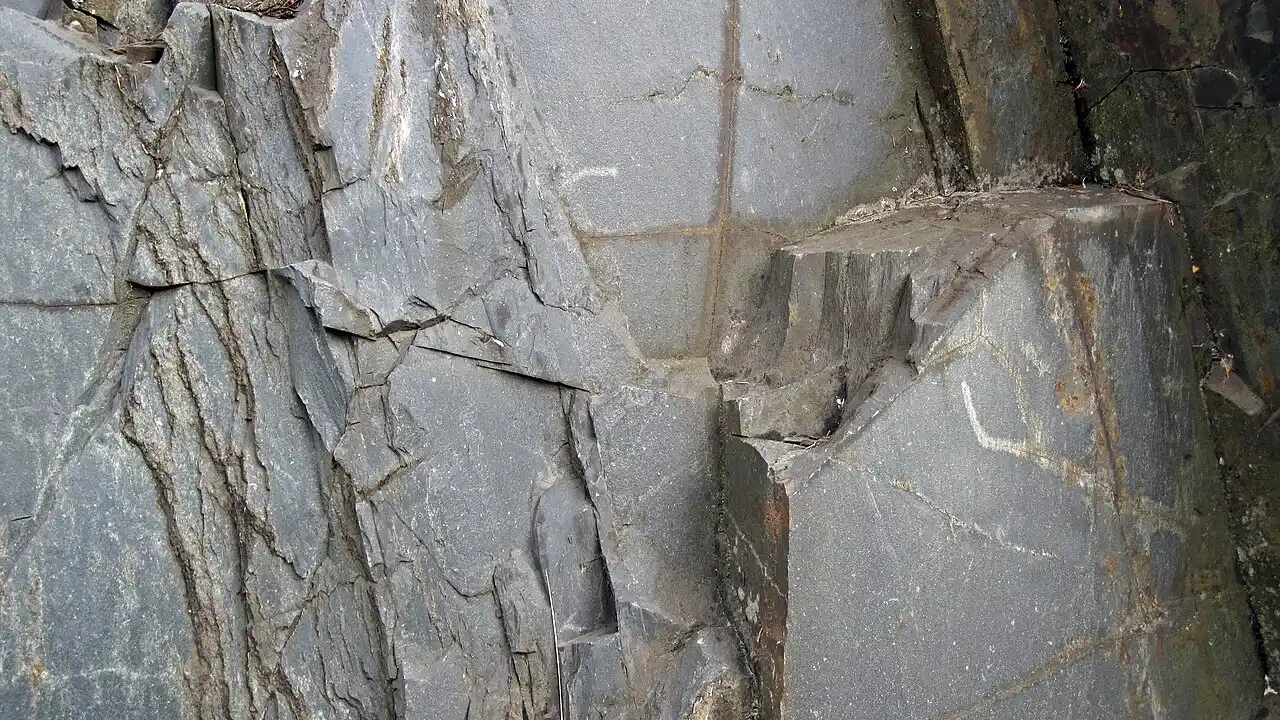
Examine a quarried block of striped slate closely, and you may spot faint tan silt ribbons crossing the stone at a slant while the rock splits into razor-flat sheets straight up and down! Those slanted stripes are relict sedimentary bedding from the ancient seafloor; the flat splitting surfaces are metamorphic slaty cleavage formed millions of years later when folding mountains compressed the beds sideways. Structural geologists measure the angle between bedding and cleavage to map giant eroded mountain folds even from a single outcrop!
2
Stretched Fossils Inside Arvonia Slate
Most metamorphism wipes fossils away, yet low-grade slate occasionally preserves a thrilling surprise. Inside Virginia's 450-million-year-old Ordovician Arvonia Slate, paleontologists found trilobites, brachiopods, and sea lilies slightly stretched and flattened by Appalachian mountain-building—proving the slate began as deep ocean mud before tectonic collision!
3
Color Chemistry of the Slate Belt
Finely dispersed graphite carbon turns Arvonia and Pennsylvania slates blue-black; green colors Vermont sea-green slate; and oxidized ferric hematite creates rare red slate prized for decorative roof patterns.
4
Climbing Higher: Slate to Phyllite to Schist
If slate stays buried as mountain temperatures climb higher, its microscopic micas grow larger—first giving rock a silky sheen in , then visible glittering flakes in schist, and finally bold stripes in gneiss!
1. Why doesn't slate always split along its original sedimentary mud layers?
2. Put these foliated rocks in order of increasing metamorphic heat and pressure, starting from shale:
🤯 Mind-Blowing Fact • Grade 5
Oval green spots inside purple slate started out as perfectly round spheres in ancient sea mud, letting geologists calculate the exact percentage a mountain range was squashed!
✨ Word Sparks (Grade 5 Glossary)
Tap 🔊 to hear
greenschist facies
Low-to-medium metamorphic temperature and pressure zone
pressure solution
Dissolving of mineral grains where tectonic stress presses hardest
strain gauge
Feature measuring how much rock stretched or flattened
🪝
Why does Virginia's Arvonia slate outlast lesser slates by more than a century on rain-swept roofs?
1
Greenschist-Facies Recrystallization and Pressure Solution
Under polarized microscopy, slate records the transition from diagenesis into lower greenschist-facies metamorphism at roughly 250 to 350 degrees Celsius and pressures of two to four kilobars. Clay smectites and illites dehydrate and react to form micron-scale white mica (muscovite/phengite), green chlorite, and interlocking micro-quartz. Simultaneously, dissolves quartz along high-stress grain contacts and re-precipitates it in pressure shadows, rotating and growing phyllosilicate domains into continuous, penetrative slaty cleavage.
2
Mineralogical Secret of Arvonia's 200-Year Lifespan
Why do some bargain roofing slates flake and soften after forty winters while Buckingham County's Arvonia Slate or Wales's Penrhyn Slate endures over two centuries? Inferior 'ribbons' contain trace calcite (CaCO3) paired with iron sulfide pyrite: humid rainwater oxidizes pyrite into sulfuric acid, which reacts with calcite to grow expanding gypsum crystals that pry cleavage planes apart! Arvonia Slate contains virtually zero carbonate and abundant microcrystalline quartz, yielding water absorption below 0.2 percent.
3
Strain Ellipsoids From Deformed Reduction Spots
Pale-green elliptical 'reduction spots' often dot purple hematitic slates where tiny organic specks chemically reduced ferric iron before deformation. Originally spherical in wet mud, these spots squashed into measurable pancakes during folding—giving structural geologists an exact 3D of how much a mountain belt shortened!
4
Laboratory Countertops and Electrical Switchboards
Because dense quartz-mica slate resists strong acids, high heat, and electric current, early power-plant switchboards and chemistry lab benches relied on thick milled slate slabs.
5
UNESCO Heritage of Global Slate Landscapes
From Gwynedd in northwest Wales to the Taconic and Piedmont belts of eastern North America, Paleozoic slates roofed the Industrial Revolution while preserving classic tectonic fabrics taught in geology classrooms worldwide.