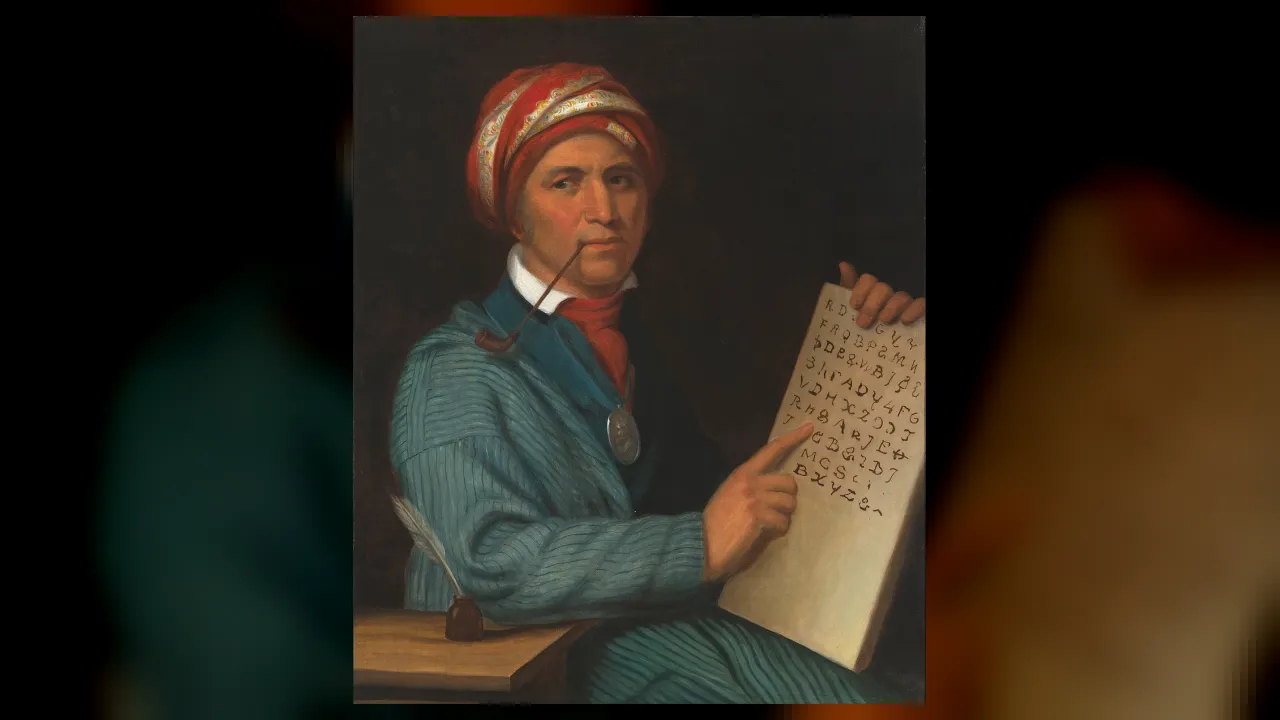
🗺️ Region / CapitalTuskegee (Monroe County), Tennessee, Alabama & Oklahoma
📜 Key MilestoneInvented the 85-symbol Cherokee syllabary completed in 1821
⚡ Historical SparkOnly known person in history to single-handedly invent a complete writing system without already reading another language
🤯 Mind-Blowing Fact • Grade 1
California's giant sequoia trees—the largest living trees on Earth—were named by botanists to honor Sequoyah's towering achievement!
✨ Word Sparks (Grade 1 Glossary)
Tap 🔊 to hear
symbol
A written mark that stands for sound
bark
The tough outer covering on tree trunks
language
Words people speak or write to share
🪝
Could one clever thinker invent a brand-new way to read and write a whole language?
1
Talking Leaves
Long ago, the Cherokee people spoke a rich , yet had no written letters. Sequoyah saw settlers reading marks on paper. People called those papers talking leaves!
2
Twelve Years of Marks
Sequoyah wanted Cherokee families to write messages too. He carved onto with a knife. For twelve years, he listened to every Cherokee sound.
3
Everyone Learns Fast!
At last, Sequoyah made eighty-five clear ! His young daughter learned them first. Soon thousands of Cherokee readers wrote letters and newspapers!
1. What did people call written sheets of paper that inspired Sequoyah?
2. Who helped Sequoyah show Cherokee leaders that his new writing system really worked?
🤯 Mind-Blowing Fact • Grade 2
Sequoyah's Cherokee syllabary matched Cherokee speech sounds so cleanly that many children and adults learned to read it in less than a week!
✨ Word Sparks (Grade 2 Glossary)
Tap 🔊 to hear
silversmith
A craftsperson who shapes things from silver
syllable
A single beat of sound in words
syllabary
A chart of symbols matching word syllables
🪝
Why are the tallest, mightiest trees in California named after a Cherokee silversmith from Tennessee?
1
A Silversmith With a Big Idea
Picture sparks glowing inside a Cherokee blacksmith and silver shop around 1809! Born in the Cherokee town of Tuskegee in present-day Tennessee, Sequoyah crafted shiny silver jewelry, spurs, and tools. Watching English-speaking soldiers and traders read letters, he wondered why Cherokee people could not put their own spoken words onto paper.
2
Listening for Syllables
At first, Sequoyah tried drawing one picture for every single Cherokee word, creating thousands of marks! Then he had a brilliant breakthrough: every Cherokee word was built from smaller sound parts called . He trimmed his chart down to eighty-five neat symbols.
3
A Reading Revolution
In 1821, Sequoyah and his young daughter Ayoka demonstrated the to Cherokee elders. Within just a few years, most of the Cherokee Nation could read and write!
1. What smart change helped Sequoyah reduce thousands of word pictures down to 85 easy-to-learn symbols?
2. What giant natural wonder was named in Sequoyah's honor?
🤯 Mind-Blowing Fact • Grade 3
Historians and linguists recognize Sequoyah as the only known person in 5,000 years of world history to independently create an entire, working writing system without already being literate in another language!
✨ Word Sparks (Grade 3 Glossary)
Tap 🔊 to hear
literate
Able to read and write a language
linguist
Someone who studies how human languages work
bilingual
Written or spoken in two different languages
🪝
How did one man—who could neither read nor write English—invent a complete writing system all on his own?
1
Watching 'Talking Leaves' at Work
Imagine scratching careful shapes onto flat strips of birch bark by firelight while neighbors wonder what you are doing! Born around 1770 in the Cherokee village of Tuskegee along the Little Tennessee River, Sequoyah grew up speaking only Cherokee and became a respected silversmith. During the War of 1812, while serving alongside U.S. soldiers, he noticed how troops sent news home through written letters—while Cherokee warriors could not.
2
Crack the Code of Sound
For twelve patient years, Sequoyah studied the rhythms of Cherokee speech. After realizing that drawing separate pictures for every word took far too much memory, he broke words into repeating syllable sounds such as 'ga,' 'na,' and 'tsi.' Borrowing shapes he saw in printed books and inventing graceful curves of his own, he perfected eighty-six—later refined to eighty-five—distinct characters.
3
Testing the Syllabary With Ayoka
In 1821, skeptical Cherokee council leaders tested Sequoyah and his six-year-old daughter, Ayoka, in separate rooms. Sequoyah wrote down whatever the elders spoke, and Ayoka walked in and read every word aloud without a single mistake! Amazed leaders immediately adopted the system.
4
The Cherokee Phoenix
By 1828, the Cherokee Nation cast metal printing type for Sequoyah's characters and published The Cherokee Phoenix—the first Native American newspaper in United States history!
1. How did Cherokee council elders test whether Sequoyah's writing system truly worked in 1821?
2. What historic newspaper began printing in both Cherokee and English in 1828?
🤯 Mind-Blowing Fact • Grade 4
Today, Sequoyah's 85 Cherokee characters are built right into modern smartphones, tablets, and computers through Unicode so Cherokee students can text and type in their ancestral language!
✨ Word Sparks (Grade 4 Glossary)
Tap 🔊 to hear
phonetics
The study of speech sounds in languages
logogram
A single written character representing one word
Unicode
Global computer standard encoding world writing systems
🪝
Why did Cherokee literacy surpass that of neighboring frontier settlements within just five years of 1821?
1
From Silversmith's Forge to Linguistic Inquiry
Step into a log workshop in Willstown, Alabama, around 1819, where sheets of paper and shaved wooden slats are covered with eighty-five crisp, looping characters. Their creator, Sequoyah—also known in English records as George Guess or Gist—had grown up in the Overhill Cherokee town of Tuskegee in eastern Tennessee without attending school or learning English. As an accomplished silversmith who stamped hallmarks onto silver gorgets and armbands, Sequoyah already understood how visual marks could carry exact meaning.
2
Why a Syllabary Fit Cherokee Perfectly
Beginning around 1809, Sequoyah first experimented with pictographs and , where one mark stood for an entire idea or word. Realizing thousands of words made memorization impractical, he analyzed Cherokee —listening carefully to conversations of his wife, children, and neighbors—and discovered that every polysyllabic Cherokee word combined a finite set of consonant-vowel syllables plus single vowels and an 's' sound. Adapting shapes seen in an English spelling book (though matching completely different Cherokee sounds!) alongside original designs, he finalized eighty-five characters.
3
Rapid Literacy and National Institutions
After Sequoyah and his young daughter Ayoka passed rigorous public trials before Cherokee leaders in 1821, literacy swept through Cherokee communities in the Southeast and western Arkansas Territory. Because each character represented one consistent syllable sound with no silent letters, fluent Cherokee speakers could master reading in days! In 1824, the Cherokee National Council awarded Sequoyah a specially struck silver medal of honor.
4
Enduring Cultural Preservation
Moving west to Arkansas and later Indian Territory (present-day Oklahoma), Sequoyah served as a diplomat uniting Eastern and Western Cherokees. Today, road signs, schools, smartphones, and computers in the Cherokee Nation still use Sequoyah's exact 85-character syllabary!
1. Why could fluent Cherokee speakers learn Sequoyah's system in just a few days?
2. How did the Cherokee National Council honor Sequoyah in 1824?
🤯 Mind-Blowing Fact • Grade 5
Sequoyah stands carved in high relief on the bronze entrance doors of the Library of Congress in Washington, D.C., alongside ancient Greek and Mesopotamian pioneers of human writing!
✨ Word Sparks (Grade 5 Glossary)
Tap 🔊 to hear
morphology
How smaller sound parts build whole words
sibilant
A hissing speech sound like letter s
movable type
Individual metal letters arranged on printing presses
🪝
How did an unlettered Cherokee artisan solve a phonological puzzle that normally takes civilizations centuries of gradual evolution to achieve?
1
Origins Along the Little Tennessee River
Examine the bronze doors of the Library of Congress Thomas Jefferson Building in Washington, D.C., where sculpted figures honor history's greatest originators of written thought—and standing beside ancient Mediterranean and Asian lawgivers is Sequoyah of the Cherokee Nation. Born circa 1770 in Tuskegee (Taskigi) near Fort Loudoun in present-day Monroe County, Tennessee, to Cherokee mother Wut-teh of the Paint Clan, Sequoyah spoke exclusively Cherokee and never learned to read, write, or speak English, French, or Spanish. Establishing a thriving smithy at Willstown in Cherokee Alabama, he mastered metallurgy while contemplating the strategic power European Americans derived from written dispatches and treaties.
2
Twelve Years of Phonological Discovery (1809–1821)
Enlisting in Colonel Gideon Morgan's Regiment of Cherokee Warriors during the Creek War (1813–1814), Sequoyah observed firsthand that Cherokee soldiers could neither write letters home nor record muster orders independently. Returning to his workshop, he initially devised thousands of ideographic symbols—a labor derided by skeptical neighbors who feared obsession or sorcery. Undeterred, Sequoyah shifted from semantic units to acoustic analysis. Isolating every recurring syllable in polysyllabic Cherokee , he reduced the entire phonetic inventory to eighty-six characters—soon streamlined to eighty-five: six core vowels, consonant-vowel combinations across distinct consonantal series, and a standalone character ('s') capable of clustering before consonants.
3
Graphic Adaptation and the 1821 Demonstration
Examining Latin, Greek, and numeral glyphs in printed almanacs and an English speller—without knowing their European phonetic values—Sequoyah repurposed familiar shapes (for instance, assigning the graphic shape 'D' to the Cherokee vowel sound 'a' and '4' to 'se') so printers could eventually cast movable lead type cleanly. In 1821, after teaching his six-year-old daughter Ayoka, he traveled from Arkansas back to eastern Cherokee towns, passing controlled oral-to-written transcription tests before Principal Chiefs and elders.
4
Constitutional Print Culture and The Cherokee Phoenix
Adoption was instantaneous and transformative. Within five years, Cherokee literacy soared past that of surrounding white frontier counties. In 1827, the Cherokee Nation drafted a written constitution, ordered custom metal type cast in Boston, and on February 21, 1828, published the inaugural bilingual issue of Tsulehisanunhi / The Cherokee Phoenix at New Echota under editor Elias Boudinot.
5
Statesman of Cherokee Unity and Living Legacy
Relocating to Indian Territory (present-day Sallisaw, Oklahoma) in 1829, Sequoyah helped mediate the 1839 Act of Union healing divisions among Old Settler and Trail of Tears Cherokee survivors. Botanist Stephan Endlicher immortalized his name in 1847 for the giant redwood genus Sequoia, and his 1829 log cabin stands today as a National Historic Landmark while Cherokee immersion schools teach new generations on Sequoyah-enabled keyboards.