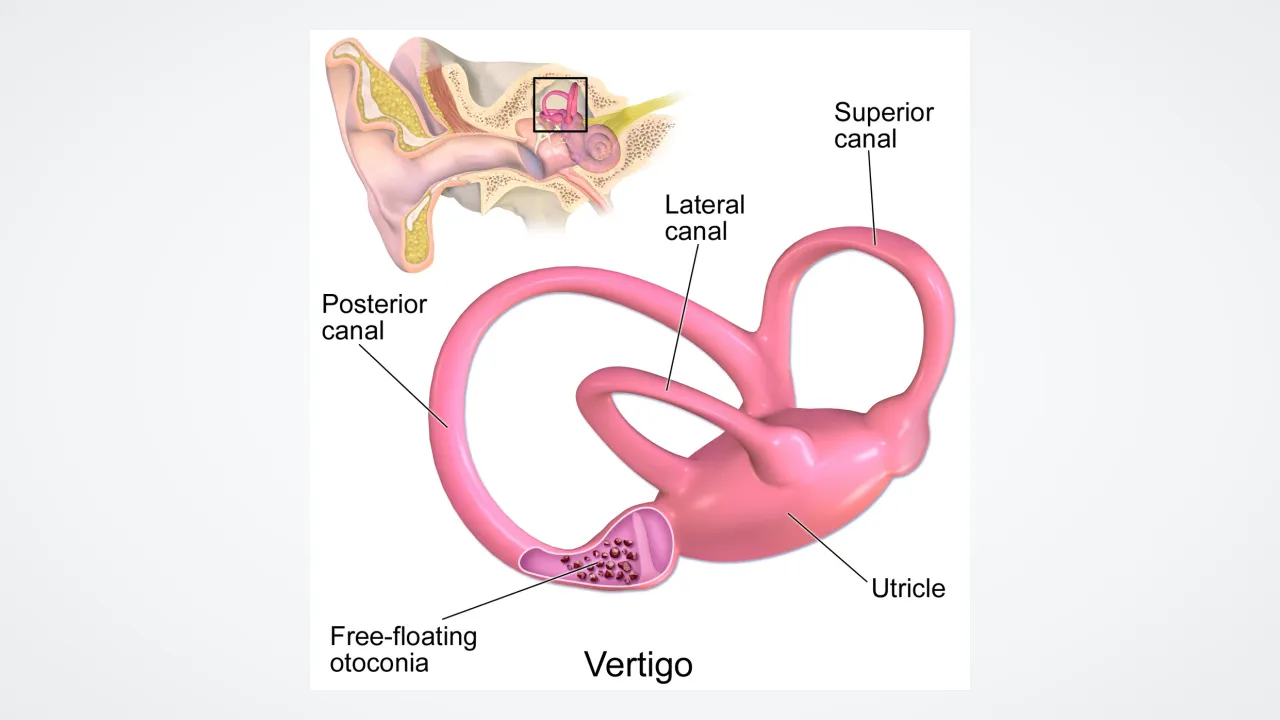
2. What moves inside the tiny ear loops when you turn your head?
🤯 Mind-Blowing Fact • Grade 2
All three semicircular canals in one ear could fit comfortably on top of a single pea!
✨ Word Sparks (Grade 2 Glossary)
Tap 🔊 to hear
inner ear
the deepest part of your ear inside bone
fluid
a liquid that flows and swishes smoothly
microscopic
so tiny you need a microscope to see
🪝
Why can you walk on a balance beam without looking at your feet?
1
Built-In Motion Detectors
Picture doing a cartwheel across soft grass! Even with your eyes shut, you still feel which way your head turns. Deep inside each , three tiny curved tubes called semicircular canals guard your balance.
2
Loops in Every Direction
Each loop points a different way, like the corner of a box. One loop senses nodding up and down. Another feels shaking side to side, and the third feels tilting ear to shoulder.
3
Hair Cells Send the News
inside the loops sloshes whenever your head moves. That moving fluid gently bends hair cells, which flash fast messages to your brain to keep your body upright.
1. How many semicircular canals do you have in ONE ear?
2. Why are the three loops aimed in different directions?
🤯 Mind-Blowing Fact • Grade 3
Your semicircular canals talk directly to your eye muscles so fast that signs stay crisp and readable even while you jog down a bumpy sidewalk!
✨ Word Sparks (Grade 3 Glossary)
Tap 🔊 to hear
vestibular
relating to the inner-ear system for balance
endolymph
special fluid swirling inside inner-ear balance loops
cupula
a tiny jelly cap that bends with fluid
🪝
How do three dime-sized loops of fluid help gymnasts land flips without falling?
1
Your Secret Carpenter's Level
Watch a gymnast leap, twist in midair, and stick a steady landing! That smooth balance starts deep inside the skull's temporal bone. Tucked next to the snail-shaped hearing organ sit three fluid-filled loops called the semicircular canals.
2
Three Right-Angle Axes
Nature arranged these three bony loops at right angles to one another, just like the floor and two walls meeting in the corner of a room. Together, the superior, posterior, and lateral canals track every pitch, roll, and spin of your head.
3
Endolymph and the Cupula
Inside each canal flows a watery liquid called . When your head rotates, the canal walls turn immediately, while the liquid lags behind for a split second. That gentle wave pushes a jelly-like sail called the .
4
Steady Eyes and Steady Feet
Bending the tilts bundles of sensory hair cells underneath it. Instantly, the nerve carries electrical signals to your brain, adjusting your leg muscles and keeping your eyes locked clearly on target.
1. What pushes against the jelly-like cupula when your head spins?
2. Besides helping your legs balance, what else do semicircular canals steady?
🤯 Mind-Blowing Fact • Grade 4
The temporal bone surrounding your semicircular canals is the densest, hardest bone in the entire human body, acting like an armored vault for your delicate balance sensors!
✨ Word Sparks (Grade 4 Glossary)
Tap 🔊 to hear
inertia
tendency of liquid or objects to resist motion changes
ampulla
widened chamber at each canal base holding sensors
stereocilia
microscopic hair-like bristles that trigger nerve signals
🪝
Why do astronauts feel dizzy during their first days floating in outer space?
1
Navigating Three-Dimensional Space
Imagine whirling across an ice rink in a rapid figure-skating spin! Without a reliable motion tracker, your brain would lose track of horizon and speed in less than a second. Encased inside the hardest bone of your skull—the petrous part of the temporal bone—three delicate loops in each ear form your personal three-dimensional gyroscope.
2
Geometry of the Three Canals
Each loop measures only about six to eight millimeters across, yet their geometry is remarkably precise. The anterior canal detects forward and backward nodding, the posterior canal detects sideways cartwheel tilts, and the horizontal canal detects left-and-right head turns. Because your left and right ears mirror each other, every turn excites one ear while calming its partner.
3
Inertia Inside the Ampulla
At the base of every canal swells a tiny chamber called the . Inside sits the crista ampullaris, crowned by a gelatinous dome named the cupula. When you whip your head to the left, keeps the potassium-rich endolymph fluid momentarily still while the canal rotates around it, deflecting the cupula like underwater kelp swaying in a current.
4
Why Spinning Tricks Your Brain
Embedded inside the cupula are microscopic hair bundles called . Bending them opens tiny ion channels that fire nerve impulses to the brainstem and cerebellum. If you spin for twenty seconds and freeze, the fluid keeps coasting forward, bending the cupula the opposite way and convincing your brain you are spinning backward!
1. Why does the endolymph fluid push the cupula when your head suddenly turns?
2. How do your left and right semicircular canals work together during a head turn?
🤯 Mind-Blowing Fact • Grade 5
The vestibulo-ocular reflex driven by your semicircular canals is one of the fastest reflexes in the human nervous system, adjusting your eyes in under ten milliseconds!
automatic circuit keeping eyes steady during head turns
angular acceleration
rate at which rotational spinning speed changes
🪝
How do microscopic fluid currents inside six millimeter-scale ear tubes rival modern aircraft gyroscopes?
1
Biological Gyroscopes in Solid Bone
Close your eyes, tilt your chin skyward, and pivot on one heel: instantly, you know your exact angle and rotational speed without a single visual clue. Deep within the labyrinth of each temporal bone, three C-shaped tubes—the anterior, posterior, and lateral semicircular canals—operate as biological angular accelerometers. Measuring roughly 6.5 millimeters in diameter with ducts narrower than a sewing needle, these loops monitor rotational movement across all three spatial planes.
2
Hydrodynamics of Endolymph and Cupula
Suspended inside the bony canals is a membranous duct filled with endolymph, an unusual extracellular fluid rich in potassium ions. Each duct expands at one end into an ampulla sealed from roof to floor by a wedge of flexible glycoprotein gel called the cupula. When rotates your skull, Newton's first law of motion—inertia—causes the endolymph to lag behind the moving duct wall, generating pressure that flexes the cupula by mere nanometers.
3
Mechanotransduction at Nanometer Scale
Projecting into the base of each cupula are thousands of vestibular hair cells topped by stepped staircases of stereocilia and a single tall . When fluid pressure bends stereocilia toward the tall kinocilium, tiny protein tip-links pull mechanically gated ion channels open, flooding the cell with potassium ions and firing rapid action potentials along the vestibulocochlear nerve. Bending away from the kinocilium closes those channels and slows nerve firing.
4
The Vestibulo-Ocular Reflex
Those twin streams of data race into the brainstem's vestibular nuclei and the cerebellum in less than ten milliseconds. Through a lightning-fast circuit called the , motor neurons rotate your eyeballs at the exact same speed—but opposite direction—as your turning head, stabilizing images on your retinas while postural pathways adjust spinal muscles.
5
Discovering the Ear's Hidden Compass
For centuries, anatomists assumed the entire inner ear existed solely for hearing. In 1824, French physiologist Jean Pierre Flourens proved otherwise by showing that semicircular canal changes disrupted balance while leaving hearing intact. Fifty years later, scientists Ernst Mach, Josef Breuer, and Alexander Crum Brown independently uncovered how endolymph fluid dynamics power human equilibrium.