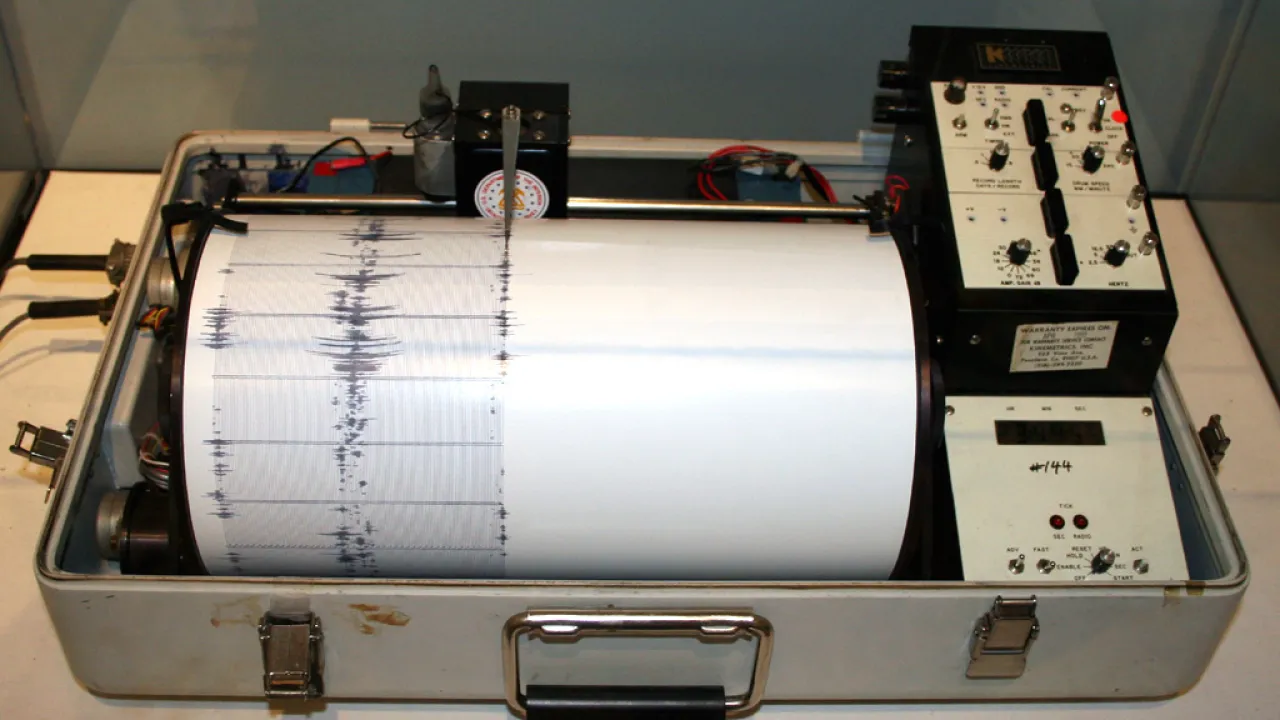
1. During an earthquake, which part actually moves to draw the wiggly lines?
2. What do very tall zigzags on the paper roll tell scientists?
🤯 Mind-Blowing Fact • Grade 2
Modern earthquake sensors are so sensitive they can feel ocean waves crashing on beaches hundreds of miles away—and even stadium fans cheering a touchdown!
✨ Word Sparks (Grade 2 Glossary)
Tap 🔊 to hear
tremor
A slight shaking motion in Earth
bedrock
Solid rock lying underneath loose soil
sensor
A tool that detects tiny changes
🪝
How could a bronze jar with eight dragons spot an earthquake four hundred miles away before anyone felt a thing?
1
Dragons and Toads in Ancient China
Clink! One day in 132 CE, a bronze ball dropped from one dragon's mouth into a bronze toad's open jaw inside the Chinese emperor's court. Nobody in the city felt a , yet days later a rider galloped in to report a distant earthquake in that exact direction!
2
Adding a Paper Trail
Inventor Zhang Heng's dragon jar was the first quake detector, and in 1880 scientist John Milne and his teammates in Japan added a spinning drum that drew permanent wave records.
3
The Heavy Weight Trick
Because a heavy hanging mass resists sudden motion, it stays calm in midair while the shakes the frame bolted to the floor. That difference traces every tiny underground shiver!
1. What did Zhang Heng's 132 CE bronze dragon jar reveal when one ball dropped?
2. Why did John Milne's 1880 invention add a rotating drum of paper?
🤯 Mind-Blowing Fact • Grade 3
NASA astronauts placed seismographs on the Moon and Mars, discovering 'moonquakes' and 'marsquakes' millions of miles from Earth!
✨ Word Sparks (Grade 3 Glossary)
Tap 🔊 to hear
inertia
Tendency of still objects to stay still
seismogram
The wiggly wave chart a seismograph draws
pendulum
A weight hung so it swings freely
🪝
If the ground, the building, and your desk all shake together in an earthquake, how can anything hold still enough to measure it?
1
Try Holding a Yo-Yo on a Bus
Picture holding a heavy yo-yo by its string when a bus lurches forward: the bus and your shoes move right away, while the heavy yo-yo lags behind for a moment! Physicists call that stubbornness , and every seismograph depends on it.
2
From Zhang Heng to Yokohama
In 132 CE, Chinese polymath Zhang Heng built an urn-shaped bronze seismoscope with a central that tipped one of eight dragon levers during faint tremors. Seventeen centuries later in 1880, after feeling frequent tremors in Yokohama, Japan, British scientists John Milne, James Ewing, and Thomas Gray invented the horizontal pendulum seismograph that traced continuous wave lines.
3
Reading P-Waves and S-Waves
Earthquakes send out different kinds of waves through rock. Speedy P-waves arrive first like gentle pokes, followed seconds later by slower, stronger S-waves that shake the ground side to side. Counting the seconds between those two arrivals tells scientists how far away the quake began!
4
Peeking Inside Our Planet
By watching how quake waves bend and bounce all the way through Earth, scientists even discovered our planet's liquid outer core and solid inner core!
1. How do scientists figure out how far away an earthquake happened?
2. What amazing secret deep inside Earth did seismograph waves help scientists discover?
🤯 Mind-Blowing Fact • Grade 4
In 1936, Danish seismologist Inge Lehmann studied subtle bends on seismograph charts and discovered that Earth's liquid outer core hides a giant solid iron ball at the very center!
✨ Word Sparks (Grade 4 Glossary)
Tap 🔊 to hear
fault
Deep rock fracture where crust blocks slide
induction
Making electricity by moving magnets near wire
crust
Earth's thin rocky outermost surface layer
🪝
How did wiggly lines on smoked glass act like an X-ray machine for the entire 12,700-kilometer-wide Earth?
1
X-Raying a Planet With Sound
Doctors use X-rays to see bones beneath your skin, yet even the deepest drill hole in history barely scratches twelve kilometers into Earth's . Instead, geophysicists listen to seismic waves racing right through the planet, captured by global networks of ultra-sensitive seismographs.
2
Two Millennia of Quake Engineering
In 132 CE, Han Dynasty astronomer Zhang Heng unveiled his bronze seismoscope in Luoyang, proving earthquakes were natural waves traveling through rock rather than mysterious omens. In 1855, Italian physicist Luigi Palmieri built an electromagnetic detector near Mount Vesuvius, and in 1880 John Milne, Thomas Gray, and James Ewing engineered modern horizontal-pendulum seismographs in Japan that scratched precise traces across rotating smoked-glass plates or paper drums.
3
Measuring Three Dimensions at Once
Because lines jolt bedrock in every direction, a complete seismic station pairs three separate sensors: one mounted on a spring to measure up-and-down motion, one aligned north-south, and one aligned east-west. Modern digital broadband instruments replace ink pens with a magnet suspended inside copper coils; when bedrock shifts by even a nanometer, electromagnetic generates a tiny voltage, and feedback currents hold the mass steady.
4
Seconds That Save Lives
Because electronic warning signals travel near light speed while destructive seismic waves move at only a few kilometers per second, modern networks automatically slow bullet trains, shut gas valves, and ping smartphones before heavy shaking arrives.
1. Why does a complete seismic station always run three sensors at the same time?
2. How can earthquake early-warning systems alert cities before the shaking reaches them?
🤯 Mind-Blowing Fact • Grade 5
On Mars, NASA's InSight seismometer sat inside a vacuum sphere so sensitive it detected tiny 'marsquakes' plus shockwaves from meteoroids crashing into the Martian dust thousands of kilometers away!
✨ Word Sparks (Grade 5 Glossary)
Tap 🔊 to hear
epicenter
Surface point directly above an earthquake's origin
damping
Absorbs extra swinging so sensors reset fast
triangulate
Pinpoint a location using three distance circles
🪝
How can an instrument bolted to solid granite detect ground displacements smaller than the width of a single atom?
1
Hearing a Whisper Across Continents
Deep inside quiet underground vaults away from highway traffic, modern broadband seismometers register ground shifts smaller than one nanometer—roughly the diameter of a few atoms. When a tectonic fault ruptures in Chile, sensors in Japan and Norway record its exact signature minutes later as elastic waves ripple through Earth's mantle.
2
From Han Dynasty Bronze to Yokohama Labs
Humanity's quest to record tremors began in 132 CE when Han court scholar Zhang Heng constructed the Houfeng Didong Yi—a two-meter bronze vessel housing an inverted inertial pendulum that released a bronze sphere toward the azimuth of a distant tremor over 500 kilometers away. Following Luigi Palmieri's 1855 mercury-tube detector on Mount Vesuvius, British expatriate researchers John Milne, James Alfred Ewing, and Thomas Gray collaborated in Meiji-era Japan in 1880 to create damped horizontal-pendulum seismographs, establishing the first global earthquake-monitoring network.
3
Damped Force-Balance Electromechanics
An undamped pendulum would keep swinging wildly after the very first jolt, obscuring later waves. Classic mechanical designs solved this with magnetic or oil dampers, while modern digital force-balance seismometers suspend a proof mass paired with a capacitive displacement sensor and an electromagnetic coil. The instant ground acceleration nudges the frame, an electronic feedback circuit drives an exact counter-current through the coil to hold the mass motionless—and the strength of that feedback current directly measures ground acceleration across frequencies from 0.001 to 50 hertz.
4
Triangulation, Magnitude, and Tomography
Compressional primary (P) waves travel nearly twice as fast (~6–8 km/s in crust) as transverse shear (S) waves (~3.5–4.5 km/s). By comparing P-to-S arrival intervals at three or more stations, seismologists the , compute logarithmic moment magnitude, and map Earth's interior—just as Richard Oldham identified the liquid core in 1906 and Inge Lehmann discovered the solid inner core in 1936.
5
Planetary and Nuclear Watchdogs
Beyond tsunami and earthquake early warnings, worldwide seismic arrays verify international nuclear test-ban treaties by instantly distinguishing sharp underground explosions from natural tectonic slip, while NASA's Apollo and InSight landers have mapped the interiors of the Moon and Mars.