🌌 COSMOS
🔭 Extreme Trans-Neptunian Object • 90377 Sedna
VA Science SOL 1.6, 4.5, 4.6 (Solar System, Stars & Space Exploration)
Sedna
The Deep Red Wanderer Beyond Neptune
Grade 4 • Expanding • 197 words
🌌 Cosmic Location & DistanceInner Oort Cloud / Detached Disk • 76 to 937 AU from the Sun
🪐 Scale / Diameter~620 miles (1,000 km) in diameter
☄️ Composition & OrbitMethane, nitrogen & water ice with red tholins • ~11,400-year orbit
⚡ Cosmic SparkTravels one of the longest, most stretched-out orbits in the Solar System
🤯 Mind-Blowing Fact • Grade 1
From Sedna's icy surface, you could cover the entire Sun with the head of a tiny pin held at arm's length!
✨ Word Sparks (Grade 1 Glossary)
Tap 🔊 to hear
orbit
The curved path an object takes in space
dwarf
Something much smaller than the usual size
surface
The outside top layer of a world
🪝
What hides in the freezing dark far past Neptune?
1
Far in the Cold Dark
Zoom way past all eight planets into the deep, freezing dark! Out there spins a lonely little world named Sedna. From Sedna, our bright Sun looks like a tiny pinprick star.
2
Shiny Red Ice
Sedna glows a rich, rusty red color. Thick layers of red ice cover its rocky ground. Only Mars looks redder in our whole Solar System!
3
A Super Long Trip
Sedna takes a giant loop around the Sun. One single trip takes more than eleven thousand Earth years!
2. About how long does Sedna take to go around the Sun once?
🤯 Mind-Blowing Fact • Grade 2
The last time Sedna was this close to the Sun, woolly mammoths were still walking across Earth during the Ice Age!
✨ Word Sparks (Grade 2 Glossary)
Tap 🔊 to hear
astronomer
A scientist who studies stars, planets, and space
crimson
A deep, rich shade of red
methane
A gas that freezes into ice far from warmth
🪝
How can a little icy world take 11,400 years to celebrate one New Year?
1
Way Past Pluto
Imagine flying three times farther from the Sun than Pluto! Out in that quiet, freezing twilight drifts Sedna. spotted this distant dwarf world through a telescope in 2003 and named it after the Inuit goddess of the icy Arctic sea.
2
A Coat of Crimson Ice
Sedna is about 620 miles wide, making it smaller than Earth's Moon. Its frozen crust holds water ice and ice. Faint sunlight slowly bakes those ices into a dark coating, making Sedna one of the reddest worlds known.
3
The Stretched-Out Loop
Most planets travel in nearly round paths, but Sedna follows a giant oval orbit. It swings from 7 billion miles away out to more than 80 billion miles from the Sun!
Sedna will reach its closest point to the Sun in the year 2076, giving future spacecraft a rare once-in-11,400-year chance to visit!
✨ Word Sparks (Grade 3 Glossary)
Tap 🔊 to hear
tholins
Reddish organic molecules formed by radiation hitting ice
detached
Separated and free from a nearby planet's gravity
ultraviolet
Invisible high-energy light rays shining from the Sun
🪝
Why does Sedna never come anywhere near the giant planets of our Solar System?
1
Discovery in the Deep Freeze
Picture peering through a mountain telescope and spotting a faint red dot creeping across the stars. In November 2003, astronomers Mike Brown, Chad Trujillo, and David Rabinowitz discovered Sedna far beyond Neptune. Because its surface stays around minus 400 degrees Fahrenheit, they named it after Sedna, the Inuit goddess of the frigid ocean depths.
2
Baked Red by Starlight
Measuring roughly 620 miles across, Sedna is an icy dwarf planet candidate. Its surface holds frozen methane, nitrogen, and water. Over billions of years, cosmic rays and sunlight transformed these simple ices into complex reddish molecules called .
3
An Extreme Oval Orbit
Astronomers measure Solar System distances in astronomical units, where one unit equals Earth's distance from the Sun. Neptune orbits at 30 units, yet Sedna never comes closer than 76 units! At its farthest point, Sedna drifts out to an astonishing 937 units.
4
A Detached Mystery
Because Sedna stays too far away to feel Neptune's pull, scientists call it a object. Studying its 11,400-year journey helps astronomers hunt for hidden gravity in the outer Solar System.
1. What gives Sedna's icy surface its deep red color?
2. Why do astronomers call Sedna a 'detached' object?
🤯 Mind-Blowing Fact • Grade 4
Sedna spins once every ten hours, a normal planetary day on a world whose single year outlasts all of recorded human civilization!
✨ Word Sparks (Grade 4 Glossary)
Tap 🔊 to hear
perihelion
The point in an orbit closest to the Sun
aphelion
The point in an orbit farthest from the Sun
eccentric
Stretched into a long oval instead of circular
🪝
What invisible force dragged Sedna into a no-man's-land billions of miles beyond Neptune?
1
A World Where It Shouldn't Be
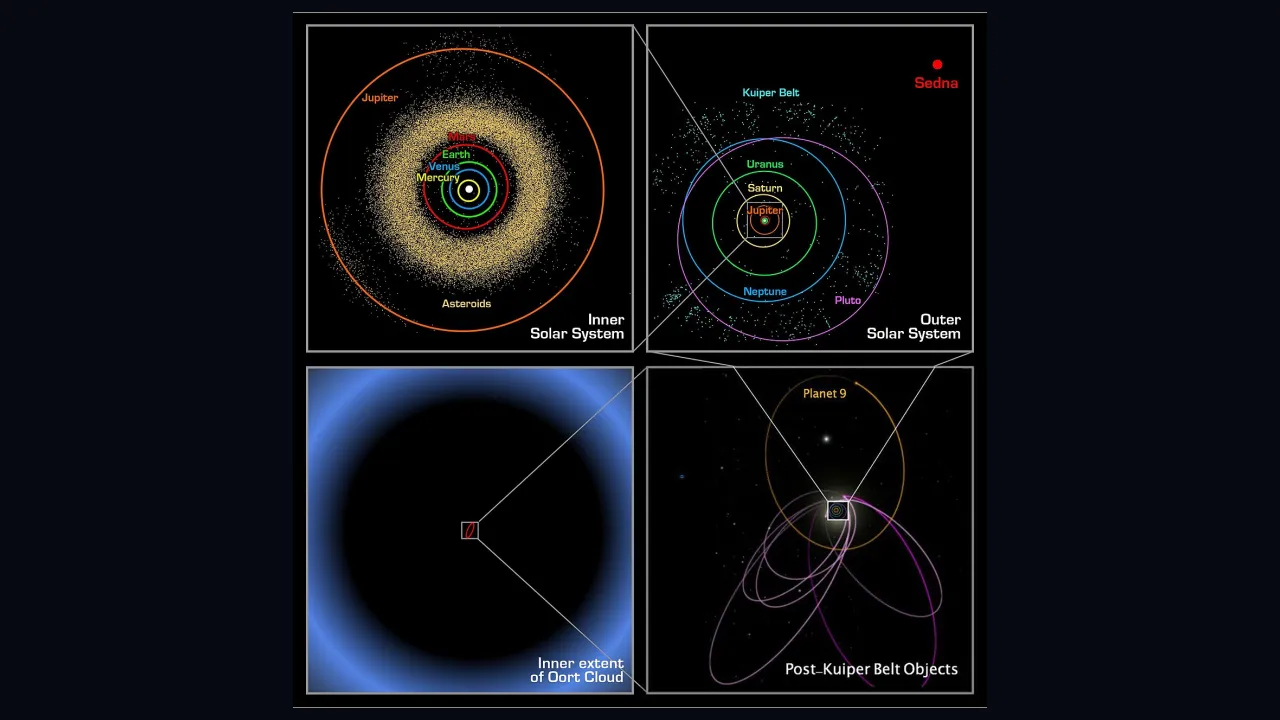
When astronomers at California's Palomar Observatory detected 90377 Sedna in 2003, they stumbled onto a cosmic puzzle. Every icy world found beyond Neptune before then either orbited inside the Kuiper Belt or swung close enough for Neptune's gravity to sling it outward. Sedna broke every rule: its entire orbit hangs suspended in empty space far beyond the Kuiper Belt's outer cliff.
2
Chemistry at Minus 400 Degrees
Spanning roughly 620 miles (1,000 kilometers) in diameter, Sedna is locked in perpetual winter near negative 400 degrees Fahrenheit. Spectroscopic measurements show a surface glazed with frozen methane, nitrogen, and water ice, heavily stained by crimson tholins. Only Mars rivals Sedna's deep scarlet hue, yet unlike dusty Mars, Sedna's surface appears remarkably smooth and reflective.
3
From 76 to 937 Astronomical Units
Sedna's highly orbit takes roughly 11,400 years to complete. At —its closest sweep—it stays 76 astronomical units from the Sun, more than twice Neptune's distance. At , it coasts to 937 astronomical units, entering the inner edge of the Oort Cloud.
4
Clues to Ancient Stars or Planet Nine
How did Sedna end up on such a detached track? Either a passing star from the Sun's birth cluster tugged Sedna outward four billion years ago, or an unseen giant world—often nicknamed Planet Nine—still shepherds Sedna and its cousin worlds in the dark.
1. Why was Sedna's orbit so surprising to astronomers in 2003?
2. Which two hypotheses do astronomers test to explain Sedna's detached orbit?
🤯 Mind-Blowing Fact • Grade 5
Because Sedna spends more than 99 percent of its 11,400-year orbit much farther out in the dark, astronomers estimate dozens of similar inner Oort Cloud worlds remain hidden beyond current telescope limits!
✨ Word Sparks (Grade 5 Glossary)
Tap 🔊 to hear
sednoid
An extreme outer world with a high-perihelion orbit
perturbation
A gravitational nudge that alters an object's orbit
kelvin
Scientific temperature scale starting at absolute zero cold
🪝
How could a single 620-mile-wide sphere of red ice rewrite the origin story of our entire Solar System?
1
Capturing a Moving Speck at Palomar
On November 14, 2003, planetary astronomers Mike Brown, Chad Trujillo, and David Rabinowitz scanned wide-field images from the Samuel Oschin Telescope at Palomar Observatory. Across three hours of exposures, a faint crimson point shifted subtly against the background stars—moving so slowly that it had to lie at an extraordinary distance. Cataloged as 90377 Sedna after the Inuit deity of the freezing marine abyss, this world became the first known member of a new class called .
2
Cryogenic Surface and Tholin Glaze
Thermal observations from the Spitzer and Herschel space telescopes constrain Sedna's diameter to approximately 620 miles (1,000 kilometers), roughly two-fifths the width of Pluto. With surface temperatures hovering near 12 (-438 degrees Fahrenheit), volatile nitrogen and methane freeze solid alongside water ice. Constant bombardment by galactic cosmic rays polymerizes those hydrocarbons into tholins, giving Sedna a uniform, glossy crimson finish second only to Mars in redness.
3
Orbital Geometry of an Inner Oort World
Sedna's orbital eccentricity of 0.855 is among the most extreme of any large Solar System body. Sweeping from a perihelion of 76 astronomical units (7.1 billion miles) out to an aphelion of roughly 937 astronomical units (87 billion miles), Sedna requires 11,400 Earth years to complete one revolution. Because astronomers only glimpsed it near the innermost fraction of its loop, dozens of sibling likely hide unseen near aphelion.
4
Fossil Gravity from the Sun's Birth Cluster
In standard orbital mechanics, an object kicked outward by Neptune must return to Neptune's neighborhood at perihelion unless a second distant force lifts its orbit. Leading dynamical models propose two culprits: gravitational from sister stars when our Sun formed inside a dense stellar nursery, or ongoing shepherding by a hypothetical multi-Earth-mass planet orbiting hundreds of astronomical units away.
5
The 2076 Window of Opportunity
Sedna is currently inbound toward its July 2076 perihelion. Mission designers are already studying high-speed solar-sail or nuclear-electric probes to intercept this pristine fossil from the dawn of the Solar System before it retreats into the abyss for another eleven millennia.