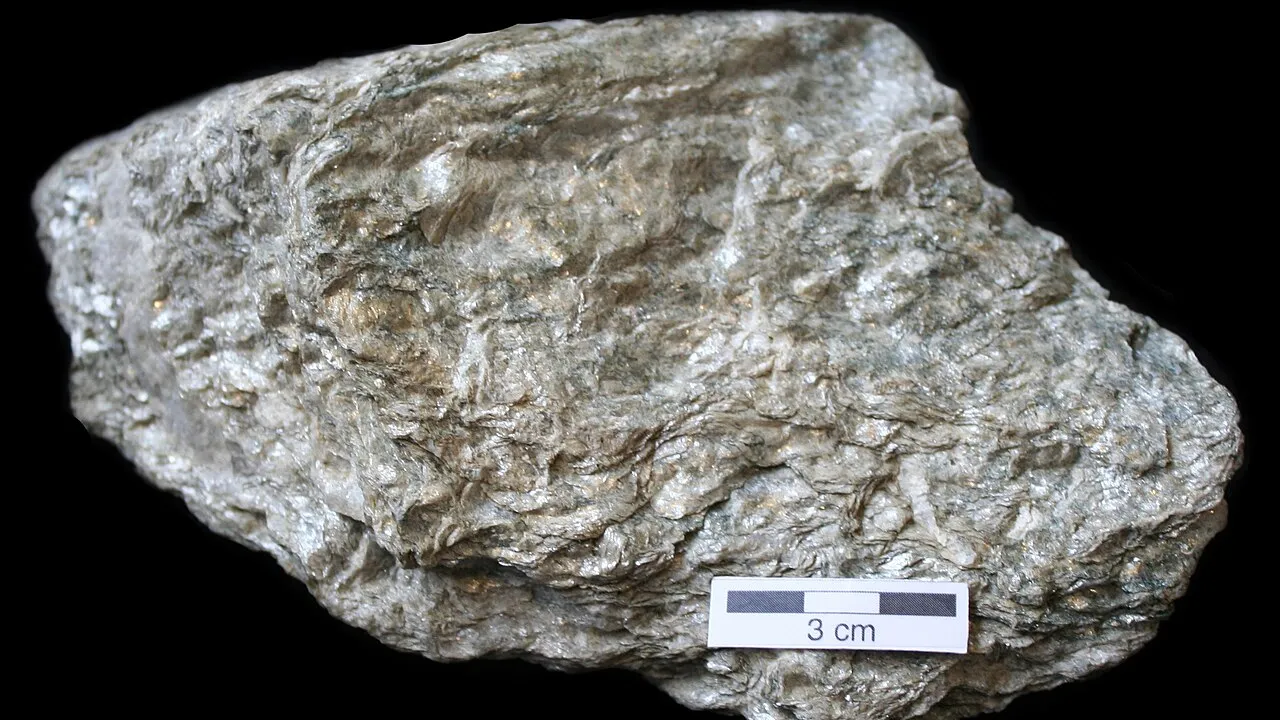
1. What makes schist glitter like shiny fish scales in the sunlight?
2. What dark-red gemstone crystals often grow inside glittering schist?
🤯 Mind-Blowing Fact • Grade 2
New York's Empire State Building and Chrysler Building stand tall because their foundations bolt directly into 450-million-year-old Manhattan Schist!
✨ Word Sparks (Grade 2 Glossary)
Tap 🔊 to hear
muscovite
Pale silvery mica mineral that peels in sheets
biotite
Dark black or brown shiny mica mineral
bedrock
Solid rock lying beneath loose soil and sand
🪝
How did New York City's tallest skyscrapers get their superpower from glittering schist?
1
Right in the Middle
Think of schist as the middle sibling of metamorphic rocks! Mild heat turns mudstone into flat slate, medium heat grows glittering mica flakes in schist, and extreme heat separates stripes in gneiss.
2
Wavy Foliation Layers
Unlike ruler-flat slate, schist splits along bumpy, wavy layers because its larger silver and black mica flakes wrap around chunky quartz grains and round red garnets.
3
Holding Up Skyscrapers
Look at a photo of New York City's skyline! Tall towers cluster in Midtown and Downtown where strong Manhattan Schist sits right near the surface to anchor deep steel foundations.
1. Why are schist's layers bumpy and wavy instead of smooth and flat like slate?
2. How did Manhattan Schist shape the famous skyline of New York City?
🤯 Mind-Blowing Fact • Grade 3
At Virginia's Fairy Stone State Park, natural cross-shaped staurolite crystals weathered out of ancient mica schist after growing miles underground during Appalachian mountain-building!
✨ Word Sparks (Grade 3 Glossary)
Tap 🔊 to hear
schistosity
Foliation made of visible, aligned platy mica crystals
staurolite
Metamorphic mineral famous for forming natural cross twins
talc
Ultra-soft, soapy magnesium mineral found in talc schist
🪝
How can little cross-shaped 'fairy stones' in Virginia grow right inside solid mica schist?
1
Schistosity: Visible Glittering Sheets
Geologists define schist by its texture—called —more than by a single chemical recipe! Whenever medium-grade metamorphic heat (around 400 to 600 degrees Celsius) and mountain pressure cause more than half of a rock's minerals to grow into visible, parallel platy or needle-like crystals, you are holding schist.
2
Naming Schist by Its Star Minerals
Because different parent rocks make different schists, geologists put the star minerals right in front of the name! Silvery muscovite and dark biotite build mica schist; metamorphosed seafloor basalt makes green chlorite schist; and magnesium-rich rocks form silky, soapy-feeling schist.
3
Virginia's Famous 'Fairy Crosses'
In Patrick County, Virginia, at Fairy Stone State Park, medium-grade mica schist grew remarkable brown twin crystals of a mineral called that intersect in neat X- and plus-shaped crosses!
4
Roaring Rapids at Great Falls
Between northern Virginia and Maryland, the Potomac River thunders through Mather Gorge over rugged, tilted ledges of ancient mica-rich Wissahickon Schist.
1. How do geologists name different varieties of schist, such as 'garnet-mica schist' or 'chlorite schist'?
2. What caused natural cross-shaped 'fairy stones' to form in Patrick County, Virginia?
🤯 Mind-Blowing Fact • Grade 4
Virginia's famous Willis Mountain in Buckingham County holds North America's largest deposit of sky-blue kyanite blades—grown from ancient aluminous schist and prized for space-shuttle and spark-plug ceramics!
✨ Word Sparks (Grade 4 Glossary)
Tap 🔊 to hear
index mineral
Mineral proving specific metamorphic temperature and pressure ranges
porphyroblast
Large crystal grown inside finer solid metamorphic rock
kyanite
Sky-blue bladed mineral formed under high metamorphic pressure
🪝
How do red garnets and blue blades inside schist act like tiny thermometers from vanished mountains?
1
Index Minerals: Nature's Underground Thermometers
Over a century ago in the Scottish Highlands, geologist George Barrow noticed that hiking across metamorphic schists revealed new minerals appearing in a strict, predictable order as rocks got hotter! Coolest zones hold green chlorite, warmer schists add biotite mica, then twelve-sided red almandine garnet, then cross-shaped brown staurolite, and hotter zones grow sky-blue blades of ! Geologists call these because spotting them pins down the exact temperature and burial depth the rock experienced.
2
Porphyroblasts Pushing Mica Aside
Large crystals like garnet, staurolite, or that sprout inside finer-grained metamorphic rock are called —the metamorphic cousins of igneous phenocrysts! Growing right in the solid state, sturdy garnet dodecahedra shoulder soft muscovite and biotite sheets aside, wrapping the rock in undulating, glittering waves.
3
Piedmont Fall Line Rapids
Where tough Piedmont schists and gneisses meet soft Coastal Plain sands—along a boundary through Richmond, Fredericksburg, and Great Falls on the Potomac—rivers plunge over rocky rapids called the Fall Line, where historic port cities grew!
4
Engineering Care With Tilted Mica
Strong across its layers yet slippery along wet mica sheets, tilted schist requires rock bolts in highway cuts and subway tunnels so slabs cannot slide along foliation planes.
1. Why are minerals like garnet, staurolite, and blue kyanite inside schist so valuable to geologists?
2. Why must civil engineers pay close attention to the tilt angle of mica layers when cutting a highway through schist?
🤯 Mind-Blowing Fact • Grade 5
Pinwheel-shaped 'snowball garnets' inside mountain schists trap spiral trails of tiny quartz grains as they grow over millions of years, recording ancient plate collisions like spinning flight recorders!
✨ Word Sparks (Grade 5 Glossary)
Tap 🔊 to hear
lepidoblastic
Foliated rock texture built of aligned scaly mica sheets
blueschist
Blue glaucophane schist formed in cold, deep subduction zones
anisotropy
Having different strength depending on direction through rock
🪝
How can a single spiral-patterned garnet inside schist record the speed at which continents collided?
1
Barrovian Zones and Pelitic Phase Equilibria
When clay-rich marine mudrocks (pelites) descend 12 to 25 kilometers inside a collisional orogen—such as the Taconic and Acadian phases that forged the Appalachian Piedmont—temperatures between 450 and 650 degrees Celsius drive continuous dehydration reactions. Chlorite and muscovite react to nucleate almandine garnet, Fe-Mg staurolite, and high-pressure kyanite (Al2SiO5), expelling superheated metamorphic water upward into quartz veins while coarsening mica foils above one millimeter in diameter.
2
Snowball Garnets and Clockwise P-T-t Paths
Slice a centimetre-wide garnet porphyroblast from Vermont or Virginia schist in half, and microscopic quartz inclusion trails often swirl outward in a pinwheel! Known as 'snowball garnets,' these crystals rotated—or overgrew folding foliation—as thrust sheets rode over one another. By analyzing chemical zoning from manganese-rich cores to magnesium-rich rims alongside lutetium-hafnium or samarium-neodymium radiometric ages, petrologists calculate that single garnets grew over five to ten million years while tracking exact pressure-temperature-time (P-T-t) loops!
3
Blueschist Versus Greenschist Tectonic Signatures
Not every schist forms in hot continental roots! In cold oceanic subduction zones—like California's Franciscan Complex—basalt dives 30 kilometers deep faster than it can warm up, growing violet-blue glaucophane amphibole and jadeite in high-pressure, low-temperature : an unmistakable fingerprint of ancient plate subduction.
4
Mechanical Anisotropy in Urban Tunnels
Subway and aqueduct engineers boring through New York's Manhattan Schist or Washington, D.C.'s Rock Creek schists model extreme mechanical , orienting rock-bolt arrays perpendicular to micaceous cleavage.
5
Orogenic Gold and Pegmatite Hosts
Metamorphic fluids dehydrated from deep schists focus gold-bearing quartz veins—including Virginia's historic Gold-Pyrite Belt in the central Piedmont—linking glittering mica bedrock to global mineral wealth.