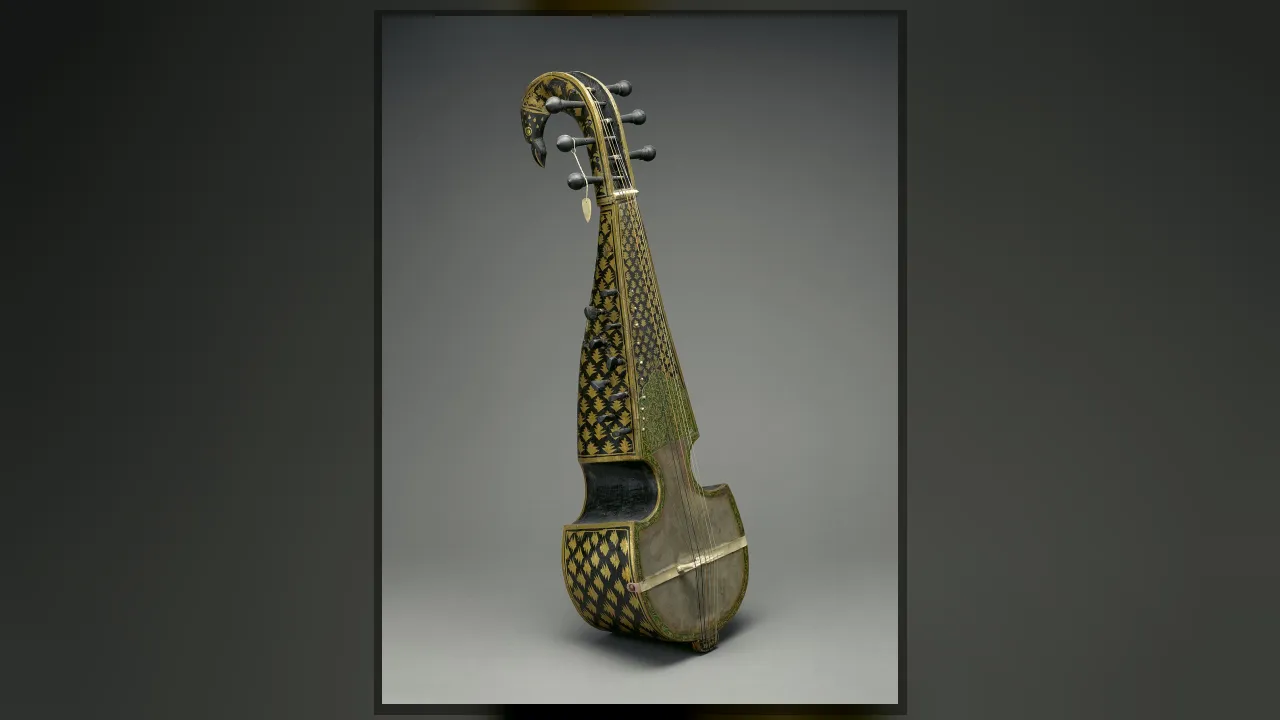
1. What covers the neck of a sarod right underneath its metal strings?
2. What surprising natural material is carved to make the sarod's pick?
🤯 Mind-Blowing Fact • Grade 2
In the Persian language, the word 'sarod' means 'beautiful sound' or 'melody'—fitting an instrument famous for deep, soulful songs!
✨ Word Sparks (Grade 2 Glossary)
Tap 🔊 to hear
java
Triangular coconut-shell pick used on sarods
goatskin
Tanned animal hide stretched as resonant belly
sculpted
Carved carefully out of one solid block
🪝
Why does a sarod have BOTH a tight skin drumhead on its belly and a polished metal mirror on its neck?
1
Majestic Voice of North India
Strike one bronze bass string with a smooth coconut-shell pick, and a deep, noble sound rolls out like a distant temple bell! Slightly shorter and deeper-voiced than the sitar, the sarod is a beloved treasure of North Indian classical concerts.
2
Goatskin Belly and Carved Wood
Artisans hollow its curved body from a single solid block of seasoned teak or cedar wood with two deep side scoops near the waist. Stretched tightly across the front belly sits thin white , giving every plucked note a warm, drum-like punch!
3
Skating With Fingernails
Soft fingertips would drag and stick on a fretless neck, so sarod players press strings with the smooth edge of their fingernails against a shiny steel fingerboard. Meanwhile, over a dozen extra echo strings shimmer softly underneath!
1. Why do sarod players press strings with the edges of their fingernails instead of soft fingertips?
2. What stretches tightly across the front wooden bowl of a sarod?
🤯 Mind-Blowing Fact • Grade 3
Before playing, many sarod musicians dab a tiny trace of natural oil onto their fingertips and steel fingerboard so their fingernails glide like ice skates!
✨ Word Sparks (Grade 3 Glossary)
Tap 🔊 to hear
rabab
Skin-bellied Central Asian lute ancestor of sarod
taraf
Untouched sympathetic strings ringing through resonance
resonance
Full echoing warmth inside a hollow chamber
🪝
How did travelers' horseman lutes from Afghanistan blend with Indian classical instruments to create the modern sarod?
1
Zero Frets, Infinite Pitch
What would happen if an instrument combined a banjo's skin drumhead, a slide guitar's seamless glides, and the sitar's shimmering cloud of sympathetic strings? Meet the sarod, whose bold, resonant voice moves from thunderous rhythms to whispered sighs!
2
Born From Cultural Exchange
About two hundred years ago in North India, musicians blended the gut-strung Afghan —famous for its carved wood body and goatskin belly—with the metal fingerboard and steel strings of an Indian instrument called the sursingar.
3
Up to Twenty-Five Metal Strings
Modern concert sarods carry seventeen to twenty-five steel and bronze strings! Four main melody strings work alongside drone wires, high rhythmic chikari strings, and up to fifteen sympathetic strings that vibrate automatically whenever matching pitches sound.
4
Dipped in Wax for Speed
Carved from dense coconut shell and often dipped in warm beeswax for a secure thumb grip, the triangular java plectrum fires rapid rhythmic bursts alongside tabla drums.
1. Which two older instruments were blended in nineteenth-century India to create the modern sarod?
2. Roughly how many total metal strings can a full concert sarod carry?
🤯 Mind-Blowing Fact • Grade 4
Because pressing steel wires thousands of times wears microscopic grooves even into fingernails, dedicated sarod virtuosos guard their left-hand index, middle, and ring nails like priceless concert tools!
✨ Word Sparks (Grade 4 Glossary)
Tap 🔊 to hear
termination
Exact point where vibrating string gets stopped
gharana
Generational Indian classical school of musical style
timbral
Relating to unique tone color and texture
🪝
Why does stopping a string with a hard fingernail against chrome-plated steel let a fretless skin-bellied lute sustain long notes without dying out?
1
Grave Weight and Vocal Grace
In the darkened hush of an evening recital, a coconut-shell java strikes a low bronze string: first comes a deep percussive thump from the goatskin belly, followed instantly by a liquid glide soaring a full octave in one unbroken breath. Where the fretted sitar sparkles like sunlit spray, the fretless sarod speaks with solemn, majestic gravity.
2
Nineteenth-Century Transformation
During the 1800s around Lucknow, Gwalior, and Rampur, descendants of Afghan horse-traders and court musicians adapted the folk kabuli rabab to suit expansive Hindustani ragas. Gut strings over wood decayed too rapidly for slow Indian meend glides, so luthiers replaced the wooden neck face with a tapered, chrome-plated steel fingerboard and strung the instrument with resonant steel and phosphor-bronze wires.
3
Solving the Skin-Damping Puzzle
Remember how a banjo's stretched drumhead drains string energy quickly? The sarod balances that rapid goatskin punch in three ingenious ways: a deep, thick-walled tun-wood chamber carved from one log, a tall horn bridge resting near the belly's edge, and rigid fingernail-to-steel string that wastes zero vibration in soft finger flesh!
4
Two Great Concert Lineages
In the twentieth century, two celebrated design traditions flourished: the twenty-five-string Maihar model perfected by Ustad Allauddin Khan and his brother Ayet Ali Khan—adding a small upper brass-or-wood resonator under the neck—and the sleeker nineteen-string Gwalior-Senia design championed by Ustad Hafiz Ali Khan and Ustad Amjad Ali Khan.
1. Why did nineteenth-century Indian makers replace the Afghan rabab's wooden fingerboard and gut strings with steel?
2. Which pair of brothers refined the twenty-five-string Maihar concert sarod in the early twentieth century?
🤯 Mind-Blowing Fact • Grade 5
Whereas a sitar's main melody strings graze a curved jawari bridge for a buzzing halo, a sarod's main melody strings sit in clean narrow notches on a horn bridge—giving the sarod a purer, punchier core note surrounded by buzzing sympathetic strings!
✨ Word Sparks (Grade 5 Glossary)
Tap 🔊 to hear
gamak
Forceful oscillating pitch shake ornamenting Indian ragas
shruti
Subtle microtonal pitch nuance within Indian scales
keratin
Tough natural protein forming fingernails and horn
🪝
How does combining a flat-bridged goatskin membrane, a zero-friction chrome steel fingerboard, and fifteen sympathetic strings bridge percussive attack with vocal sustain?
1
Introspective Majesty in Three and a Half Octaves
Strike the lowest bronze kharaj string tuned to C2 (65.4 hertz) with a beeswax-coated coconut-shell java, then glide a fingernail seamlessly up the ma string past C6 (1,046.5 hertz) without crossing a single fret boundary! Classified under Hornbostel-Sachs 321.312 as a fretless skin-bellied composite lute, the Hindustani sarod commands a brooding, chest-resonant gravitas distinct from every wooden-top chordophone.
2
Trans-Himalayan Organological Synthesis
Emerging in mid-nineteenth-century Lucknow, Shahjahanpur, and Gwalior through masters such as Ghulam Ali Khan Bangash and Niamatullah Khan, the sarod synthesized the waisted body and animal-skin soundtable of the Afghan rabab with the unfretted metal fingerboard and metal strings of the Indian dhrupad sursingar. Sculpted from a single seasoned block of Toona ciliata (tun) or teak measuring roughly one hundred centimeters, its pinched waist permits steep downward plectrum strokes.
3
Acoustic Coupling: Membrane, Nail, and Bridge
Unlike the sitar's wide parabolic jawari bridge, the sarod's main playing strings cross narrow notches atop an upright water-buffalo-horn bridge seated squarely on taut, unbleached goatskin—producing a cleaner fundamental pitch with formidable low-midrange punch, while secondary flat jawari ledges impart subtle harmonic shimmer only to chikari and sympathetic strings. Stopping strings with fingernail edges against mirror-polished chromium-plated steel creates high-impedance reflection, preserving sustain during sweeping microtonal meend and vigorous shakes.
4
Maihar and Senia-Bangash Structural Schools
Twentieth-century concert lutherie diverged into two revered architectures: the Maihar school codified by Ustad Allauddin Khan, Ayet Ali Khan, and Ustad Ali Akbar Khan—featuring a rounder resonator, an auxiliary upper neck tumba, four melody strings, four jawari-tuned harmony drones, two chikaris, and fifteen taraf strings (twenty-five total)—and the streamlined nineteen-string Senia-Bangash instrument played by Ustad Amjad Ali Khan.
5
Rhythmic Fire of Jor, Jhala, and Sawal-Jawab
Whether tracing microtonal inflections in deep midnight ragas or firing exhilarating rhythmic triplets in high-velocity jhala dialogues (sawal-jawab, 'question and answer') beside the tabla, the sarod transforms raw wood, skin, horn, coconut, and steel into timeless poetry.