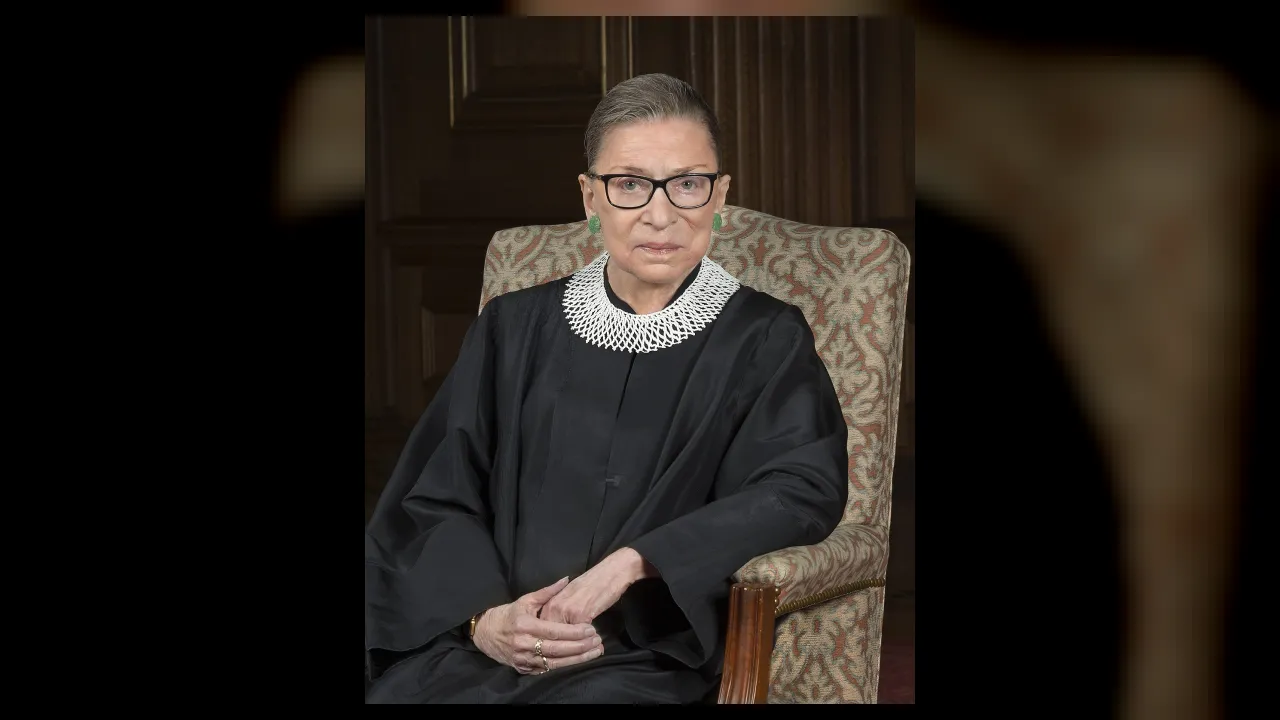
1. Where did young Ruth love to go every week in Brooklyn?
2. What special accessory did Justice Ginsburg wear over her black judicial robe?
🤯 Mind-Blowing Fact • Grade 2
Sandra Day O'Connor and Ruth Bader Ginsburg both wore special decorative collars called 'jabots' because standard judicial robes were originally designed to show a man's shirt and tie!
✨ Word Sparks (Grade 2 Glossary)
Tap 🔊 to hear
professor
A teacher at a college or university
jabot
A decorative collar worn over a robe
opportunity
A fair chance to learn or succeed
🪝
How did one determined student finish tied for first in her law school class while caring for her family?
1
Nine Women Out of Five Hundred
Imagine walking into Harvard Law School in 1956 and seeing over five hundred male students—and only eight other women! Raised in Brooklyn, New York, Ruth Bader Ginsburg stayed up late taking notes for her sick husband, Martin, studied her own lessons, cared for their baby daughter, and later tied for first place at Columbia Law School.
2
Winning Equal Rights in Court
As a law and lawyer in the 1970s, Ruth argued six big cases before the U.S. Supreme Court and won five! She showed judges that unfair gender rules hurt both fathers and mothers.
3
Twenty-Seven Years as Justice
Appointed in 1993, she became the second woman on the Supreme Court and served for twenty-seven years.
1. How many women were in Ruth Bader Ginsburg's entering class of more than 500 students at Harvard Law School?
2. How many of the six equal-rights cases she argued before the Supreme Court in the 1970s did Ruth win?
🤯 Mind-Blowing Fact • Grade 3
Despite opposite approaches on many cases, Justice Ruth Bader Ginsburg and fellow Justice Antonin Scalia shared a warm lifelong friendship, traveling together and attending operas!
✨ Word Sparks (Grade 3 Glossary)
Tap 🔊 to hear
independent
Able to stand strong on your own
unconstitutional
Going against rules in the U.S. Constitution
opinion
A court's official written explanation of law
🪝
Why did Ruth Bader Ginsburg choose a devoted widowed father for one of her most famous equal-rights cases?
1
Lessons From Brooklyn
Picture a quiet girl reading above a bustling neighborhood delicatessen in Brooklyn, New York, during the 1940s. Ruth Bader's mother, Celia, taught her two guiding rules: 'Be a lady,' meaning never let anger cloud your thinking, and 'Be ,' meaning learn skills to support yourself. Ruth earned top honors at Cornell University before attending Harvard and Columbia Law Schools.
2
Teaching Judges Step by Step
Even after tying for first in her Columbia Law class in 1959, New York law firms hesitated to hire a woman and mother. Ruth became a respected law professor instead. In the 1970s, inspired by Thurgood Marshall's step-by-step legal strategy, she argued landmark cases before nine male Supreme Court justices.
3
Proving Unfair Laws Hurt Everyone
In one famous 1975 case, she represented Stephen Wiesenfeld, a widowed father denied child-care benefits that only widowed mothers could receive. All nine justices agreed that assuming only women care for children—or only men earn paychecks—was !
4
Supreme Court Justice and Virginia Milestone
Nominated by President Bill Clinton in 1993, Justice Ginsburg served twenty-seven years, including writing the famous 1996 opening the Virginia Military Institute in Lexington, Virginia, to qualified women.
1. Why did Ruth Bader Ginsburg represent widowed father Stephen Wiesenfeld before the Supreme Court?
2. Which historic Virginia college opened its doors to female cadets after Justice Ginsburg's 1996 Supreme Court opinion?
🤯 Mind-Blowing Fact • Grade 4
When Ruth Bader Ginsburg passed away in September 2020, she became the very first woman in American history to lie in state inside the U.S. Capitol!
✨ Word Sparks (Grade 4 Glossary)
Tap 🔊 to hear
bipartisan
Supported together by both major political parties
collegiality
Working respectfully together despite differing viewpoints
statute
A written law passed by a legislature
🪝
How did Ruth Bader Ginsburg persuade the Supreme Court that the Fourteenth Amendment's promise of equal protection applies to women and men alike?
1
Perseverance Through Closed Doors
Listen to a soft, deliberate voice addressing nine Supreme Court justices in January 1973—a voice so calm and thoroughly prepared that every listener leans forward. Born Joan Ruth Bader in Brooklyn, New York, in 1933, she graduated first among women at Cornell University, made the Harvard Law Review while caring for an infant daughter and helping her husband Martin recover from cancer, and tied for first in her 1959 graduating class at Columbia Law School.
2
Building Constitutional Precedent in the 1970s
After teaching civil procedure at Rutgers Law School and becoming the first tenured female professor at Columbia Law School, Ginsburg co-founded the Women's Rights Project in 1972. Modeling her incremental approach directly on Thurgood Marshall's campaign for racial equality, she challenged hundreds of federal and state that classified citizens strictly by sex. Arguing six cases before the Supreme Court between 1973 and 1978—and winning five, including Frontiero v. Richardson and Weinberger v. Wiesenfeld—she established heightened constitutional scrutiny under the Equal Protection Clause.
3
Appointment and United States v. Virginia
Appointed to the U.S. Court of Appeals for the D.C. Circuit in 1980 by President Jimmy Carter and nominated to the Supreme Court in 1993 by President Bill Clinton, Ginsburg won Senate confirmation by a 96–3 vote. In 1996, she authored the 7–1 majority opinion in United States v. Virginia, holding that state-funded Virginia Military Institute could not exclude women capable of meeting its rigorous training standards.
4
Civility and Collegiality
Serving until September 2020, Ginsburg modeled civic respect—famously demonstrating through her close friendship with Justice Antonin Scalia that Americans can disagree passionately on legal questions while remaining warm colleagues.
1. Whose earlier constitutional strategy inspired Ruth Bader Ginsburg's step-by-step equal-rights litigation in the 1970s?
2. By what Senate vote was Ruth Bader Ginsburg confirmed to the U.S. Supreme Court in 1993?
🤯 Mind-Blowing Fact • Grade 5
On the cover of her groundbreaking 1971 Supreme Court brief in Reed v. Reed, Ruth Bader Ginsburg listed civil rights lawyer and poet Pauli Murray as co-author to honor Murray's pioneering legal ideas!
✨ Word Sparks (Grade 5 Glossary)
Tap 🔊 to hear
jurisprudence
The philosophy and body of court law
tenured
Holding a permanent senior university teaching post
plaintiff
A person bringing a case to court
🪝
How did a methodical professor of civil procedure reshape Fourteenth Amendment jurisprudence before ever putting on a Supreme Court robe?
1
Academic Distinction Against Steep Odds
Step into Langdell Hall at Harvard Law School in the autumn of 1956, where 552 first-year law students take their seats—only nine of them women. Among those nine sits twenty-three-year-old Ruth Bader Ginsburg of Flatbush, Brooklyn, already mother to a fourteen-month-old daughter. When her husband, tax law student Martin D. Ginsburg, underwent intensive cancer treatments the following year, Ruth typed his dictated papers, attended classes, edited the Harvard Law Review, and transferred with him to New York, graduating tied for first at Columbia Law School in 1959.
2
Comparative Law in Sweden and Early Professorship
Passed over by Manhattan firms and even for a Supreme Court clerkship despite glowing faculty recommendations, Ginsburg clerked for Federal District Judge Edmund Palmieri before spending 1962–1963 at Lund University in Sweden co-authoring a treatise on Swedish civil procedure. Observing Swedish women balancing legal careers and family life broadened her vision of civic equality. Joining Rutgers Law School in 1963 and becoming Columbia Law School's first female professor in 1972, she co-authored the first American law-school casebook on sex-based discrimination.
3
Architect of Equal Protection Jurisprudence
Prior to 1971, the Supreme Court had never invalidated a law under the Fourteenth Amendment for discriminating on the basis of sex. Co-authoring the winning brief in Reed v. Reed (1971)—and placing deceased suffragists Dorothy Kenyon and Pauli Murray on the cover in tribute to their foundational insights—Ginsburg then argued six landmark cases before the high court between 1973 and 1978, prevailing in five: Frontiero v. Richardson (1973), Weinberger v. Wiesenfeld (1975), Edwards v. Healy, Califano v. Goldfarb (1977), and Duren v. Missouri (1979). Her strategic selection of male and female demonstrated that statutory gender stereotypes abridged individual liberty across family and economic life.
4
Appellate Bench and Supreme Court Tenure
Following thirteen years on the U.S. Court of Appeals for the D.C. Circuit (1980–1993), Ginsburg was nominated by President Bill Clinton and confirmed 96–3 as the 107th—and second female—Supreme Court Justice. Her landmark 1996 majority opinion in United States v. Virginia struck down the male-only admissions policy at the Virginia Military Institute, writing that generalizations about women could no longer justify denying opportunity to individuals possessing the talent and capacity to excel.
5
Civic Discourse and Constitutional Legacy
Across twenty-seven terms until her death in September 2020, Ginsburg paired rigorous procedural precision with legendary bipartisan collegiality—reminding citizens to 'fight for the things that you care about, but do it in a way that will lead others to join you.'