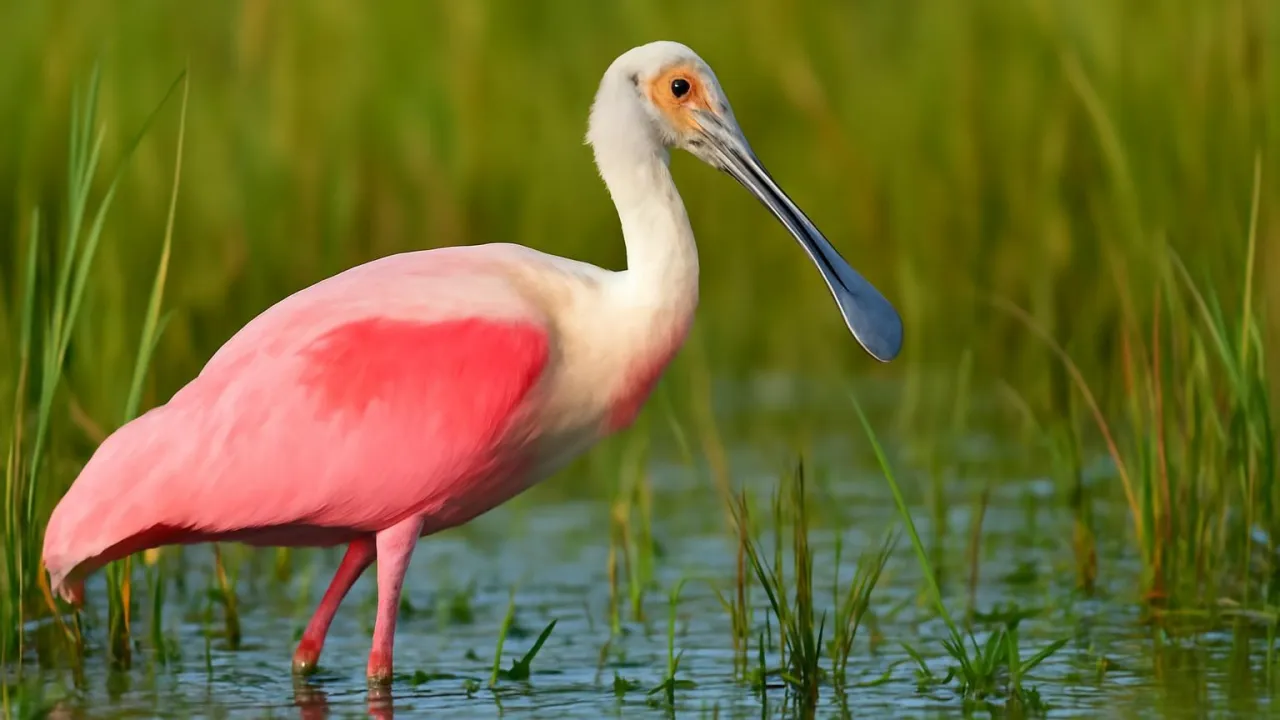
Roseate spoonbills get their pink color from eating shrimp and crustaceans!
✨ Word Sparks (Grade 2 Glossary)
Tap 🔊 to hear
wetlands
Land with lots of water and plants
crustaceans
Small water animals like shrimp and crabs
nest
A bird’s home made of sticks and leaves
🪝
Have you ever seen a bird with a pink spoon for a mouth?
1
Bright Pink Feathers
The roseate spoonbill has bright pink feathers that cover its body and wings. These colors come from the food it eats. The pink feathers help it stand out in . It looks very pretty when flying.
2
Special Spoon-Shaped Beak
Its beak is long and shaped like a spoon, which helps it catch food. The bird sweeps its beak side to side in shallow water. It eats small fish, shrimp, and insects this way. This beak is very good for finding food.
3
Warm Wetland Homes
Roseate spoonbills live in warm near coasts and rivers. They build in trees or bushes. These places have lots of water and food. The birds like to stay where it is warm.
Roseate spoonbills’ pink color is a result of eating carotenoid-rich shrimp and crustaceans!
✨ Word Sparks (Grade 3 Glossary)
Tap 🔊 to hear
camouflage
Colors or patterns that help animals hide
tactile
Using touch to find or feel things
ecosystem
A community of plants and animals living together
🪝
Did you know the roseate spoonbill uses its spoon-shaped beak to find food in muddy water?
1
Colorful Feathers and Camouflage
The roseate spoonbill has bright pink feathers that help it attract mates. Its color comes from pigments in the shrimp and crustaceans it eats. Although bright, the pink feathers blend well in wetland plants. This adaptation helps the bird stay safe from predators.
2
Unique Spoon-Shaped Beak
Its long, flat beak looks like a spoon and is perfect for sweeping through water. This shape helps it catch small fish and insects by feeling them in muddy water. The bird moves its beak side to side quickly to find food. This feeding method is called foraging.
3
Wetland Habitat and Life Cycle
Roseate spoonbills live in warm wetlands and coastal marshes in the Americas. They build nests in trees or shrubs above water to protect eggs from predators. The chicks hatch after about three weeks and learn to fly after several weeks. Wetlands provide nutrients and shelter for the whole family.
4
Role in the Ecosystem
Roseate spoonbills help control fish and insect populations by eating them. They are also prey for larger animals like alligators and raptors. Their feeding stirs up mud, which helps recycle nutrients in wetlands. This bird plays an important part in keeping its balanced.
1. Why does the roseate spoonbill have pink feathers?
2. What does the roseate spoonbill use its beak for?
🤯 Mind-Blowing Fact • Grade 4
Roseate spoonbills help recycle nutrients in wetlands by stirring up mud while feeding!
✨ Word Sparks (Grade 4 Glossary)
Tap 🔊 to hear
carotenoids
Pigments in food that color feathers pink
mangroves
Trees that grow in salty coastal wetlands
pollution
Dirty stuff that harms animals and plants
🪝
How does the roseate spoonbill’s unique beak shape help it survive in wetlands?
1
Bright Feathers and Their Cause
The roseate spoonbill’s bright pink feathers result from pigments called found in its diet of shrimp and crustaceans. These pigments accumulate in the feathers, creating the vivid color that helps attract mates during breeding season. This color also plays a role in social signaling among birds. Without this diet, their feathers would be much paler.
2
Spoon-Shaped Beak and Feeding Adaptations
Its distinctive spoon-shaped beak is perfectly adapted for tactile feeding in shallow waters, allowing the bird to sweep side to side and detect prey by touch rather than sight. This adaptation helps it find food in murky water where visibility is low. The beak’s shape increases the surface area for scooping small fish, shrimp, and insects. This specialized feeding method is key to its survival.
3
Wetland Ecosystem Role and Distribution
Roseate spoonbills inhabit warm coastal wetlands, marshes, and from the southern United States to South America. They play an important role in controlling populations of aquatic invertebrates and small fish. Their feeding stirs up sediments, which recycles nutrients and supports wetland plant growth. This bird is an integral part of the wetland food web and ecosystem health.
4
Human Impact and Conservation
Wetland loss and threaten roseate spoonbill habitats, causing population declines in some areas. Conservation efforts focus on protecting wetlands and water quality to support their survival. These birds benefit from protected reserves and environmental laws. Public education about wetland importance also helps preserve their habitats.
1. What helps the roseate spoonbill detect prey in murky water?
2. Why is wetland protection important for roseate spoonbills?
🤯 Mind-Blowing Fact • Grade 5
Roseate spoonbills sweep their bills side to side about 20 times each second to catch hidden prey!
✨ Word Sparks (Grade 5 Glossary)
Tap 🔊 to hear
Threskiornithidae
The bird family of spoonbills and ibises
tactile
Using touch to find food or objects
habitat fragmentation
Breaking habitats into smaller, separated parts
🪝
What makes the roseate spoonbill’s spoon-shaped bill a remarkable evolutionary adaptation for wetland survival?
1
Taxonomy and Scientific Classification
The roseate spoonbill, scientifically named Platalea ajaja, belongs to the family , which includes ibises and spoonbills. It is a wading bird found primarily in the Americas’ coastal wetlands, marshes, and mangrove forests. Its closest relatives share similar feeding adaptations, but the roseate spoonbill is notable for its vivid pink plumage. This taxonomic classification helps scientists understand its evolutionary relationships.
2
Physiological Mechanics of Feeding
The roseate spoonbill’s bill is flattened and widened at the tip, resembling a spoon, which allows it to sweep through shallow water efficiently. Sensitive nerve endings inside the bill detect prey by touch, enabling the bird to forage in turbid water with limited visibility. This feeding strategy lets it catch small fish, crustaceans, and aquatic insects. The bird sweeps its bill side to side at approximately 20 times per second.
3
Conservation History and Challenges
Historically, roseate spoonbills faced habitat loss due to wetland drainage and pollution, leading to population declines in the 20th century. Conservation efforts including wetland preservation, pollution control, and legal protections have helped populations recover in many regions. Continued threats include climate change and . Monitoring and habitat restoration remain critical for their long-term survival.
4
Ecological Role and Quantitative Impact
Roseate spoonbills contribute to wetland ecosystems by controlling invertebrate populations and recycling nutrients through their feeding behavior. By stirring sediments, they enhance nutrient availability for aquatic plants, supporting biodiversity. An adult bird weighs about 2.5 to 3.5 pounds (1.1 to 1.6 kilograms) and can reach speeds up to 25 miles per hour (40 kilometers per hour) in flight. Their presence indicates healthy wetland environments.
5
Comparative Adaptations and Global Distribution
Compared to other spoonbill species, the roseate spoonbill’s bright pink coloration is unique and linked to its diet rich in carotenoids. It ranges from the southeastern United States through Central and South America, favoring warm coastal wetlands. Unlike some related species that inhabit freshwater, it often frequents brackish and saltwater habitats. These adaptations allow it to thrive in diverse wetland ecosystems.