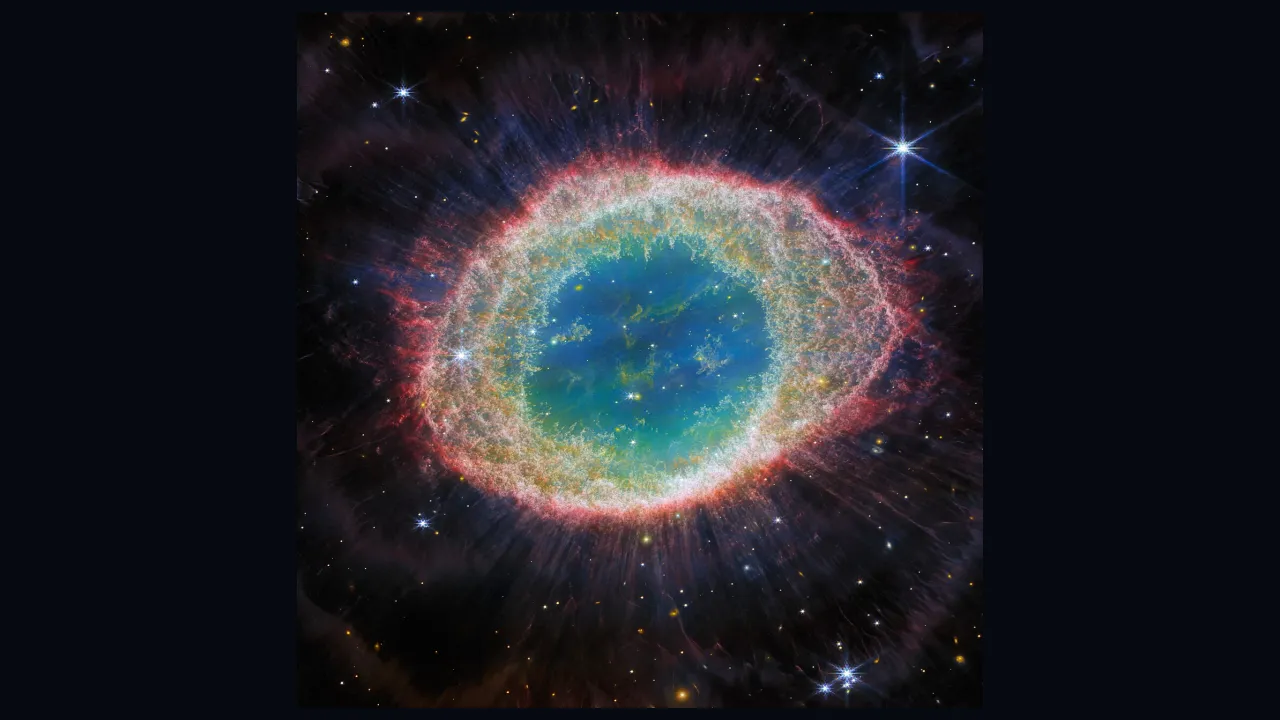
1. What sits right in the middle of the Ring Nebula lighting up its colors?
2. What tasty treat does the Ring Nebula look like from Earth?
🤯 Mind-Blowing Fact • Grade 2
The tiny white dwarf star inside the Ring Nebula is shrunk down to Earth's size, yet its surface is twenty times hotter than our Sun!
✨ Word Sparks (Grade 2 Glossary)
Tap 🔊 to hear
planetary nebula
Glowing gas shell shed by dying star
Lyra
Small summer star pattern shaped like harp
red giant
Swollen cool stage of an aging star
🪝
Why do astronomers call the Ring Nebula a 'planetary nebula' when zero planets made it?
1
A Funny Old Nickname
Long ago in the 1700s, astronomers looking through small telescopes thought round gas clouds looked like blue-green planets such as Uranus. Even though planets did not make them, the name '' stuck forever! The Ring Nebula in is the most famous one of all.
2
Preview of Our Sun's Future
About four thousand years ago, a star much like our Sun ran low on fuel, swelled into a , and gently shed its outer gas layers. Five billion years from now, our own Sun will paint a glowing nebula too!
3
Secret Football Shape
Surprise—the Ring Nebula is not really a flat ring! It is shaped like an open barrel pointed almost straight toward Earth.
1. Why are clouds like the Ring Nebula called 'planetary nebulae'?
2. What is the Ring Nebula's true 3D shape in space?
🤯 Mind-Blowing Fact • Grade 3
Each of the 20,000 dense gas globules lining the Ring Nebula packs about as much mass as the entire planet Earth!
✨ Word Sparks (Grade 3 Glossary)
Tap 🔊 to hear
cylinder
Tube-shaped object open at both ends
nitrogen
Gas glowing red along cool nebula rims
kelvin
Scientific scale used for star temperatures
🪝
What makes each ring of the Ring Nebula glow in a different color of the rainbow?
1
Jewel of the Summer Harp
Tucked neatly between two bright stars in the constellation Lyra the Harp, roughly 2,570 light-years away, shines Messier 57—the Ring Nebula. Discovered in 1779 in France, it is a favorite target for backyard telescopes all summer long.
2
Colors Tell Temperature
Inside the ring's center blazes a white dwarf star at a blistering 120,000 ! Closest to that searing core, super-hot helium gas glows deep blue. Farther out, warm oxygen and hydrogen shine bright green and yellow, while cooler along the outer rim glows ruby red.
3
Peering Down a Cosmic Tunnel
3D maps from Hubble and the James Webb Space Telescope show we are staring nearly straight down a tilted of dense gas, with wispy bubbles puffing out both open ends like a jelly doughnut!
4
Twenty Thousand Dense Knots
Webb's sharp infrared cameras also revealed 20,000 dense clumps of hydrogen gas lining the inner ring like spokes on a bicycle wheel.
1. Why does the center of the Ring Nebula look blue while the outer edge glows red?
2. How many Earth-mass hydrogen globules did the James Webb Space Telescope reveal inside the Ring Nebula?
🤯 Mind-Blowing Fact • Grade 4
Outside the bright 1-light-year doughnut you see in backyard telescopes, faint petal-shaped loops of glowing hydrogen stretch more than twice as wide across space!
✨ Word Sparks (Grade 4 Glossary)
Tap 🔊 to hear
torus
Thick doughnut-shaped ring in three dimensions
concentric
Circles sharing the exact same center
binary star
Two stars orbiting each other closely
🪝
How did the James Webb Space Telescope uncover a hidden partner star sculpting the Ring Nebula?
1
Gentle Farewell of a Sun-Like Star
Massive stars like Deneb die in violent supernova explosions, whereas intermediate-mass stars—roughly one to eight times our Sun's mass—enjoy a far more artistic finale. Around four thousand years ago, an aging red giant 2,570 light-years away in Lyra pulsed away its outer envelope at 12 to 20 miles per second, unveiling a white-hot carbon-oxygen core that illuminated Messier 57.
2
Illusion of Geometry
For two centuries, observers assumed Messier 57 was a spherical soap bubble appearing brighter along its thicker outer edge. Spectroscopic Doppler maps from ground observatories and Hubble overturned that view: the bright ring is actually a dense equatorial —a thick waist belt—while lower-density lobes balloon toward and away from Earth along our line of sight!
3
Ten Concentric Ripples
When NASA's James Webb Space Telescope aimed its NIRCam and MIRI infrared cameras at the faint outer halo in 2023, astronomers spotted ten evenly spaced arcs rippling outside the main ring like tree rings in a pond, spaced roughly 280 years apart along with twenty thousand dense hydrogen globules.
4
Clues to a Binary Sculptor
Isolated single stars rarely blow neat open barrels and clockwork outer ripples all on their own. Those 280-year arcs betray a hidden companion star orbiting the dying giant roughly as far out as Pluto orbits our Sun, stirring spiral density waves into the escaping red-giant wind!
1. What did the ten concentric outer arcs spotted by JWST around the Ring Nebula reveal?
2. What kind of core sits left behind at the center of the Ring Nebula?
🤯 Mind-Blowing Fact • Grade 5
In 1864, British pioneer William Huggins aimed a prism spectroscope at planetary nebulae like the Ring and saw crisp green emission lines of 'nebulium'—later proven to be ordinary oxygen glowing in ways impossible to copy in nineteenth-century vacuum tubes!
✨ Word Sparks (Grade 5 Glossary)
Tap 🔊 to hear
stratification
Sorting into distinct nested layers
forbidden lines
Gas light emitted only in ultra-thin space
prolate ellipsoid
Three-dimensional stretched football-like shape
🪝
How does a dying star recycle carbon, nitrogen, and stardust back into the galaxy to build future worlds?
1
Asymptotic Giant Branch Finale
Discovered independently by French astronomers Antoine Darquier de Pellepoix and Charles Messier in early 1779 while tracking a passing comet across Lyra, Messier 57 (NGC 6720) lies approximately 790 parsecs (2,570 light-years) away according to Gaia satellite astrometry. Its glowing shells chronicle the asymptotic giant branch (AGB) finale of an intermediate-mass star once two to four times as massive as our Sun, which shed most of its envelope roughly 4,000 years ago to expose a luminous 0.6-solar-mass, 120,000-kelvin white dwarf.
2
Ionization Stratification and Forbidden Lines
Messier 57 serves as a textbook showcase of nebular ionization . High-energy extreme-ultraviolet photons get absorbed closest to the scorching central white dwarf, exciting doubly ionized helium (glowing deep blue) inside the central cavity; intermediate-energy photons drive 'forbidden' teal-green emission lines from doubly ionized oxygen ([O III]); and lower-energy photons reach the dense outer equatorial torus to excite singly ionized nitrogen ([N II]) and sulfur ([S II]) in vivid crimson.
3
JWST's Molecular and PAH Architecture
In August 2023, high-resolution observations from JWST's NIRCam and MIRI cameras resolved roughly 20,000 Earth-mass molecular hydrogen globules shielded inside optically thick dust knots, alongside narrow infrared emission bands from polycyclic aromatic hydrocarbons (PAHs)—complex soot-like carbon-ring molecules surviving inside harsh ultraviolet shadows.
4
Concentric Shells and Binary Shaping
MIRI also discovered radial spikes streaming outward away from the central star through gaps in the inner ring alongside ten concentric outer shells spaced 280 years apart, clinching hydrodynamic models in which a wide binary companion near 40–50 astronomical units sculpted a tilted cavity.
5
Transient Art in Cosmic Recycling
Expanding outward at 20 to 30 kilometers per second as its central white dwarf gradually cools, the Ring Nebula will disperse invisibly into interstellar space within 10,000 to 20,000 years—seeding future star-forming clouds with freshly synthesized carbon and nitrogen essential for rocky planets and life.