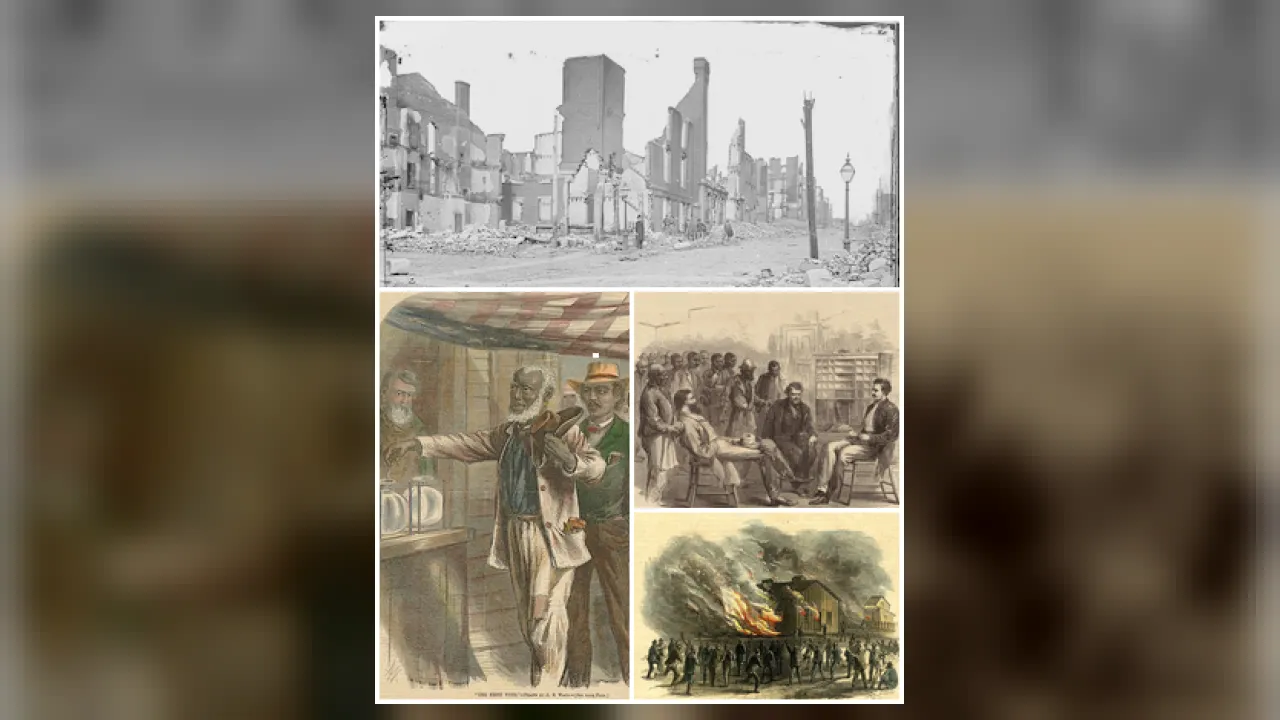
⚡ Historical SparkWrote equal citizenship and voting rights permanently into the U.S. Constitution
🤯 Mind-Blowing Fact • Grade 1
In Freedmen's schools after 1865, seventy-year-old grandparents often sat at the exact same wooden benches as six-year-old grandchildren so everyone could learn to read together!
✨ Word Sparks (Grade 1 Glossary)
Tap 🔊 to hear
reconstruction
Rebuilding and reuniting the country after war
freedmen
People newly freed from slavery after war
vote
Choosing leaders and laws in an election
🪝
How do you rebuild schools, towns, and fair rules after a big war?
1
School Bells Ring for Everyone
Scritch-scratch goes chalk on small slate boards! Kids and grandparents sit side by side learning to read! Joy fills the new wooden schoolhouse.
2
Rebuilding Together
After the Civil War ended in 1865, America entered the Era. Broken bridges, farms, and railroads needed fixing across the South.
3
Three Big Amendments
New constitutional rules ended slavery, promised equal citizenship, and protected voting rights. Millions of freed families began hopeful new lives!
1. When did the Reconstruction Era take place in American history?
2. Who eagerly attended the brand-new Freedmen's schools opened during Reconstruction?
🤯 Mind-Blowing Fact • Grade 2
Hiram Revels of Mississippi became the very first African American U.S. Senator in 1870, taking a Senate seat during Reconstruction!
✨ Word Sparks (Grade 2 Glossary)
Tap 🔊 to hear
Freedmen's Bureau
Government agency helping freed families with schools and food
public school
Community school open free to local children
citizenship
Full membership and equal rights in a country
🪝
How did Reconstruction bring the very first free public school systems to states like Virginia?
1
Healing After Appomattox
Imagine looking across Virginia and the South in spring 1865 after the Civil War ended at Appomattox Court House. Railroad tracks were twisted, farms lay empty, and four million newly freed African Americans needed food, jobs, schools, and legal protections.
2
The Freedmen's Bureau Helps Communities
Congress created the to provide medicine, reunite separated families, and open thousands of schools, including Hampton University in Virginia! Soon, Southern states wrote new constitutions creating free statewide for all children.
3
Citizenship and Voting
The Thirteenth, Fourteenth, and Fifteenth Amendments ended slavery, guaranteed equal , and protected Black men's right to vote.
1. Which government agency helped reunite families, provide medical care, and open thousands of schools after the Civil War?
2. Who became the first African American member of the United States Senate in 1870?
🤯 Mind-Blowing Fact • Grade 3
Virginia rejoined full representation in the U.S. Congress in January 1870 after ratifying the Fourteenth and Fifteenth Amendments and creating Virginia's very first statewide public school system!
✨ Word Sparks (Grade 3 Glossary)
Tap 🔊 to hear
equal protection
Rule requiring laws to treat all citizens fairly
sharecropping
Farming someone else's land in trade for crops
readmission
Allowing Southern states back into Congress
🪝
How did three landmark amendments passed in just five years rewrite the U.S. Constitution for future generations?
1
Twin Challenges of Peace
Between 1865 and 1877, the Reconstruction Era tackled two giant questions at once: how should former Confederate states rejoin Congress, and how would the nation safeguard freedom and equal rights for four million formerly enslaved citizens?
2
Three Reconstruction Amendments
Congress and the states answered with three historic additions to the Constitution. The Thirteenth Amendment (1865) abolished slavery; the Fourteenth Amendment (1868) guaranteed birthright citizenship and of the laws; and the Fifteenth Amendment (1870) stated that voting rights could not be denied because of race.
3
Schools, Churches, and New Leaders
Supported by the Freedmen's Bureau and Northern teachers, African American communities pooled pennies to build churches, schools, and colleges such as Howard University and Virginia's Hampton Institute. Across the South, voters adopted state constitutions establishing universal public education—including Virginia's 1869 constitution—and elected Black lawmakers to statehouses and Congress.
4
Challenges After 1877
Hardships like debt-heavy persisted, and after federal Reconstruction ended in 1877, unfair Jim Crow laws restricted rights until later civil rights heroes enforced those three constitutional amendments.
1. Which Reconstruction Amendment guaranteed citizenship to everyone born in the United States and promised 'equal protection of the laws'?
2. What lasting educational change did Virginia's 1869 Reconstruction state constitution create?
🤯 Mind-Blowing Fact • Grade 4
Virginia-born educator and diplomat John Mercer Langston helped found Howard University's law school during Reconstruction and later became the first African American elected to the U.S. Congress from Virginia!
✨ Word Sparks (Grade 4 Glossary)
Tap 🔊 to hear
malice
Desire to hurt or punish someone unfairly
Black Codes
Unfair postwar state rules limiting freed people's rights
Jim Crow
State laws enforcing racial segregation after Reconstruction
🪝
Why do historians call Reconstruction 'America's Second Founding'—and why did its promises take another century to fulfill completely?
1
Rebuilding From Virginia to Texas
Walk down the brick streets of Richmond or Charleston in April 1865, where burned warehouses, collapsed bridges, and worthless Confederate currency left the Southern economy in ruins. Before his assassination, Abraham Lincoln urged healing 'with toward none, with charity for all,' while Confederate General Robert E. Lee encouraged Southerners to reunite peacefully and served as president of Washington College in Lexington, Virginia. Meanwhile, Frederick Douglass insisted true peace required full constitutional citizenship and the ballot for freed African Americans.
2
Constitutional Transformation (1865–1870)
When early postwar state legislatures passed restrictive ',' Congress stepped in to direct Reconstruction. Lawmakers sustained the Freedmen's Bureau—which distributed millions of rations, oversaw labor contracts, and helped establish over 4,000 schools and historic Black colleges including Virginia's Hampton Normal and Agricultural Institute (1868). Congress also proposed the Thirteenth, Fourteenth, and Fifteenth Amendments, transforming the Constitution into a national charter of equal citizenship.
3
Civic Participation and Economic Struggles
Nearly 2,000 African Americans held local, state, and federal office during Reconstruction, including sixteen members of the U.S. Congress—and later Virginia Congressman John Mercer Langston. Yet without land ownership, many freed families and poor white farmers fell into sharecropping, borrowing seeds and tools at high interest that trapped families in debt.
4
End of Reconstruction and Constitutional Seeds
When federal troops withdrew in 1877, Southern states enacted poll taxes and segregation known as . Even so, the Fourteenth and Fifteenth Amendments remained right inside the Constitution—ready for Ruby Bridges, Jackie Robinson, and Dr. Martin Luther King Jr. to awaken in the twentieth century!
1. How did Confederate General Robert E. Lee encourage reconciliation in Virginia after the Civil War?
2. Why did sharecropping make economic independence so difficult for many postwar Southern families?
🤯 Mind-Blowing Fact • Grade 5
Ratified in 1868 during Reconstruction, the Fourteenth Amendment directly overturned the Supreme Court's 1857 Dred Scott decision and is today cited in more Supreme Court cases than any other amendment in the Constitution!
✨ Word Sparks (Grade 5 Glossary)
Tap 🔊 to hear
suffrage
The legal right to vote in elections
birthright citizenship
Automatic citizenship for anyone born in the country
disenfranchised
Unfairly deprived of the legal right to vote
🪝
How did twelve turbulent years between 1865 and 1877 forge the constitutional amendments that underpin modern American civil rights law?
1
Presidential Visions and Voices of Reconciliation
In his March 1865 Second Inaugural Address, President Abraham Lincoln envisioned national restoration 'with malice toward none; with charity for all,' prioritizing swift reunion over punitive retribution—a spirit echoed after Appomattox when Robert E. Lee urged former Confederates to accept peace loyally and assumed the presidency of Washington College in Virginia. Simultaneously, abolitionist statesman Frederick Douglass championed full civic equality, warning that emancipation without the ballot and equal legal standing would leave four million freedpeople vulnerable. Lincoln's assassination in April 1865 elevated Vice President Andrew Johnson, whose lenient policies collided with Southern 'Black Codes' restricting freedpeople's movement, property, and courtroom testimony.
2
Congressional Reconstruction and the Three Amendments
Asserting legislative authority in 1866–1867, Congress passed the Civil Rights Act of 1866 over Johnson's veto, extended the Bureau of Refugees, Freedmen, and Abandoned Lands (the Freedmen's Bureau), and enacted the Reconstruction Acts requiring new state constitutions with universal male . Permanently restructuring American federalism, three Reconstruction Amendments entered the Constitution: the Thirteenth (1865) abolishing slavery; the Fourteenth (1868) overturning the 1857 Dred Scott ruling by establishing , due process, and equal protection of the laws against state infringement; and the Fifteenth (1870) barring racial discrimination in voting.
3
Schools, Universities, and Multiracial Democracy
Across the South, freed African Americans placed literacy and institutional autonomy first—pooling scarce wages alongside Freedmen's Bureau aid and philanthropic societies to build over 4,000 elementary schools and enduring Historically Black Colleges and Universities, including Howard University (1867), Fisk University (1866), and Virginia's Hampton Institute (1868). Constitutional conventions—such as Virginia's 1867–1868 Underwood Convention, featuring twenty-four Black delegates—mandated the South's first universal tax-supported public school systems, paving the way for Virginia's January 1870 readmission to Congress while sixteen Black congressmen, including U.S. Senators Hiram Revels and Blanche K. Bruce, served on Capitol Hill.
4
Sharecropping and the Compromise of 1877
Lacking widespread land redistribution, devastated Southern agriculture settled into sharecropping and crop-lien credit systems that bound Black and landless white tenant families in chronic debt. Economic depression after the Panic of 1873, violent intimidation against Black voters, and waning federal enforcement culminated in the disputed 1876 presidential election and the Compromise of 1877, withdrawing the last federal Reconstruction troops.
5
Dormant Amendments Awakened
Although Redeemer state governments soon imposed poll taxes, literacy tests, and Jim Crow segregation that Black Southerners for decades, Reconstruction's constitutional architecture endured intact—providing the exact Fourteenth and Fifteenth Amendment foundations for Brown v. Board of Education (1954), the Civil Rights Act of 1964, and the Voting Rights Act of 1965.