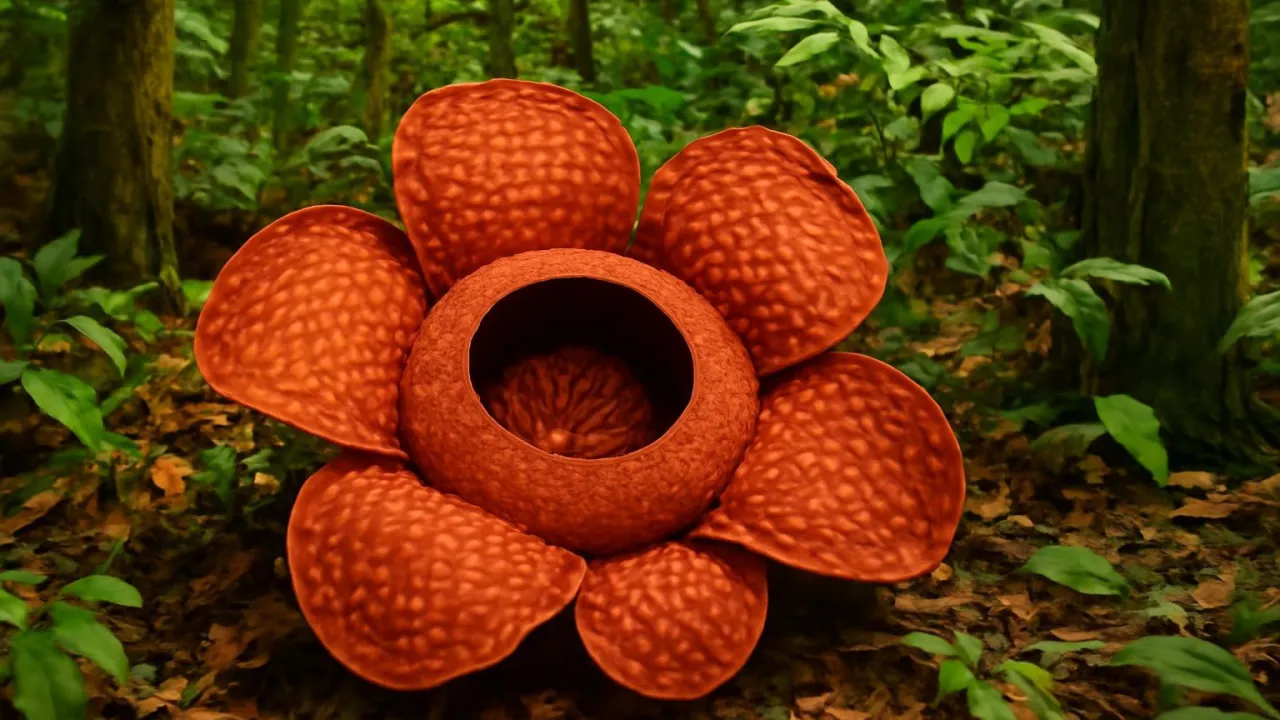
Rafflesia can grow as wide as a small child is tall!
✨ Word Sparks (Grade 2 Glossary)
Tap 🔊 to hear
pollinate
When bugs help flowers make seeds
parasite
A plant that lives on another plant
tropical
Warm and rainy places near the equator
🪝
Have you ever smelled a flower that smells like rotten meat?
1
A Giant Smelly Flower
Rafflesia is the largest flower in the world and smells like rotten meat. It uses this smell to attract flies and bugs that help it . The flower can grow up to three feet wide and has five thick, red petals.
2
No Leaves or Roots
This flower does not have leaves or roots like other plants. Instead, it lives inside a vine and takes nutrients from it. It is a because it depends on another plant to survive and grow.
3
Where It Grows
Rafflesia grows in rainforests in Southeast Asia. It likes dark and humid places where vines grow thick. The flower blooms for only a few days before it starts to fade away.
Rafflesia’s huge flower can weigh up to 15 pounds, making it a giant in the plant world!
✨ Word Sparks (Grade 3 Glossary)
Tap 🔊 to hear
camouflage
Colors or patterns that help hide something
pollination
When insects help flowers make seeds
parasite
A plant that lives on and takes from others
🪝
Did you know the rafflesia flower is both huge and smells like rotting meat?
1
The Largest Flower
Rafflesia arnoldii produces the largest single flower on Earth, growing up to three feet wide. Its petals are thick and reddish with white spots that help it blend into the forest floor. This helps protect it from predators while it blooms. The flower’s size is an adaptation for attracting pollinators.
2
A Smelly Survival Trick
Rafflesia emits a strong odor like rotting meat to attract flies and beetles for . This smell tricks the insects into thinking they found food or a place to lay eggs. The flower’s scent is a clever adaptation that solves the problem of attracting pollinators in dense forests. Without insects, the flower cannot reproduce.
3
A Parasitic Lifestyle
Unlike most plants, rafflesia has no leaves, stems, or roots and cannot photosynthesize. It lives as a inside the roots of a host vine called Tetrastigma. This vine provides water and nutrients, which rafflesia absorbs through special structures. This adaptation allows rafflesia to survive in the dark rainforest understory.
4
Where It Lives
Rafflesia is found in tropical rainforests of Southeast Asia, especially Indonesia and Malaysia. It grows in humid, shaded areas where its host vines thrive. The flower blooms for only a few days before wilting, so spotting it in the wild is rare and special.
2. Why can rafflesia survive without leaves or roots?
🤯 Mind-Blowing Fact • Grade 4
Rafflesia’s giant flower can weigh as much as a small dog and smells like decaying meat!
✨ Word Sparks (Grade 4 Glossary)
Tap 🔊 to hear
parasitic
Living on another plant and taking nutrients
ecosystem
All plants and animals living together
deforestation
Cutting down many trees in forests
🪝
What makes the rafflesia flower a unique giant in tropical rainforests?
1
Gigantic Flower and Its Role
Rafflesia arnoldii produces the largest single flower on Earth, growing up to one meter wide and weighing about 15 pounds. This enormous flower plays a key role in its by attracting carrion flies with its strong odor, which helps pollinate the species. Its size and smell are adaptations that evolved to solve the problem of attracting pollinators in dense rainforest environments. Without these traits, the flower would struggle to reproduce.
2
Parasitic Relationship with Host Vines
Unlike most plants, rafflesia lacks leaves, stems, and roots, making it fully on the Tetrastigma vine. It extracts water and nutrients through specialized structures embedded in the vine’s tissue, which allows it to survive without photosynthesis. This relationship impacts the host vine by drawing resources, but the vine generally survives. This parasitism is a unique adaptation that enables rafflesia to thrive in shaded forest understories.
3
Geographic Distribution and Habitat
Rafflesia is native to tropical rainforests of Southeast Asia, primarily in Indonesia, Malaysia, and the Philippines. It grows in humid, shaded environments where its host vines flourish. The flower blooms rarely and only for a few days, making it difficult for scientists and tourists to observe. Its limited distribution and specialized habitat make it vulnerable to .
4
Ecosystem Role and Human Impact
As a rare and unusual flower, rafflesia contributes to rainforest biodiversity by supporting carrion fly populations. However, habitat loss due to logging and land conversion threatens its survival. Conservation efforts focus on protecting rainforest habitats and educating people about this unique flower. Humans also study rafflesia to understand parasitic plant adaptations and rainforest ecology better.
Rafflesia arnoldii’s flower can weigh as much as a large cat and smells like rotting meat to attract pollinators!
✨ Word Sparks (Grade 5 Glossary)
Tap 🔊 to hear
haustoria
Special parts that connect parasite to host plant
holoparasite
A plant that fully depends on another plant
volatile
A smelly gas that spreads in the air
🪝
How does Rafflesia arnoldii’s unique biology make it a marvel of tropical parasitic plants?
1
Taxonomy and Scientific Context
Rafflesia arnoldii belongs to the genus Rafflesia in the family Rafflesiaceae, known for producing the largest flowers on Earth. This genus is part of the order Malpighiales, which includes many parasitic plants. Unlike typical flowering plants, rafflesia lacks leaves, stems, and roots, making it a that relies entirely on its host for survival. Its discovery in the early 19th century fascinated botanists due to its unusual size and parasitic lifestyle.
2
Physiological Mechanics and Adaptations
Rafflesia obtains nutrients and water by penetrating the vascular tissues of its host vine, Tetrastigma, through specialized . It does not perform photosynthesis because it lacks chlorophyll and traditional plant organs. Its massive flower, which can be up to one meter wide and weigh 11 to 15 pounds, emits sulfur compounds that mimic the smell of decaying flesh to attract carrion flies for pollination. This chemical mimicry is a sophisticated adaptation to its shaded rainforest environment.
3
Conservation and Botanical History
Rafflesia arnoldii is considered vulnerable due to habitat destruction caused by deforestation and human activity in Southeast Asia. Conservation programs focus on protecting its host vines and rainforest habitat to ensure the species’ survival. Historically, the flower was first documented by British naturalists Sir Stamford Raffles and Dr. Joseph Arnold in 1818, highlighting its importance in botanical exploration and tropical biodiversity studies.
4
Quantitative Comparisons and Physical Traits
The rafflesia flower can reach diameters of up to 39 inches (1 meter) and weigh as much as 15 pounds (7 kilograms), making it the largest single flower globally. Its odor intensity is comparable to that of decomposing animal carcasses, which can be detected from several meters away. The flower blooms for only 5 to 7 days before decaying, a short lifespan compared to many other plants. This brief bloom period aligns with the activity patterns of its carrion fly pollinators.
5
Ecological Importance and Human Impact
Rafflesia contributes to rainforest ecosystems by supporting specialized carrion fly populations and adding to biodiversity. Its parasitic relationship with Tetrastigma vines demonstrates complex ecological interactions in tropical forests. However, habitat fragmentation and illegal collection threaten its populations. Ongoing research aims to better understand its reproductive biology and develop conservation strategies to protect this botanical marvel amid increasing human pressures.