🧬 HUMAN BODY
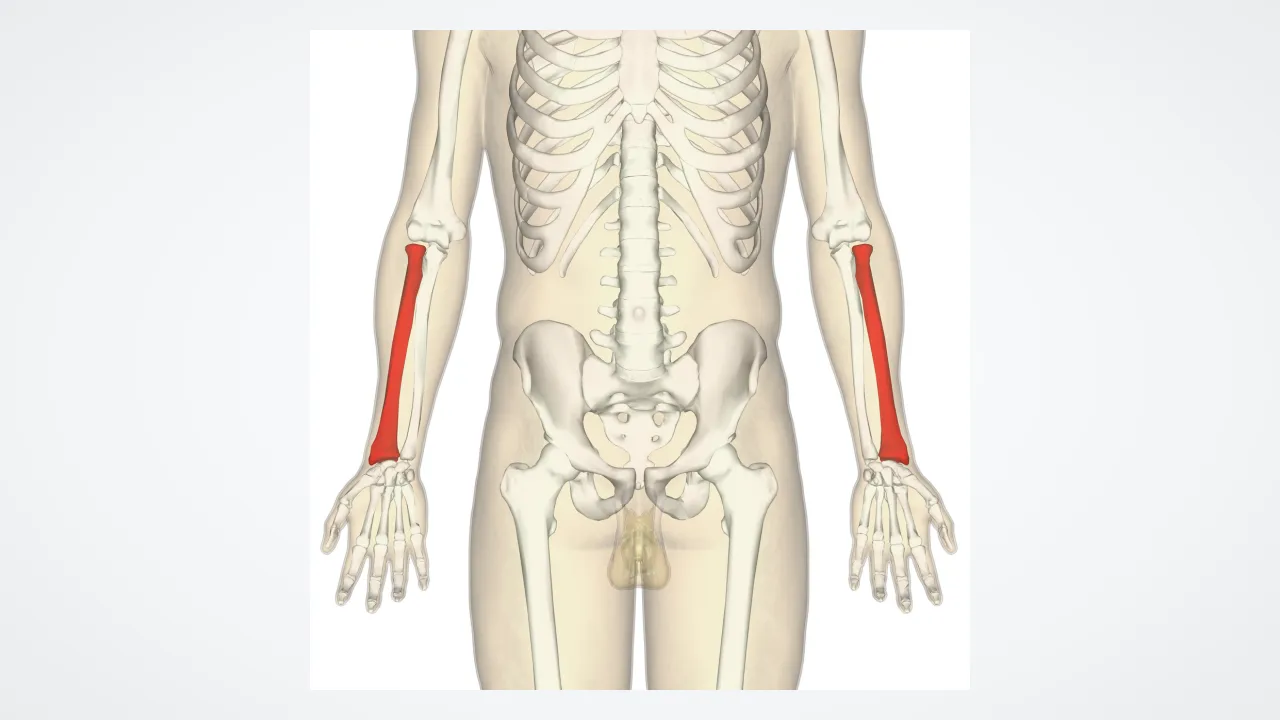
🧬 Radius & Ulna • Appendicular Skeletal System (Forearm)
VA Science & Health SOL 1.1, 3.1, 4.2, 5.1 (Cells, Organs & Body Systems)
Radius & Ulna
Twin Forearm Partners That Twist Your Hands
Grade 4 • Expanding • 212 words
🩺 Body System & LocationForearm (Antebrachium) • Bridging Elbow Joint to Wrist
🔬 Size / Cell CountPaired 9.5–11 in (24–28 cm) long bones • Linked by a tough fiber sheet
⚙️ Core JobUlna forms the sturdy elbow hinge while Radius flips over it to rotate your palm
⚡ Body SuperpowerCrisscrossing into an X lets you turn doorknobs, use spoons, and write!
🤯 Mind-Blowing Fact • Grade 1
If you only had one bone in your lower arm instead of two, you could never turn a doorknob or scoop soup with a spoon without swinging your whole shoulder!
✨ Word Sparks (Grade 1 Glossary)
Tap 🔊 to hear
Radius
Thumb-side forearm bone that rolls and flips
Ulna
Pinky-side forearm bone forming pointy elbow
Forearm
Lower arm section between elbow and wrist
🪝
Hold your hand flat, then flip it palm-up and palm-down—how did your arm just twist?
1
Two Bones Are Better Than One!
Pinch your lower arm between your elbow and your wrist! Hidden inside sit two buddy bones side by side—not just one! Their names are the and the .
2
Thumb Side and Pinky Side
Hold your palm up like catching raindrops! Your runs straight along your thumb side. Your runs straight along your pinky-finger side.
3
Making a Cool Letter X!
Now flip your palm face down! Inside your arm, your just rolled right across your like the letter X!
1. Which finger side does your radius bone line up with?
2. What cool shape do your radius and ulna make inside your forearm when you flip your palm face down?
🤯 Mind-Blowing Fact • Grade 2
When a doctor or nurse checks your pulse on your thumb-side wrist, they are gently pressing your radial artery right against your radius bone!
✨ Word Sparks (Grade 2 Glossary)
Tap 🔊 to hear
Pivot
Spin smoothly around a central point
Pulse
Rhythmic beat felt in wrist blood vessels
Wrench
Curved C-shaped grip fitting around a bar
🪝
Touch the pointy tip at the back of your bent elbow—did you know that belongs to your pinky-side bone?
1
Opposite Twins!
Imagine two best friends who swap jobs from top to bottom! At your elbow, the ulna is thick and big—its curved C-shaped hooks onto your upper arm bone and forms the hard, pointy tip of your elbow. Down at your wrist, however, the ulna narrows to a tiny bump!
2
The Rolling Radius
Meanwhile, your radius starts small like a flat coin up at the elbow and grows wide at the bottom to carry your wrist and hand! Because its top looks like a little wheel, the radius spins smoothly.
3
Thumbs-Up Memory Trick
Give a big 'RAD' thumbs-up anytime to remember that the radius is ALWAYS on your thumb side!
1. Which forearm bone forms the hard, pointy tip at the back of your elbow?
2. Which forearm bone grows wide at the bottom to carry most of your wrist joint?
🤯 Mind-Blowing Fact • Grade 3
Before metal rulers were invented, people measured cloth using a 'cubit'—the exact length of an adult ulna from the pointy elbow tip to the fingertip!
✨ Word Sparks (Grade 3 Glossary)
Tap 🔊 to hear
Supination
Turning forearm so palm faces upward ('soup!')
Pronation
Crossing radius over ulna turning palm downward
Cubit
Ancient measurement based on forearm bone length
🪝
What does holding a bowl of soup have to do with how scientists name your forearm's flipping motions?
1
Supination: Holding a Bowl of Soup!
Doctors have two fun words for flipping your forearm, and an easy soup trick makes them impossible to forget! When you turn your palm face UP—like cupping your hands to hold a warm bowl of SOUP—that motion is called '.' During supination, your radius and ulna lie side by side like straight railroad tracks.
2
Pronation: Pouring the Soup Out!
Flip your palm face DOWN—as if pouring soup onto the floor or dribbling a basketball—and that motion is called '.' Notice your pointy elbow doesn't spin at all! Instead, your ulna stays rock-steady while the wheel-shaped head of the radius pivots inside a ring ligament and crosses diagonally over the ulna.
3
Why Is It Named 'Radius'?
Just like the radius of a circle in math class—or a spoke spinning around a bicycle wheel hub—the radius bone swings in a smooth arc around the steady ulna!
4
Linked Down the Middle
Stretched between both bones runs a super-tough sheet of fibers that shares lifting forces evenly between the twins.
1. How are your radius and ulna arranged when you 'supinate' your hand to hold an imaginary bowl of soup?
2. Why is the thumb-side forearm bone named 'radius,' like the radius of a circle?
🤯 Mind-Blowing Fact • Grade 4
Horses, deer, and frogs have fused forearm bones locked permanently 'palm-down' for running and jumping—while cats, raccoons, and primates kept separate spinning bones to climb and grasp!
✨ Word Sparks (Grade 4 Glossary)
Tap 🔊 to hear
Interosseous
Tough fibrous membrane linking two neighboring bones
Annular
Ring-shaped ligament holding radial head spinning smoothly
Styloid
Small pointed wrist bumps stabilizing side motion
🪝
If you catch yourself on an outstretched hand during a skateboard tumble, how does a hidden fiber sheet transfer force from your radius to your ulna?
1
Handoff Along the Interosseous Membrane
Trace what happens mechanically when you do a handstand on a gym mat! About 80 percent of the force from your hand enters the wide lower end of your radius at the wrist—yet up at the elbow, it is the ulna's deep trochlear notch that forms the main weight-bearing hinge with the humerus! How does force jump from one bone to its neighbor mid-arm? Stretched diagonally between the two shafts is a tough collagen sheet called the membrane. Angled downward from radius to ulna, its fibers transfer pushing forces smoothly across to the ulna before reaching the elbow!
2
Twin Pivot Rings: Proximal and Distal
Turning a screwdriver requires two separate pivot joints—the proximal and distal radioulnar joints—working simultaneously! Up at the elbow, a circular collar called the ligament straps the disc-shaped radial head against the ulna so it spins like an axle in a bearing. Down at the wrist, the wide radius swings around the stationary round head of the ulna.
3
Why Dogs and Horses Can't Turn Doorknobs
In running mammals like horses, cows, and frogs, the radius and ulna fuse partially or completely together into a rigid, non-twisting column locked permanently palm-down (pronated) for sprinting stability!
4
Styloid Bump Guards at Your Wrist
Feel both sides of your wrist: those two little bony bumps are the radial and ulnar processes, stabilizing your wrist from slipping sideways.
1. How do forces pushing up into your wrist during a handstand travel safely up to the strong ulna-humerus elbow hinge?
2. Why can't a horse flip its front hooves 'palm up' like a human or raccoon?
🤯 Mind-Blowing Fact • Grade 5
Screwdrivers and jar lids tighten clockwise specifically because right-handed people use their super-strong biceps muscle to supinate (twist outward clockwise) with far greater torque than pronating!
✨ Word Sparks (Grade 5 Glossary)
Tap 🔊 to hear
Antebrachium
Anatomical region of forearm from elbow to wrist
Carpals
Eight small pebble-like bones building human wrist
Greenstick
Bendy childhood bone crack like young twig
🪝
How do three synchronized synovial joints, an oblique diagonal axis, and a bowing radial shaft achieve 180 degrees of effortless hand rotation?
1
Reciprocal Osteology of the Antebrachium
Forming the twin osseous framework of the forearm (), the lateral radius and medial ulna exhibit striking reciprocal symmetry: the ulna is massive proximally—where its C-shaped trochlear notch (bounded by the posterior olecranon and anterior coronoid process) locks onto the humeral trochlea—and tapers distally, whereas the radius starts as a slender cylindrical disc proximally and flares distally into a broad concave platform articulating directly with the scaphoid and lunate carpal bones.
2
Kinematics of the Oblique Rotational Axis
Pronation and supination span roughly 150 to 180 degrees along a mechanical axis passing diagonally from the center of the proximal radial head to the distal fovea of the ulnar head! Proximally, at the proximal radioulnar joint (PRUJ), the hyaline-rimmed radial head spins within an osteofibrous ring formed by the radial notch of the ulna and the strong annular ligament. Distally, at the distal radioulnar joint (DRUJ), the ulnar notch of the radius sweeps in an arc around the stationary ulnar head, cushioned from the wrist by the triangular fibrocartilage complex (TFCC).
3
Why the Radial Shaft Curves Outward
Notice that a healthy radial shaft is not ruler-straight—it features a deliberate ~10-degree lateral 'pronator bow'! If the radius were completely straight, crossing over the ulna during pronation would cause the two bones to collide mid-shaft and pinch deep flexor tendons and arteries; that gentle outward bow lets the radius vault cleanly across the ulna without bone-on-bone clash!
4
Muscular Motors and the Interosseous Membrane
Four dedicated muscles drive rotation: biceps brachii (the powerhouse supinator when the elbow is flexed—explaining why right-handed people drive screws clockwise!) and deep supinator turn the palm up, while pronator teres and pronator quadratus turn the palm down. Between the shafts, the central band of the interosseous membrane behaves like an isometric ligament, transmitting ~80 percent of radiocarpal load proximally to the ulnohumeral hinge.
5
Pediatric Buckle Physics
Because growing pediatric periosteum is thick and collagen-rich, childhood forearm tumbles often produce minor 'torus' (buckle) or '' bends that remodel rapidly back to full alignment.