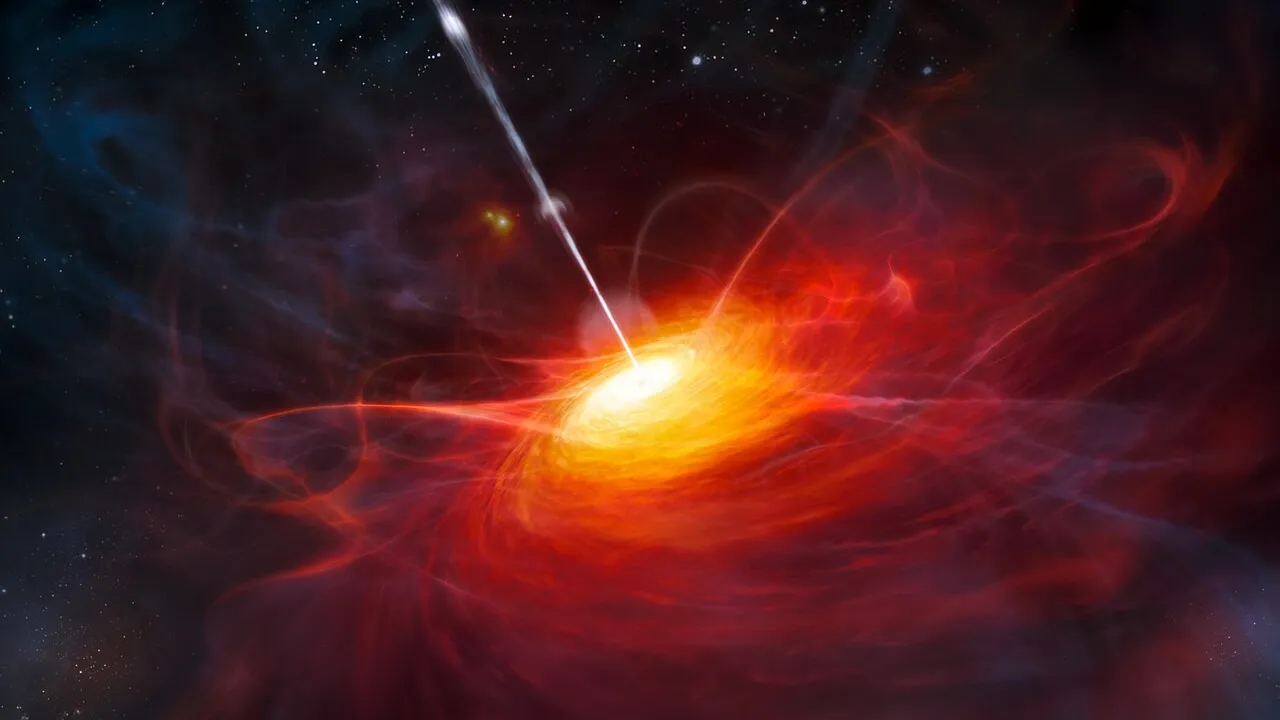
1. Where does a quasar's blinding light actually come from?
2. How far away from Earth do quasars live?
🤯 Mind-Blowing Fact • Grade 2
One hungry quasar named J0529-4351 gobbles up an entire Sun's worth of gas every single day—shining 500 trillion times brighter than our Sun!
✨ Word Sparks (Grade 2 Glossary)
Tap 🔊 to hear
quasi-stellar
Looking like a pinpoint star through telescopes
supermassive
Weighing millions or billions of Suns
friction
Heat made when things rub fast together
🪝
Why did astronomers mistake the brightest powerhouses in space for ordinary nearby stars?
1
Looking Like a Single Star
In the 1950s, radio telescopes heard booming radio signals coming from what looked like faint blue stars! Scientists named them '' objects—shortened to quasars—meaning 'star-like.' Then in 1963, astronomer Maarten Schmidt cracked their light code: they were billions of light-years away!
2
Messy Eaters!
To look like a star from billions of light-years away, a quasar must outshine hundreds of entire galaxies combined! At the center of a young galaxy, a black hole pulls in gas so fast that a glowing traffic jam forms outside.
3
Twin Cosmic Jets
Twisted magnets launch twin beams of plasma from the poles, blasting thousands of light-years into deep space!
2. What shoots out from the north and south poles of many quasars?
🤯 Mind-Blowing Fact • Grade 3
In about 4.5 billion years, when our Milky Way collides with the Andromeda Galaxy, fresh gas funneling inward could briefly wake our central black hole up as a real quasar!
✨ Word Sparks (Grade 3 Glossary)
Tap 🔊 to hear
Sagittarius A*
Quiet supermassive black hole in our galaxy
3C 273
Closest bright quasar discovered in 1963
beacon
Bright distant light seen from far away
🪝
Why isn't the giant black hole at the center of our own Milky Way shining as a quasar right now?
1
Maarten Schmidt's Big Surprise
In 1963, astronomer Maarten Schmidt stared at weird rainbow lines from an object called . Suddenly he gasped—they were ordinary hydrogen lines stretched way toward the red end by cosmic expansion! 3C 273 sat 2.4 billion light-years away, yet amateur telescopes in backyards can still spot its tiny point of light!
2
Solar-System Size, Hundred-Galaxy Glow
How can so much light pour from one galaxy core? Gravity around a billion-Sun black hole whips an accretion disk of gas to nearly half the speed of light! Friction heats that Solar-System-sized pancake to millions of degrees, outshining every star in its galaxy combined.
3
Why Our Milky Way Is Quiet
Our Milky Way has its own supermassive black hole (Sagittarius A*), weighing four million Suns. Why isn't it a blazing quasar? Because it ran out of big gas clouds to eat—today it is on a quiet cosmic diet!
4
Time-Machine Beacons
Because light takes billions of years to travel here, looking at quasars lets us see galaxies back when the universe was young and gas-rich!
1. Why isn't the Milky Way's central black hole shining like a bright quasar today?
2. About how wide is the glowing accretion disk that powers a typical quasar?
🤯 Mind-Blowing Fact • Grade 4
Gravity around a spinning black hole converts up to 30–42% of falling matter's mass into pure light energy—over forty times more efficient than nuclear fusion inside the Sun!
✨ Word Sparks (Grade 4 Glossary)
Tap 🔊 to hear
event horizon
Point of no return around black holes
blazar
Quasar aiming its relativistic jet straight at Earth
cosmic web
Filament network of gas and galaxies in space
🪝
Why is dropping gas toward a black hole thirty times better at making energy than nuclear fusion inside stars?
1
Gravity Beats Nuclear Fusion!
Stars shine by fusing hydrogen into helium, converting just 0.7 percent of their fuel's mass into pure energy ($E = mc^2$). Swirling matter down into a spinning black hole's accretion disk converts 10 to over 30 percent of its mass into blinding radiation before crossing the ! That unrivaled gravitational efficiency makes quasars the brightest persistent beacons in the cosmos.
2
Blazars: Staring Straight Down the Jet
Frame-dragging around a spinning supermassive black hole twists magnetic fields into tight coils, blasting relativistic jets of electrons and protons thousands of light-years into intergalactic space. When a quasar's jet happens to aim straight at Earth like a flashlight beam, astronomers call it a ''!
3
Sculpting Whole Galaxies
Fierce quasar radiation pressure and million-mile-per-hour plasma winds don't merely illuminate deep space—they sweep cold molecular star-forming gas clean out of their host galaxies! Astrophysicists call this self-regulating mechanism 'quasar feedback,' solving why giant elliptical galaxies stopped birthing new stars and why heavier galactic bulges always host proportionally heavier central black holes.
4
Backlighting the Cosmic Web
Much like distant car headlights illuminating thin wisps of fog across a dark highway, brilliant quasar beams pierce billions of light-years of intergalactic space. Every invisible cloud of hydrogen gas along the path absorbs a tiny slice of light at its own redshift, letting astronomers map the shadowy connecting galaxies across time!
1. How much mass can a spinning black hole's accretion disk turn into light compared to star fusion (0.7%)?
2. How can an overly energetic quasar actually STOP new stars from forming in its own galaxy?
🤯 Mind-Blowing Fact • Grade 5
Earth's global coordinate frame—used by GPS satellites and VLBI radio dishes to track continental drift down to millimeters—anchors itself against hundreds of fixed, ultra-distant quasars across the sky!
✨ Word Sparks (Grade 5 Glossary)
Tap 🔊 to hear
Eddington limit
Maximum brightness before radiation pushes gas away
Einstein Cross
Four mirrored quasar images bent by galaxy gravity
Lyman-alpha forest
Barcode of cosmic hydrogen clouds in quasar spectra
🪝
How could monster billion-solar-mass quasars already blaze brightly less than 600 million years after the Big Bang?
1
Cracking 3C 273 and the AGN Unified Model
Following Cyril Hazard's lunar-occultation pinpoint of radio source 3C 273 at Parkes Observatory, Maarten Schmidt recognized in 1963 that its mysterious emission lines were Balmer hydrogen transitions redshifted by $z = 0.158$—receding at $47,000 \text{ km/s}$! Theorists Edwin Salpeter, Yakov Zel'dovich, and Donald Lynden-Bell deduced that only viscous magnetorotational accretion onto supermassive black holes ($10^6\text{–}10^{10} M_\odot$) inside a compact light-days-wide disk could sustain $10^{40}$ watts. Today's Unified AGN Model recognizes radio galaxies, Seyfert galaxies, quasars, and blazars as identical engines viewed from different inclination angles relative to a dusty torus.
2
The Eddington Limit and Blandford-Znajek Jets
Outward radiation pressure on infalling electrons balances inward gravity at the 'Eddington luminosity,' naturally capping how fast black holes feed. Meanwhile, relativistic frame-dragging inside a rotating Kerr black hole's ergosphere winds poloidal magnetic fields via the Blandford-Znajek mechanism, extracting rotational spin energy to launch collimated synchrotron jets at $99.9\%$ light speed.
3
Lyman-Alpha Forests and Cosmic Reionization
High-redshift quasar spectra display dense ''—hundreds of narrow ultraviolet hydrogen absorption lines stamped at progressive redshifts along the line of sight—mapping the three-dimensional clumping of intergalactic dark-matter filaments and pinpointing when ultraviolet starlight finished reionizing neutral cosmic hydrogen roughly one billion years after the Big Bang.
4
JWST and Early Supermassive Seeds
Observing luminous quasars such as J0313-1806 and X-ray-bright UHZ1 past redshift $z > 7.5$—when the universe was less than 670 million years old—with the James Webb Space Telescope challenges Eddington-limited growth from ordinary 20-solar-mass stellar remnants, pointing strongly toward heavy 10,000-to-100,000-solar-mass 'direct-collapse black hole' seeds forged directly from primordial gas clouds!
5
Gravitational Lensing Einstein Crosses
When a massive foreground galaxy aligns squarely in front of a background quasar, gravitational lensing splits the quasar into four mirrored points called an ''; timing brightness flickers arriving days apart across each bent path measures cosmic expansion and maps invisible dark matter halos.