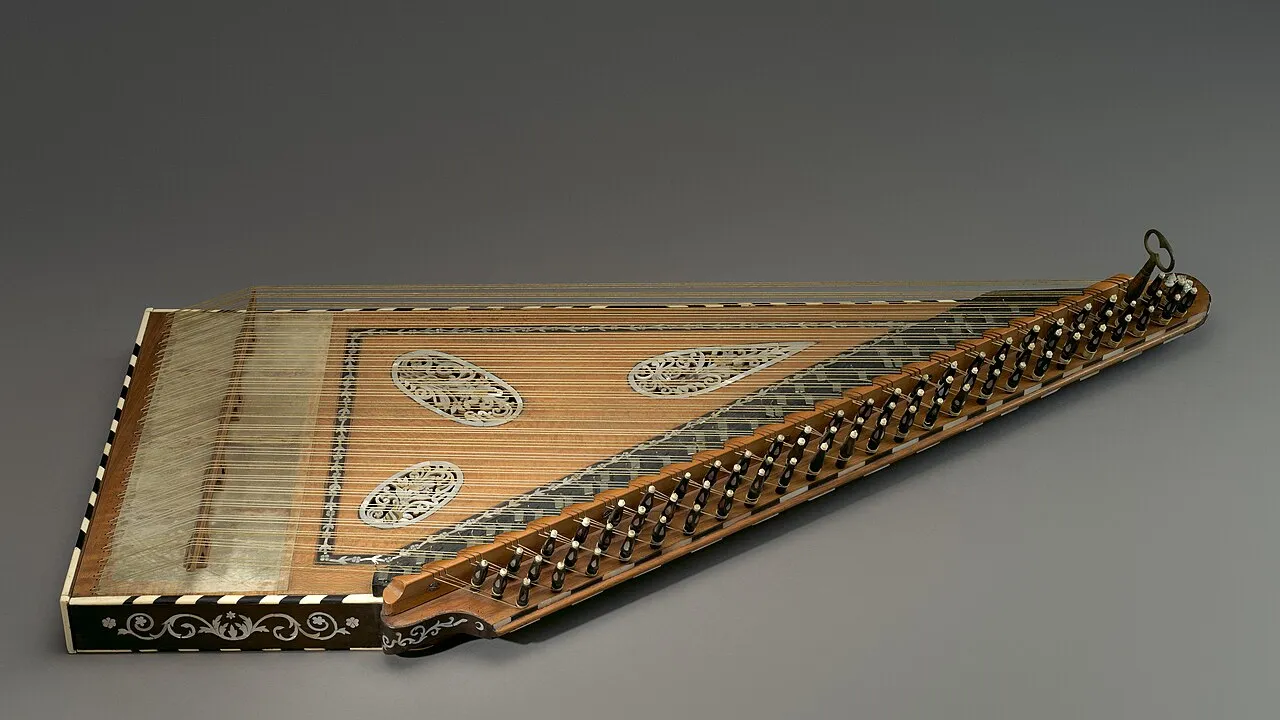
🔊 How Sound Is MadeRing-held finger picks pluck triple-string courses over a skin-mounted bridge
⚡ Signature Sound SparkFlips tiny brass levers mid-song to unlock quarter-tone notes between piano keys
🤯 Mind-Blowing Fact • Grade 1
A single qanun has up to seventy-eight strings grouped in neat sets of three!
✨ Word Sparks (Grade 1 Glossary)
Tap 🔊 to hear
zither
A flat wooden instrument with many stretched strings.
pluck
To pull and let go of a string.
lever
A tiny metal switch that flips up or down.
🪝
How can one flat wooden box hold seventy-eight singing strings?
1
Shimmering Silver Rain
Plink, ripple, ring! What makes that bright, sparkling sound? Meet the qanun, a flat wooden harp from the Middle East. Many shiny strings stretch across its wide board.
2
Rings on Two Fingers
A player rests the box flat on their lap. Flat picks slip under metal rings on two fingers. Fast make the strings dance and sing.
3
Tiny Gold Switches
Look at the tiny brass on one side! Flipping a lever changes a note right away. One instrument can play sunny or dreamy songs.
1. Where does a musician usually hold the qanun while playing?
2. What do the tiny brass levers on the side of a qanun do?
🤯 Mind-Blowing Fact • Grade 2
The word qanun comes from an ancient word meaning law, because it sets the tuning rules for the whole band!
✨ Word Sparks (Grade 2 Glossary)
Tap 🔊 to hear
vibration
A fast back-and-forth shake that makes sound.
bridge
A wooden strip that holds strings up high.
mandal
A small brass lever that changes string pitch.
🪝
Why does this instrument hide miniature drumheads underneath its wooden bridge?
1
A Waterfall of Strings
Close your eyes and listen to seventy-eight strings ripple like sunlight dancing on water! Across the Middle East, Turkey, and North Africa, musicians rest the qanun across their laps. Its flat wooden body looks like a sleek, four-sided wing.
2
Bridges Built on Stretched Skin
Strings line up in teams of three so every single note rings out loud and clear. All those strings cross one long wooden standing on small windows of tight fish skin, and bounce warmly inside the hollow box.
3
Flipping Levers Mid-Song
Players wear silver rings that hold flat picks on both pointer fingers. Along the left edge sit rows of tiny brass levers called , and one quick flick shifts a string's pitch without ever stopping the song!
1. How are the strings arranged across the top of a classic qanun?
2. What sits directly underneath the feet of the qanun's wooden bridge?
🤯 Mind-Blowing Fact • Grade 3
A Turkish kanun can feature more than one hundred tiny brass mandal levers lined up like miniature golden dominoes!
✨ Word Sparks (Grade 3 Glossary)
Tap 🔊 to hear
resonance
Rich, echoing sound amplified inside a hollow space.
plectrum
A flat pick used to pluck instrument strings.
microtone
A tiny pitch step smaller than piano keys.
🪝
How can a musician play secret notes tucked right between the keys of a piano?
1
The Lawmaker of Melody
Shimmering cascades of notes tumble across a quiet courtyard like silver raindrops! For centuries across Arab, Turkish, and Armenian traditions, the qanun has guided ensembles with dazzling clarity. Its name comes from an ancient Greek and Arabic word meaning law, because its steady strings set the exact pitch rule for every singer and player nearby.
2
Seventy-Eight Strings in Harmony
Crafted as a flat trapezoidal zither from walnut, maple, or sycamore wood, a classic qanun carries twenty-six courses of three strings each. Plucking three matching strings together with finger-ring plectra creates bright that fills an entire hall.
3
Skin Windows and Sound Waves
Instead of resting only on solid wood, the long bridge stands on four or five translucent patches of fish skin or synthetic film. When plucked strings vibrate, energy travels down the bridge feet, pumps the tight skin windows, and blooms inside the hollow soundbox.
4
Microtonal Magic Levers
Beside the tuning pegs gleam dozens of tiny brass levers called mandals. By flicking these levers up or down mid-melody, a player slightly changes a string's speaking length to unlock —expressive quarter-tone notes hidden right between standard piano keys!
1. Why is this zither named after an ancient word meaning 'law' or 'rule'?
2. What happens acoustically when a player flips a brass mandal lever upward?
🤯 Mind-Blowing Fact • Grade 4
Before nylon strings were invented in the twentieth century, qanun strings were spun from twisted lamb gut and plucked with tortoise-shell picks!
✨ Word Sparks (Grade 4 Glossary)
Tap 🔊 to hear
trapezoidal
Four-sided with one pair of parallel edges.
glissando
A rapid, smooth glide across many strings.
maqam
A traditional Middle Eastern system of melodic scales.
🪝
What happens when carpentry, drum-skin physics, and tiny brass levers unite inside one ancient zither?
1
Unlocking the Spaces Between Notes
What would happen if you peered between two neighboring keys on a grand piano and discovered whole worlds of hidden melody waiting inside the gap? Step onto a concert stage in Cairo, Damascus, or Istanbul, where a virtuoso sweeps two ringed index fingers across the gleaming strings of a qanun. Instantly, seventy-eight nylon strings shimmer like sunlit fountains, anchoring classical ensembles with bell-like precision.
2
Trapezoidal Geometry and Triple Courses
Classified by musical scholars as a plucked box zither, the qanun owes its generous three-and-a-half-octave span to smart geometry. Long bass strings stretch parallel to the wide bottom edge, while progressively shorter treble strings angle toward the narrow upper rim. Grouping twenty-six courses into trios of unison strings ensures that every rapid trill or sweeping projects clearly over flutes, fiddles, and percussion.
3
How Fish-Skin Membranes Shape Timbre
Peer beneath the single long hardwood bridge on the right side and you will spot rectangular cutouts covered in taut fish skin or translucent synthetic parchment called rakma. Because thin skin flexes far more easily than rigid timber, string vibrations plunge down the bridge's five narrow feet to pump those miniature membranes like tiny drumheads, giving the qanun its unmistakable crisp, silvery snap.
4
Mastering Maqam Scales with Mandal Levers
Classical Middle Eastern music explores melodic modes called maqamat, which rely on expressive quarter-tone intervals smaller than a Western half step. Before Turkish makers introduced hinged brass mandal levers in the late nineteenth century, players had to press strings manually with a left thumbnail to bend pitches. Today, flicking levers mid-phrase lets musicians modulate seamlessly between dozens of intricate scales.
1. Why does the qanun have a four-sided trapezoidal body instead of a square one?
2. How did qanun musicians play microtones before brass mandal levers were added in the late 1800s?
🤯 Mind-Blowing Fact • Grade 5
On classical Turkish kanuns, up to twelve miniature mandal levers per string course allow musicians to divide a single whole-step interval into tiny pitch shadings called commas!
✨ Word Sparks (Grade 5 Glossary)
Tap 🔊 to hear
organology
The scientific study of musical instruments and acoustics.
taqsim
A solo melodic improvisation exploring a musical mode.
transient
The crisp initial burst of a musical sound.
🪝
How does a tenth-century zither combine chordophone string tension with membranophone skin physics to map microtonal scales?
1
Liquid Gold Across Three and a Half Octaves
Picture seventy-eight gleaming strings suspended millimetres above carved rosewood lattices, erupting into cascades of crystalline sound at the flick of two ringed forefingers. Across Arab, Turkish, Armenian, and Persian musical worlds, the qanun reigns as the sovereign plucked zither of classical chamber ensembles. Spanning roughly three and a half octaves from G2 to D6—nearly 98 to 1,175 hertz—it unites harp-like delicacy with harpsichord-like projection.
2
Organology of the Trapezoidal Box Zither
In the Hornbostel-Sachs classification system, the qanun is cataloged as a trapezoidal plucked box zither. Its shallow soundbox, crafted from seasoned walnut, maple, plane wood, or mahogany, measures roughly ninety-five centimetres along its bass edge while tapering sharply along an angled pinblock. Twenty-five to twenty-seven triple-string courses—seventy-five to eighty-one strings in total—wind around wooden tuning pegs tuned with a metal key, equalizing tension across the soundboard.
What sets the qanun apart from European psalteries is its dual-medium acoustic coupling. While four-fifths of the soundboard consists of carved wood pierced with geometric rosettes, the right-hand margin features four or five rectangular apertures stretched with cured fish skin—traditionally ray or carp—or weather-stable synthetic film called rakma. A single bridge rests directly atop these skin windows on slender feet, converting transverse string motion into immediate, bright energy.
4
Microtonal Engineering: Mandals and Maqam Theory
Whereas equal-tempered Western pianos divide each octave into twelve uniform semitones, Middle Eastern maqam and Turkish makam traditions divide intervals into subtle commas and quarter-tones. Hinged brass levers called mandals flank the left nut—typically four to twelve levers per course depending on regional design. Flipping a mandal raises or lowers a course's speaking length by precise fractions of a semitone, enabling instantaneous modulation mid-improvisation.
5
From Medieval Treatises to Global Concert Stages
Rooted in the ancient Greek monochord or kanon—used by Pythagoras to measure harmonic ratios—the qanun flourished during the Islamic Golden Age and appears in tenth-century acoustic writings and One Thousand and One Nights tales. Today, soloists wearing silver kustuban rings holding tortoise-shell or Delrin plectra perform dazzling unmetered improvisations alongside symphony orchestras worldwide.