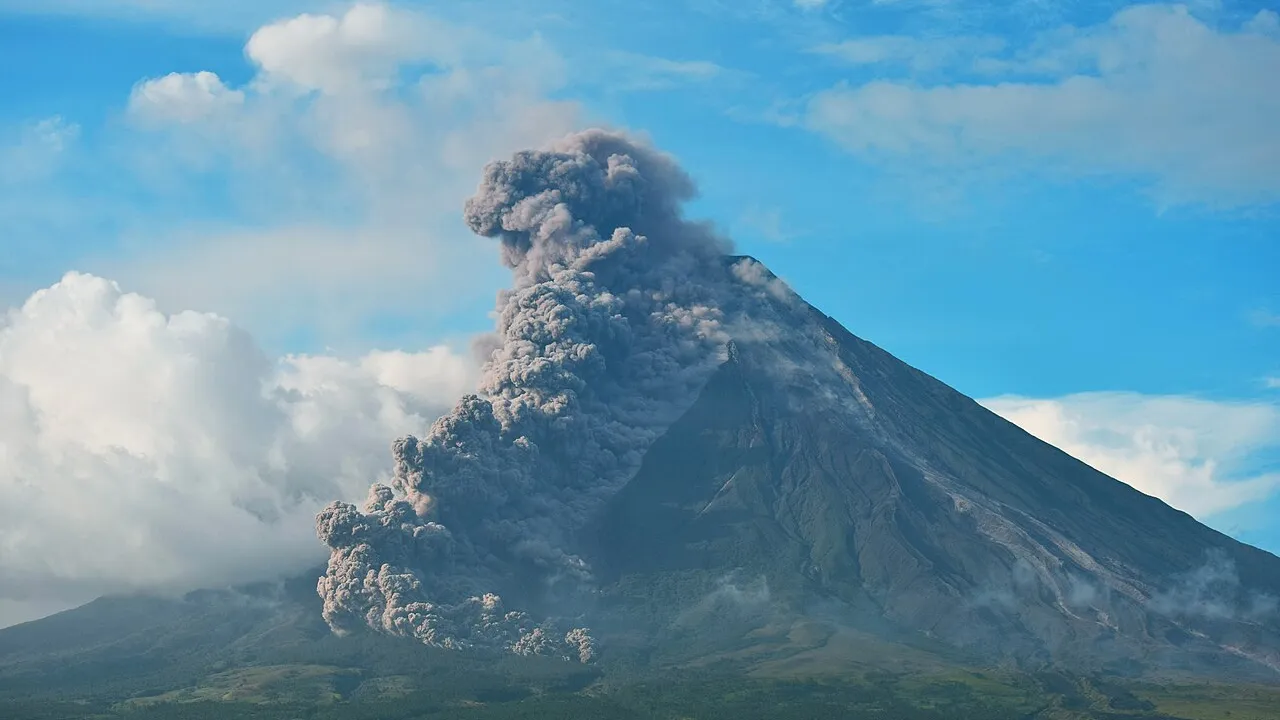
2. How fast does a pyroclastic flow move compared with most liquid lava rivers?
🤯 Mind-Blowing Fact • Grade 2
Hot volcanic ash from ancient pyroclastic flows fused into sturdy 'tuff' stone that builders carved into homes and churches for centuries!
✨ Word Sparks (Grade 2 Glossary)
Tap 🔊 to hear
pyroclastic
Greek word meaning rock broken by volcanic fire.
gravity
Earth's invisible pull drawing heavy things downward.
tuff
Solid rock formed from compacted volcanic ash.
🪝
What does the Greek word 'pyroclastic' mean—and why does this volcanic cloud hug the ground instead of floating up?
1
Fire-Broken Rock
Break the word '' into two Greek clues: 'pyro' means fire, and 'clastic' means broken into pieces! During a big eruption, gas blasts hot magma into millions of broken rock bits and dusty ash.
2
Too Heavy to Float
Sometimes an ash plume shoots high up, cools slightly, and grows heavier than the air around it. pulls the whole column crashing back down the mountainside like a roaring curtain!
3
Welded Into Tuff Rock
When the rushing cloud finally stops in a valley, its hot ash and pumice settle into thick layers. Often the pieces are still hot enough to fuse together into sturdy volcanic rock called !
1. What do the Greek roots of the word 'pyroclastic' mean?
2. What rock forms when thick layers of hot volcanic ash settle and fuse together?
🤯 Mind-Blowing Fact • Grade 3
Because expanding hot gas pushes every ash grain apart, a pyroclastic flow glides downhill on a near-frictionless cushion just like an air-hockey puck!
✨ Word Sparks (Grade 3 Glossary)
Tap 🔊 to hear
friction
Rubbing force that slows moving objects down.
lava dome
Steep mound of sticky lava inside craters.
plume collapse
Heavy eruption cloud falling back down slopes.
🪝
How can tons of heavy boulders and ash glide downhill almost without friction—and even skim right across water?
1
Two Layers in One Flow
Watch remote-camera footage of an erupting composite volcano, and a billowing grey cloud appears to surf right down its valleys. Inside that cloud, a pyroclastic flow actually travels in two layers: a dense lower river of boulders, pumice, and coarse ash hugging the ground, topped by a towering cloud of swirling fine dust.
2
Riding an Air Hockey Cushion
How does heavy rock travel over 150 kilometers per hour? Expanding volcanic gases and trapped air heat up inside the flow, pushing rock grains apart so they glide like pucks on an air-hockey table with very little !
3
Two Ways They Start
Pyroclastic flows start either when a tall vertical ash column becomes too dense and collapses downward, or when a steep, sticky crumbles on a mountain slope.
4
Skimming Over the Sea
During Indonesia's 1883 Krakatoa eruption, frothy, gas-rich pyroclastic clouds were light enough on top to skim dozens of kilometers right across open ocean water!
1. Why does a pyroclastic flow move with almost no friction?
2. Which two events commonly trigger a pyroclastic flow on a composite volcano?
🤯 Mind-Blowing Fact • Grade 4
Before the 1991 eruption of Mount Pinatubo, scientists mapped prehistoric pyroclastic rock layers in nearby valleys to predict exactly where new flows would go—saving over 20,000 lives!
✨ Word Sparks (Grade 4 Glossary)
Tap 🔊 to hear
ignimbrite
Thick volcanic rock deposited by pumice-rich pyroclastic flows.
Pliny the Younger
Roman eyewitness whose letters described Vesuvius's eruption.
fluidization
Gas streaming through solid grains making them flow.
🪝
How did geologists read ash layers around Italy's Bay of Naples to reconstruct Mount Vesuvius's famous AD 79 eruption?
1
Pyroclastic Density Currents Explained
Modern volcanologists group pyroclastic flows and surges under one descriptive scientific name: pyroclastic density currents (PDCs). Unlike basaltic shield volcanoes that pour slow, predictable lava streams, silica-rich stratovolcanoes and calderas shatter gas-charged magma into incandescent ash, pumice lapilli, and blocks. When that mixture is denser than surrounding atmosphere, gravity accelerates it downslope at 100 to over 400 kilometers per hour at temperatures between 300 and 700 degrees Celsius.
2
Pliny the Younger and Fountain Collapse
In AD 79, seventeen-year-old Roman observer wrote letters describing Mount Vesuvius's towering pine-tree-shaped ash column—the first eyewitness volcano report in science history! For hours, white and grey pumice rained from the buoyant plume. Overnight, as gas pressure dipped, the heavy eruption column collapsed repeatedly into fast ground-hugging pyroclastic currents that buried Roman towns in meters of preserved volcanic strata.
3
Ignimbrites and Bandelier Tuff
Geologists recognize ancient pyroclastic deposits across North America as rocks called or welded tuffs. In New Mexico's Bandelier National Monument, massive Pleistocene pyroclastic flows from the Valles Caldera cooled into pinkish-orange cliffs hundreds of meters thick, where ancestral Pueblo builders later carved sheltered cliff dwellings!
4
Hazard Mapping Saves Lives
Before Mount Pinatubo erupted in 1991, geologists mapped ancient valleys around the volcano—guiding timely evacuations that saved tens of thousands of lives when fresh pyroclastic flows filled those exact same canyons!
1. How did studying ancient ignimbrite rock layers help scientists at Mount Pinatubo in 1991?
2. Where in the American Southwest did ancient Pueblo communities carve homes into soft volcanic tuff from prehistoric pyroclastic flows?
🤯 Mind-Blowing Fact • Grade 5
As a pyroclastic flow drops its heaviest boulders along a valley floor, the remaining superheated cloud can suddenly become lighter than air and lift straight off the ground like a giant hot-air balloon!
Fast, dilute, turbulent cloud able to cross ridges.
infrasound
Low-frequency sound waves below human hearing range.
🪝
How can a ground-hugging volcanic current climb straight up and over a 1,000-meter mountain ridge miles from its crater?
1
Fluid Mechanics of Pyroclastic Density Currents
In physical volcanology, pyroclastic density currents (PDCs) span a spectrum from concentrated, valley-confined granular flows to dilute, turbulent . Inside a concentrated flow, exsolving juvenile gases, ingested air heated to rapid expansion, and escaping pore pressure support a dense basal avalanche of lithic blocks, pumice clasts, and glass shards. Because internal pore-gas pressure counteracts grain-to-grain normal stress, effective basal friction drops tenfold—allowing currents to reach 150 to 700 kilometers per hour.
2
Buoyancy Reversal and Ridge-Overtopping Surges
As a PDC races downslope, denser lithic fragments settle progressively onto the valley floor (forming an aggrading ignimbrite sheet) while cooler ambient air mixes into the turbulent upper phoenix cloud. Remarkably, momentum and density stratification allow fast dilute surges to climb uphill over topographic barriers more than 1,000 meters tall! Once enough heavy rock drops out, the remaining hot ash-and-gas mixture suddenly becomes lighter than surrounding air—lifting off the ground completely as a giant co-ignimbrite ash plume.
3
Soufrière Hills and Merapi-Type Dome Collapse
Not all PDCs require towering Plinian columns. Beginning in 1995 on the Caribbean island of Montserrat, viscous andesite extruding into the Soufrière Hills crater built steep, unstable lava domes. Repeated gravitational collapses of incandescent dome lobes generated 'Merapi-type' block-and-ash flows, teaching volcanologists worldwide how to track dome tilt, rockfall seismicity, and exclusion zones.
4
Welding, Fiamme, and Cooling Joints
When thick pumice-rich ignimbrites come to rest above ~550–600 °C, overlying weight flattens still-plastic glass shards and pumice lenses into dark glassy streaks called ('little flames' in Italian), welding loose ash into erosion-resistant stone.
5
Doppler Radar and Acoustic Array Detection
Today, volcano observatories deploy microphone arrays, thermal infrared cameras, and Doppler weather radar to track PDCs inside storm clouds or darkness in real time.