🇺🇸 U.S. HISTORY
🏛️ Powhatan Cultural Emissary & Peacemaker • c. 1596–1617
VA History & Social Science SOL K.1, 1.2, 2.4, VS.1–VS.10, USI & USII
Pocahontas
Powhatan Peacemaker of Early Virginia
Grade 5 • Advanced • 380 words
⏳ Era / Statehoodc. 1596–1617 • Powhatan Chiefdom & Jamestown Era (1607–1617)
🗺️ Region / CapitalWerowocomoco & Jamestown, Tidewater Virginia
📜 Key MilestoneBridged Powhatan and English cultures, bringing vital food and lasting peace
⚡ Historical SparkServed as a courageous young ambassador between the Powhatan people and Jamestown settlers
🤯 Mind-Blowing Fact • Grade 1
Pocahontas was actually a childhood nickname meaning 'Playful One'—her formal Powhatan names were Amonute and Matoaka!
✨ Word Sparks (Grade 1 Glossary)
Tap 🔊 to hear
settler
A person building a home somewhere new
nickname
A fun extra name given by family
communicate
To share words and ideas clearly
🪝
What curious girl in Virginia helped two very different groups become peaceful neighbors?
1
Playful One
Along wide rivers in Virginia lived Chief Powhatan's bright daughter. Her real name was Matoaka. Her family nicknamed her Pocahontas, which meant playful one!
2
Sharing Corn and Bread
In 1607, English ships landed at Jamestown. The newcomers did not know how to grow food there. Pocahontas brought baskets of corn and helped them .
3
A Bridge for Peace
Pocahontas helped Captain John Smith and the understand her people. Her kindness brought peaceful years to early Virginia!
1. What did the Powhatan nickname 'Pocahontas' mean?
2. How did Pocahontas help the hungry English settlers at Jamestown?
🤯 Mind-Blowing Fact • Grade 2
Among the Powhatan people, bringing a young daughter like Pocahontas along with food gifts was an unmistakable sign that visitors came in peace!
✨ Word Sparks (Grade 2 Glossary)
Tap 🔊 to hear
colonist
Someone living in a distant settlement
harmony
Living together peacefully without fighting
Tidewater
Low coastal Virginia land touched by tides
🪝
Why did three wooden sailing ships anchoring in Virginia in 1607 change eleven-year-old Pocahontas's life forever?
1
Growing Up in Tsenacommacah
Picture wooden canoes gliding across sparkling rivers in coastal Virginia more than four hundred years ago! Matoaka—nicknamed Pocahontas—grew up in Tsenacommacah, the homeland of over thirty Algonquian-speaking tribes led by her father, Chief Powhatan. She learned to plant corn, beans, and squash and weave reed mats.
2
Helping Jamestown Survive
When English founded Jamestown in 1607, they struggled to find clean water and grow crops. Befriending leader Captain John Smith, young Pocahontas accompanied Powhatan messengers bringing deer meat, bread, and corn while trading words from both languages.
3
The Peace of Pocahontas
In 1614, her marriage to John Rolfe created eight years of known in Virginia history as the Peace of Pocahontas.
2. What happened in Virginia after Pocahontas married colonist John Rolfe in 1614?
🤯 Mind-Blowing Fact • Grade 3
Archaeologists in Gloucester County, Virginia, rediscovered the actual footprint of Chief Powhatan's capital town, Werowocomoco, along the York River in 2003!
✨ Word Sparks (Grade 3 Glossary)
Tap 🔊 to hear
emissary
A messenger sent on a peaceful mission
yehakin
A traditional Powhatan woven bark longhouse
ambassador
A respected representative visiting another nation
🪝
How did an eleven-year-old Powhatan girl become an international ambassador across the Atlantic Ocean?
1
Daughter of Werowocomoco
Step into the bustling riverside town of Werowocomoco along Virginia's York River around 1607, where bark-covered longhouses called stand among tall oaks and gardens of corn. Born around 1596, Amonute—privately named Matoaka and nicknamed Pocahontas—was a favorite daughter of Wahunsenacawh, the paramount chief whom English newcomers called Chief Powhatan.
2
Envoy to Fort James
After English ships Susan Constant, Godspeed, and Discovery established Jamestown in May 1607, Captain John Smith met Chief Powhatan that winter. Over the next two years, young Pocahontas served as a trusted to Jamestown fort—delivering gifts of corn and venison from her father during hungry months and exchanging Algonquian and English phrases with young English interpreters.
3
Marriage and the Peace of 1614
Following years of conflict after John Smith returned injured to England, Pocahontas was held at Henricus in 1613, where she learned English customs, took the baptismal name Rebecca, and chose to marry tobacco planter John Rolfe in April 1614—ushering in the 'Peace of Pocahontas.'
4
Voyage to London
In 1616, Pocahontas, John Rolfe, and their infant son Thomas sailed to England, where she met King James I and Queen Anne with quiet royal dignity before falling ill on the journey home in 1617.
1. What was the name of Chief Powhatan's capital town along the York River in Virginia?
2. Where did Pocahontas travel by ship in 1616 with her husband John Rolfe and young son Thomas?
🤯 Mind-Blowing Fact • Grade 4
When Pocahontas sailed to England in 1616, Powhatan holy man Uttamatomakkin carried a wooden stick to notch and count every English person—until teeming London crowds made him run out of room on the very first day!
✨ Word Sparks (Grade 4 Glossary)
Tap 🔊 to hear
intermediary
A helpful bridge connecting two different groups
tributary
A smaller group allied under a chief
truce
An agreement to stop fighting and live peacefully
🪝
Why is Pocahontas remembered in Virginia history not just from legend, but as a vital diplomat between two worlds?
1
Life in Powhatan's Tidewater Confederacy
Listen to paddles dipping rhythmically into the tidal waters of the James and York Rivers in 1607, where more than fourteen thousand Algonquian-speaking people live in settled towns across Tsenacommacah—coastal Tidewater Virginia. Paramount Chief Wahunsenacawh (Powhatan) governed roughly thirty chiefdoms from Werowocomoco. His bright daughter Amonute—called Matoaka within her family and nicknamed Pocahontas—grew up learning agriculture, diplomacy, and community responsibilities.
2
Cultural Intermediary at Jamestown
When 104 English men and boys founded Jamestown on a marshy peninsula in May 1607, brackish water and scarce supplies threatened the colony's survival. After Captain John Smith encountered Powhatan at Werowocomoco in December 1607—an event Smith later described as a dramatic rescue or adoption ceremony welcoming Jamestown as a town—eleven-year-old Pocahontas regularly accompanied food convoys to Jamestown. Because Powhatan war parties never brought children, her presence signaled peaceful intent while she helped Smith and young English pages learn Algonquian trade words.
3
Diplomatic Marriage at Jamestown Church
After Smith departed for England in autumn 1609, relations deteriorated into the First Anglo-Powhatan War. Captured via shipboard ruse in 1613 and brought to Henricus up the James River, Pocahontas mastered English, embraced Christianity under Reverend Alexander Whitaker with the name Rebecca, and married planter John Rolfe on April 5, 1614, with both Chief Powhatan's and Governor Thomas Dale's blessing—sealing an eight-year across Tidewater Virginia.
4
Transatlantic Diplomacy
Sailing to London in 1616 with Rolfe, their son Thomas, and Powhatan counselor Uttamatomakkin, she met royal officials and reunited briefly with John Smith before falling fatally ill at Gravesend in March 1617 at approximately age twenty-one.
1. Why did Chief Powhatan include young Pocahontas when sending food supplies to Jamestown in 1608?
2. What major conflict ended in 1614 when Chief Powhatan and English leaders blessed the marriage of Pocahontas and John Rolfe?
🤯 Mind-Blowing Fact • Grade 5
Tree-ring studies of 800-year-old bald cypress trees along Virginia rivers proved that 1606–1612 was the worst seven-year drought in nearly eight centuries, making the food gifts Pocahontas accompanied even more extraordinary!
✨ Word Sparks (Grade 5 Glossary)
Tap 🔊 to hear
paramountcy
A political union led by a high chief
paleoclimatology
Studying ancient weather using clues like tree rings
matrilineal
Tracing family heritage through mothers' lines
🪝
How do archaeology, Algonquian oral tradition, and seventeenth-century records illuminate Pocahontas's real diplomatic role in founding-era Virginia?
1
Tsenacommacah and Powhatan Governance
Stand along Purtan Bay on Virginia's York River, where archaeologists partnering with Virginia tribes uncovered ancient earthworks marking Werowocomoco—seat of Wahunsenacawh, paramount chief (mamanatowick) of Tsenacommacah. Comprising over thirty Algonquian-speaking communities and roughly 14,000 inhabitants between the fall line and Chesapeake Bay, the Powhatan possessed sophisticated kinship networks, three-sisters agriculture, and formal diplomatic protocols. Born circa 1596, Amonute—known privately as Matoaka and playfully as Pocahontas—grew up immersed in the ceremonial expectations of a paramount chief's household.
2
Interpreting the 1607 Encounter and Early Provisioning
When the Virginia Company's 104 settlers constructed James Fort in May 1607, severe drought—confirmed centuries later by cypress tree-ring —strained regional harvests alongside colonial inexperience. Captured along the Chickahominy River in December 1607, Captain John Smith was brought before Wahunsenacawh at Werowocomoco. While Smith's 1608 True Relation emphasized Powhatan hospitality and only his 1624 Generall Historie popularized the dramatic stone-rescue account, modern scholars and Virginia Indian historians interpret the event—if enacted—as an Algonquian political adoption ritual incorporating Smith as a subordinate werowance (town leader). Throughout 1608, eleven- and twelve-year-old Pocahontas served as a visible peace envoy accompanying grain deliveries that kept James Fort alive, exchanging vocabulary with English youth Thomas Savage.
3
Captivity, Conversion, and the 1614 Diplomatic Alliance
Following Smith's October 1609 departure after a gunpowder injury, drought and land encroachments ignited the First Anglo-Powhatan War (1609–1614). In April 1613, Captain Samuel Argall lured Pocahontas aboard his ship on the Potomac River as a diplomatic hostage. Residing at Citie of Henricus under Reverend Alexander Whitaker, she perfected spoken English, accepted Christian baptism as Rebecca, and consented to marry widower John Rolfe—whose cultivation of sweet Orinoco tobacco transformed Virginia's economy. Celebrated on April 5, 1614, with Wahunsenacawh's consent and her uncle Opitchapam attending, the marriage forged a formal kinship alliance securing eight years of peace.
4
Transatlantic Embassy to the Stuart Court (1616–1617)
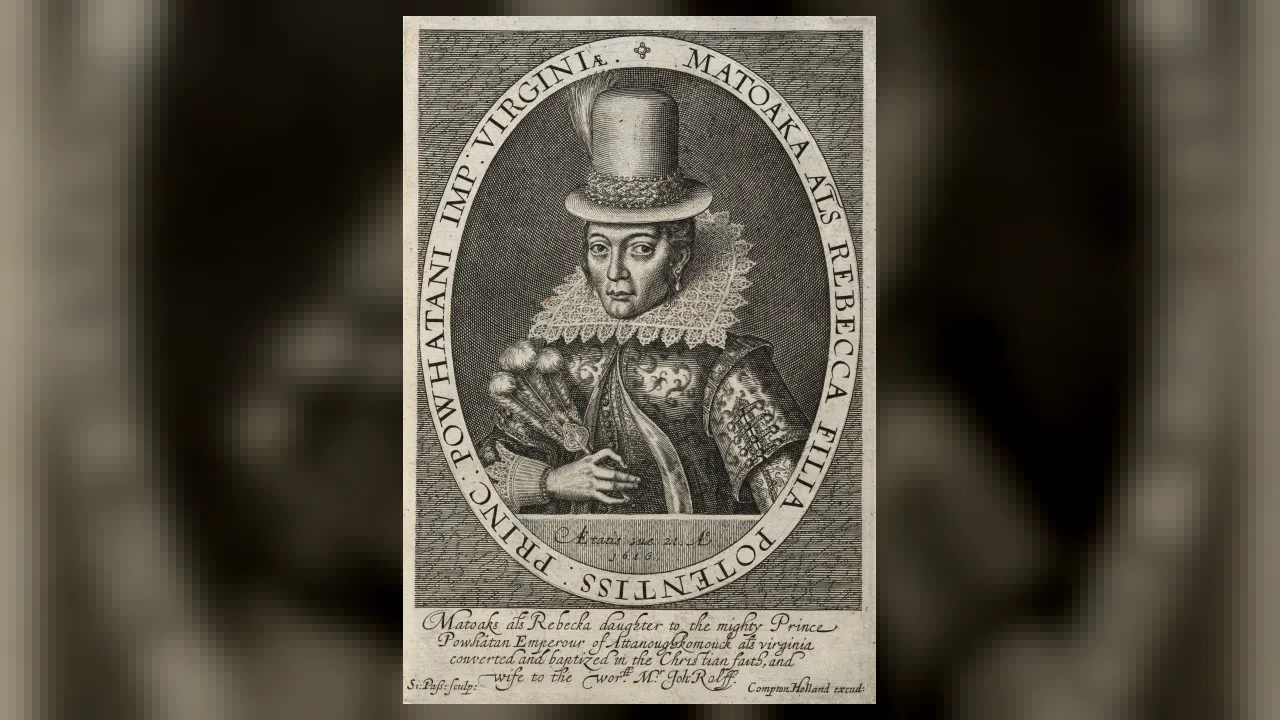
Sponsored by the Virginia Company to showcase colonial harmony, Rebecca Rolfe sailed to England in spring 1616 with her husband, infant son Thomas, and Powhatan advisor Uttamatomakkin. Presented at Whitehall Palace's Twelfth Night masque before King James I and Queen Anne in January 1617 and engraved from life by Simon van de Passe, she navigated European aristocracy with composed dignity.
5
Final Days at Gravesend and Virginia Heritage
Embarking down the Thames to return to Virginia in March 1617, she succumbed suddenly to respiratory illness at Gravesend, Kent, at roughly age twenty-one. Her son Thomas Rolfe later returned to Virginia in 1635, bridging English and Indigenous lineages in the Commonwealth's enduring history.