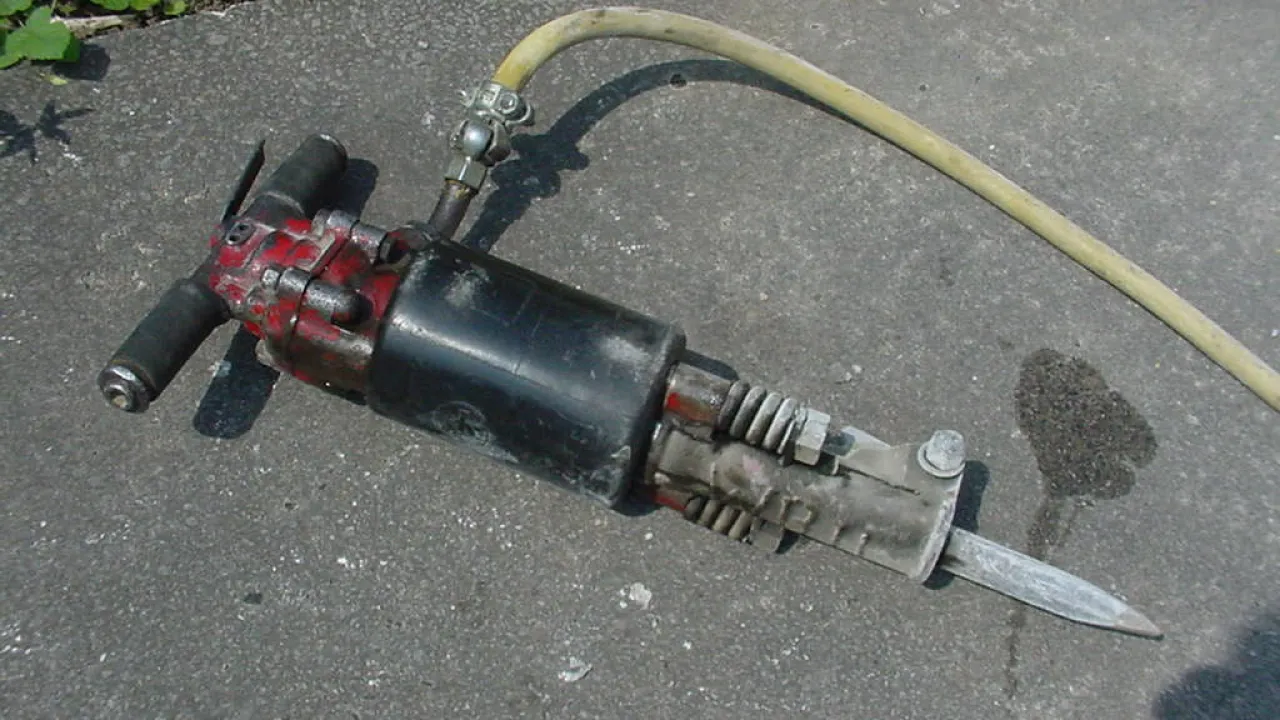
1. What flows through the thick hose to make a classic road jackhammer work?
2. Why should workers and bystanders wear ear protection near a jackhammer?
🤯 Mind-Blowing Fact • Grade 2
Before Charles Brady King became famous for building Detroit's very first gasoline automobile, he invented the handheld pneumatic hammer shown at the 1893 World's Fair!
✨ Word Sparks (Grade 2 Glossary)
Tap 🔊 to hear
pneumatic
Powered by tightly squeezed, pressurized air
compressor
Machine that squeezes air into high pressure
valve
Gate that switches where air flows inside
🪝
Why did deep-mine workers cheer when air hoses replaced electric wires underground?
1
Thunder Under Your Boots
Brrrr-CRACK! Stand safely behind a street barrier and feel the sidewalk buzz beneath your sneakers. A road worker guides a roaring tool as chunks of thick gray pavement split apart like brittle peanut brittle.
2
What Pneumatic Means
The word comes from the Greek word for wind or breath. Inside the cylinder, compressed air pushes a steel piston down to whack a chisel bit, and then a clever flips the air to lift it right back up.
3
Safe Deep Underground
American inventor Charles Brady King patented the handheld hammer in 1894. Miners loved air-powered drills because compressed air makes zero electrical sparks, keeping dusty underground tunnels much safer while carving through solid rock!
2. Why were air-powered jackhammers much safer than early electric motors inside coal mines?
🤯 Mind-Blowing Fact • Grade 3
When engineers used pneumatic rock drills on the Alps' Mont Cenis Tunnel in the 1860s, the exhausting air hoses actually helped supply fresh breathing air to the workers deep inside the mountain!
✨ Word Sparks (Grade 3 Glossary)
Tap 🔊 to hear
brittle
Hard material that cracks under sharp blows
striker piston
Internal metal weight that slams the bit
exhaust port
Opening that lets used air puff out
🪝
Why does a jackhammer pound straight up and down instead of spinning like a wood drill?
1
Hammering vs. Spinning
Try twisting a smooth metal screw into a hard brick—it just scrapes and gets hot! Concrete and granite are materials, meaning sharp, sudden blows crack them far faster than spinning blades. That is why a pavement breaker punches straight up and down.
2
Inside the Air Chamber
A diesel or electric air compressor parks nearby, packing outside air to nearly 100 pounds per square inch. Rushing through a thick rubber hose, that air enters the jackhammer handle whenever the operator squeezes the thumb throttle.
3
1,500 Blows Every Minute
Inside the barrel, a flutter valve routes high-pressure air above a heavy free-floating , slamming it onto the top of a hardened steel bit. Instantly, open and air shoots underneath to bounce the piston back up 1,500 times a minute!
4
Carving Tunnels Through Mountains
In 1861, engineer Germain Sommeiller used giant rail-mounted pneumatic drills to bore the eight-mile Mont Cenis Tunnel through the Alps, cutting decades off hand-chiseling time before Charles Brady King shrank the design for two hands.
1. Why does a pavement-breaking jackhammer slam straight down instead of spinning rapidly like a carpenter's wood drill?
2. What bonus benefit did early tunnel builders get when compressed air puffed out of pneumatic rock drills?
🤯 Mind-Blowing Fact • Grade 4
When compressed air expands suddenly out of a jackhammer's exhaust ports on a humid day, its temperature drops so fast that white ice frost can form right on the steel casing in summer!
✨ Word Sparks (Grade 4 Glossary)
Tap 🔊 to hear
kinetic energy
Energy a moving object carries from motion
recoil
Backward kick felt after a sharp strike
percussion
Striking one hard object forcefully against another
🪝
How does invisible air stored at seven times atmospheric pressure shatter reinforced highway slabs in seconds?
1
Shockwaves Focused on a Wedge
Watch a slow-motion camera aimed at the tip of a working jackhammer: the steel moil point barely travels a few centimeters, yet cracks spiderweb outward through foot-thick concrete! Instead of muscling through stone with steady pressure, the tool concentrates high-speed onto a narrow wedge.
2
The Flutter-Valve Cycle
A portable rotary-screw compressor packs ambient air to roughly 6 to 7 bar (90 to 100 psi) and feeds it through reinforced hosing. Squeezing the grip lever admits pressurized air past an automatic distribution valve, accelerating an internal alloy-steel hammer piston downward at high velocity to strike the anvil end of the chisel shank.
3
Adiabatic Cooling and Spring Handles
As the piston passes side exhaust ports, trapped pressure vents loudly to the atmosphere, creating a pressure drop that flips the valve and drives air beneath the piston for its return stroke—repeating 1,200 to 2,000 times per minute. Rapidly expanding exhaust air cools dramatically (sometimes frosting the muffler in damp weather!), while modern ergonomic spring-damped handles shield operators' hands from harsh vibrations.
4
From Alpine Railways to Modern Demolition
Following Jonathan Couch's 1849 steam drill and Germain Sommeiller's 1861 pneumatic tunnel rigs, Charles Brady King patented the compact handheld pneumatic hammer in 1890–1894 for stone carving and steel bridge riveting. Soon skyscrapers, subways, quarries, and highway crews worldwide ran on compressed air.
1. What automatically switches the compressed air from pushing the internal piston down to lifting it back up?
2. Why can frost sometimes form on the outside of a pneumatic jackhammer even on a mild, humid afternoon?
🤯 Mind-Blowing Fact • Grade 5
Carving the 60-foot granite faces of Mount Rushmore between 1927 and 1941 relied on workers dangling on canyon ropes with pneumatic jackhammers to honeycomb and wedge off 450,000 tons of stone to within inches of the final skin!
✨ Word Sparks (Grade 5 Glossary)
Tap 🔊 to hear
tensile strength
Resistance of material against being pulled apart
kilopascal
Metric pressure unit equal to thousand pascals
stress wave
High-speed mechanical pulse traveling through solid rock
🪝
Why does a high-velocity three-kilogram air piston fracture granite slabs that a stationary ten-ton weight cannot crack?
1
Tensile Failure in Brittle Solids
Granite bedrock and cured Portland-cement concrete boast enormous compressive strength—supporting towering bridge piers with ease—yet possess roughly ten times weaker when wedged apart suddenly. A pneumatic jackhammer exploits this crystal-lattice vulnerability by firing concentrated acoustic into stone faster than mineral grains can deform plastically, opening branching micro-fractures with remarkable energy efficiency.
2
Thermodynamics and Pneumatic Cycling
Compressed air delivered from a rotary-screw compressor at approximately 690 (100 psi) enters a precision-honed alloy-steel cylinder housing a free-flying percussion piston. Guided by an automatic pressure-differential flapper or spool valve, expanding air accelerates the three-kilogram piston along a short stroke at 1,200 to 1,800 blows per minute, converting pneumatic pressure-volume work into focused kinetic energy (KE = ½mv²). Upon striking the collared tool shank, an elastic compression pulse races down the hardened chisel tip into the substrate in microseconds.
3
Rock Drills vs. Pavement Breakers
Heavy civil engineers carefully distinguish pure demolition pavement breakers—which hammer straight down without rotating to split slabs—from pneumatic sinker rock drills, which incorporate a helically rifled splinebar and ratchet pawl that index a tungsten-carbide button bit a fraction of a turn on every upstroke while flushing pulverized rock flour out of deep blast holes with a high-velocity jet of air or mist.
4
Industrial Revolution of Subterranean Infrastructure
Before Germain Sommeiller's 1861 pneumatic drills pierced the 12.8-kilometer Mont Cenis Alpine railway tunnel and Charles Brady King's 1894 handheld pneumatic hammer mechanized urban construction, mining crews advanced barely centimeters per shift swinging hand sledges against iron stars. Pneumatic percussion rapidly built New York's subways, Hoover Dam's spillways, and steel-riveted Art Deco skyscrapers.
5
Acoustic and Ergonomic Engineering Today
Because unmuffled exhaust blasts and steel-on-steel impacts exceed 105 decibels and transmit intense hand-arm vibration capable of injuring blood vessels, modern breakers integrate wrap-around polyurethane mufflers, air-cushioned piston buffers, and spring-isolated ergonomic handles alongside quiet brushless electric and excavator-mounted hydraulic breakers.