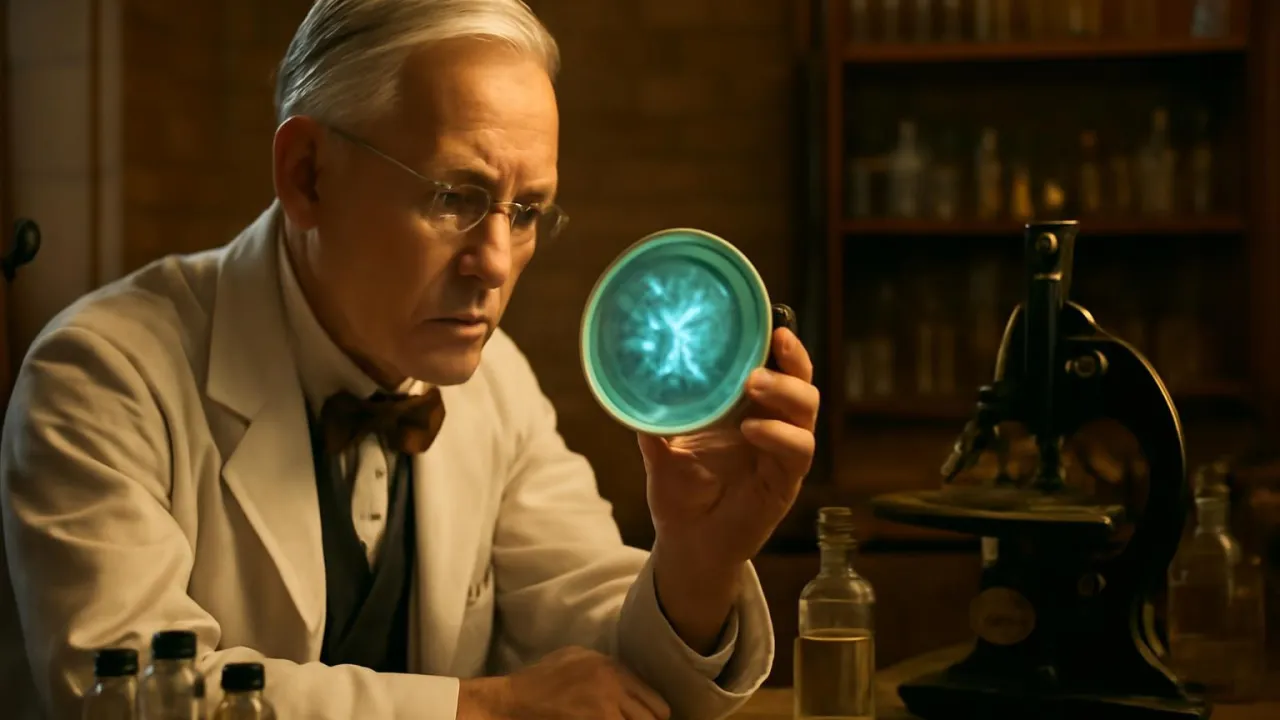
Penicillin was the first true antibiotic medicine in history.
✨ Word Sparks (Grade 2 Glossary)
Tap 🔊 to hear
infection
When germs make your body sick
antibiotic
A medicine that kills bad germs
scientist
A person who learns about science
🪝
Have you ever wondered how mold could help save lives?
1
A Lucky Find
One day, a named Alexander Fleming saw green mold in his dish. The mold was killing the germs next to it, and he was amazed. He wanted to learn more about this mold.
2
How Penicillin Works
Doctors use penicillin to help people who are sick with . The medicine stops the germs from growing, so people can get better. It is given as a pill or a shot.
3
Changing the World
Before penicillin, many people stayed sick from . After its discovery, doctors could help more people get well. Penicillin made a huge difference in hospitals everywhere.
Penicillin helped save thousands of soldiers during World War II.
✨ Word Sparks (Grade 3 Glossary)
Tap 🔊 to hear
bacteria
Tiny living things that can cause illness
antibiotic
Medicine that kills harmful bacteria
cell wall
The hard outer shell of a cell
🪝
What if a forgotten dish in a lab held the secret to saving millions?
1
A Moldy Marvel
In 1928, Alexander Fleming noticed a strange green mold growing in his Petri dish. The mold, called Penicillium notatum, was destroying harmful nearby. Fleming realized this mold made something powerful that could stop infections. His accidental discovery would change medicine forever.
2
How Penicillin Fights Germs
Penicillin is an , a special medicine that kills but not viruses. It works by breaking down the bacteria’s , causing them to burst and die. Doctors use penicillin to treat infections like strep throat and pneumonia. This medicine helps people heal faster and prevents dangerous diseases.
3
From Lab to Hospital
At first, Fleming struggled to make enough penicillin for patients. Later, other scientists made a process to grow and collect penicillin in large amounts. Hospitals around the world soon used it to save lives during World War II. Penicillin became a symbol of hope for sick people everywhere.
4
A Lasting Impact
Penicillin started the era, making once-deadly infections treatable. It inspired scientists to search for more life-saving medicines. Today, doctors still use penicillin and other antibiotics to fight many diseases. Fleming’s moldy dish helped create a healthier world for everyone.
Deep fermentation tanks helped scientists make enough penicillin for millions of people.
✨ Word Sparks (Grade 4 Glossary)
Tap 🔊 to hear
fermentation
A way to grow things using microbes
resistant
Hard to stop or kill
microbe
A tiny living thing, like bacteria
🪝
Imagine peering into a dish and finding the answer to deadly infections—what would you do?
1
A Chance Discovery in the Lab
In 1928, Alexander Fleming returned from vacation to find a Petri dish covered in Penicillium mold, which had killed the surrounding bacteria. Fleming’s curiosity led him to investigate the mold’s antibacterial properties, marking the beginning of the antibiotic revolution. He carefully grew more of this mold to study its effects on harmful . Fleming’s discovery would soon be recognized as one of the greatest medical breakthroughs in history.
2
How Penicillin Works on Bacteria
Penicillin is an antibiotic that targets the cell walls of bacteria, causing them to weaken and burst. Unlike viruses, bacteria have a rigid cell wall that penicillin can break down, making the bacteria unable to survive. Doctors prescribe penicillin to treat infections like strep throat, pneumonia, and ear infections. This medicine has saved countless lives by stopping infections before they become dangerous.
3
From Small Lab to Global Impact
At first, producing enough penicillin to treat patients was a major challenge for scientists. During World War II, teams in the United States and Britain developed methods to mass-produce penicillin using deep tanks. This allowed hospitals to treat wounded soldiers and civilians, greatly reducing deaths from infection. Penicillin’s success inspired the search for more antibiotics to fight different bacteria.
4
A World Changed by Antibiotics
The discovery of penicillin marked the start of the antibiotic era, transforming how doctors treat bacterial diseases. Today, penicillin and its relatives are still used to fight many types of infections, though some bacteria have become . Fleming’s moldy dish reminds us that even small accidents can lead to world-changing discoveries in science and medicine.
1. What did scientists use to make lots of penicillin?
2. Why do some bacteria not die from penicillin today?
🤯 Mind-Blowing Fact • Grade 5
By D-Day in 1944, Allied forces had enough penicillin to treat every wounded soldier landing in Normandy.
✨ Word Sparks (Grade 5 Glossary)
Tap 🔊 to hear
peptidoglycan
A strong material in bacterial cell walls
fermentation
A process where microbes help things grow
antibiotic resistance
When bacteria stop being killed by medicine
🪝
What if the world’s greatest medical breakthrough began with a messy lab and a forgotten Petri dish?
1
The Accidental Breakthrough
In September 1928, Alexander Fleming returned to his cluttered laboratory at St. Mary’s Hospital in London to find that a Petri dish containing Staphylococcus bacteria had been contaminated by a blue-green mold. Remarkably, the bacteria surrounding the mold had been destroyed, while colonies farther away remained untouched. Fleming’s keen observation led him to identify the mold as Penicillium notatum, and he soon realized it produced a substance capable of killing many harmful bacteria. This accidental discovery would forever alter the course of medicine.
2
Mechanics of Antibiotic Action
Penicillin works by interfering with the synthesis of , a crucial component of bacterial cell walls, causing bacterial cells to weaken and eventually lyse due to osmotic pressure. Because human cells lack cell walls, penicillin selectively targets bacteria without harming the patient. This antibiotic is especially effective against Gram-positive bacteria, which have thick cell walls. Its discovery introduced the concept of targeted microbial therapy, revolutionizing how doctors treat infectious diseases.
3
Scaling Up: From Laboratory to Mass Production
Initially, Fleming struggled to extract and purify enough penicillin for clinical use, as the mold produced only tiny amounts. During World War II, scientists in the United States and Britain—most notably Howard Florey and Ernst Chain—developed deep-tank methods using corn steep liquor to grow Penicillium at industrial scale. By 1944, penicillin was being produced in quantities large enough to treat thousands of wounded soldiers, dramatically reducing deaths from sepsis and infection.
4
Transforming Medicine and Global Health
The introduction of penicillin marked the dawn of the antibiotic era, making previously deadly bacterial infections like pneumonia, scarlet fever, and syphilis easily treatable. Penicillin’s success inspired the discovery of many other antibiotics, fundamentally changing clinical practice and life expectancy worldwide. However, overuse and misuse of antibiotics have led to the rise of resistant bacterial strains, presenting new challenges for modern medicine.
5
A Legacy of Curiosity and Caution
Fleming himself warned that improper use of penicillin could lead to , urging doctors and patients to use it responsibly. Today, penicillin remains a cornerstone of medical treatment, but scientists continue to search for new antibiotics to combat evolving bacteria. The story of penicillin reminds us that careful observation, curiosity, and teamwork can spark world-changing innovations—and that scientific progress must be balanced with responsibility.