👷 CAREERS
💼 Intellectual Property Law, Engineering Review & Civic Innovation
VA Economics, Civics & Career Readiness SOL K.8, 1.8, 2.8, 3.9
Patent Examiner
First to Inspect Tomorrow's Brand-New Inventions
Grade 5 • Advanced • 319 words
🧭 Career FieldGovernment, Engineering, Science & Intellectual Property
🛠️ Key Tools & SkillsGlobal patent databases, technical blueprints, patent laws, and scientific training
🏢 WorkplaceU.S. Patent and Trademark Office (Alexandria, Virginia), regional offices, and digital workstations
⚡ Everyday Impact SparkTesting whether an invention is truly brand-new so inventors can share ideas safely
🤯 Mind-Blowing Fact • Grade 1
Kids can earn real patents too—in 1963, a six-year-old boy earned a U.S. patent for an improved toy shovel!
✨ Word Sparks (Grade 1 Glossary)
Tap 🔊 to hear
invention
A brand-new useful tool or creation
patent
Official government paper protecting an inventor's idea
blueprint
Detailed drawing showing how something works
🪝
Who gets to read secret blueprints for brand-new toys, rockets, and gadgets first?
1
A Brand-New Idea!
Ding! An inventor builds a clever solar backpack and draws neat plans. To protect the idea from copycats, the inventor sends those plans to a examiner.
2
Idea Detectives
examiners search giant computer libraries of past . Did anyone build this exact gadget before? Does the really work?
3
Stamping Official Approval
If the is truly new and useful, it earns an official U.S. ! That encourages inventors everywhere to keep dreaming big!
1. What does a patent examiner check when an inventor sends in plans?
2. How does earning a patent help an inventor?
🤯 Mind-Blowing Fact • Grade 2
President Abraham Lincoln is the only U.S. president to hold a patent, earned in 1849 for a device to lift riverboats over shallow sandbars!
✨ Word Sparks (Grade 2 Glossary)
Tap 🔊 to hear
application
Formal request sent in for approval
original
Fresh and never made before
diagram
Labeled drawing explaining parts and steps
🪝
Why must an inventor explain every single gear and wire clearly to earn a patent?
1
A Fair Deal for Inventors
Imagine inventing a self-tying sneaker! If you hide it in a closet, nobody benefits; if you sell it without protection, factories might copy it overnight. A patent solves both problems through a fair civic trade overseen by patent examiners.
2
Searching Millions of Records
Working at the U.S. Patent and Trademark Office, examiners study engineering, chemistry, or biology. When an arrives, they compare its against millions of older patents, books, and articles from around the world.
3
Sharing Knowledge With Everyone
Once an examiner approves a patent, the government protects the inventor's rights for about twenty years—and publishes the clear instructions publicly so students and engineers everywhere can learn from the science!
1. Why are patent examiners trained in science and engineering fields?
2. What happens to the instructions of an approved patent?
🤯 Mind-Blowing Fact • Grade 3
In 2018, the United States Patent and Trademark Office issued U.S. Patent Number 10,000,000—more than two centuries after Patent Number 1!
✨ Word Sparks (Grade 3 Glossary)
Tap 🔊 to hear
prior art
Earlier proof an idea already existed
specialize
Focus deeply on one specific subject
claim
Exact sentence defining what a patent protects
🪝
Did you know America's very first patent examiner was Virginia's own Thomas Jefferson?
1
Written Into the Constitution
Rustle, stamp! On July 31, 1790, Secretary of State Thomas Jefferson—himself a curious Virginian who loved gadgets—personally examined and helped approve the United States' very first patent! America's Founders valued invention so highly that they wrote patent protection directly into Article I of the U.S. Constitution.
2
Specialists for Every Technology
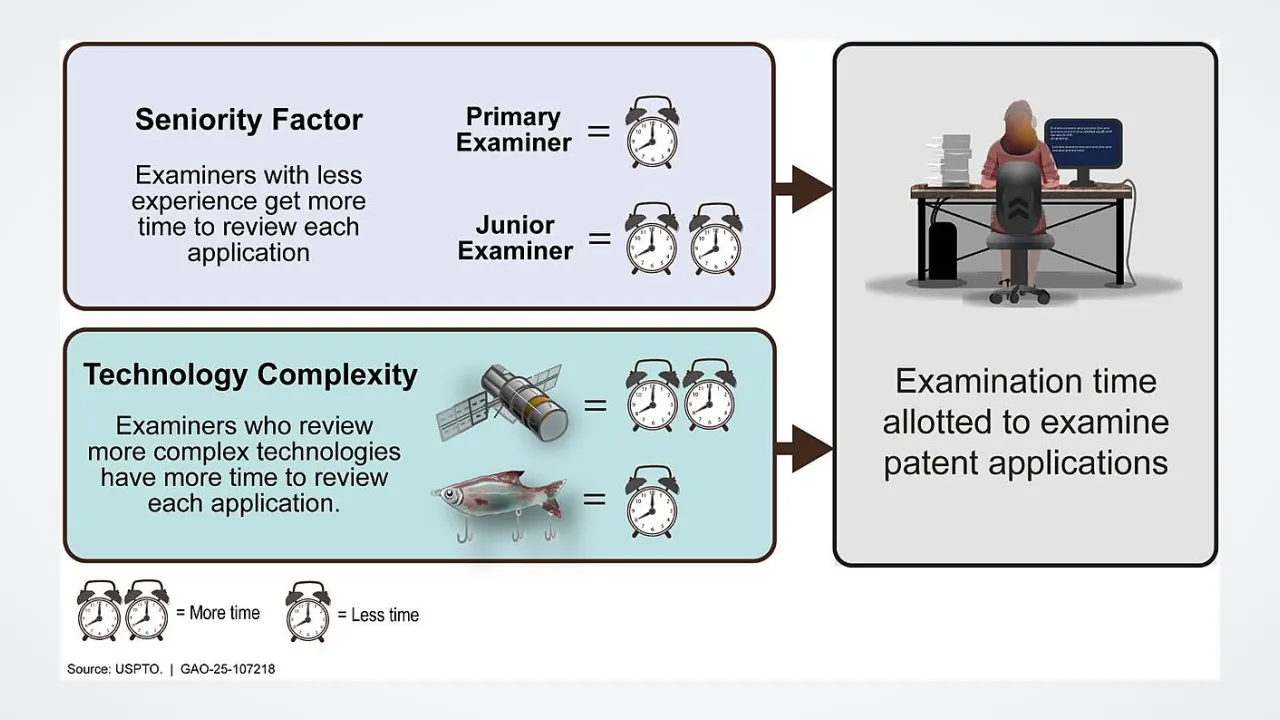
Today, more than 8,000 patent examiners work for the U.S. Patent and Trademark Office, headquartered in Alexandria, Virginia! Because no single person knows every branch of science, examiners in focused 'art units'—such as artificial heart valves, clean battery chemistry, farm robotics, or new fruit varieties.
3
Hunting for Prior Art
Examiners search global computer databases for ''—any earlier patent, science article, or product proving the idea already existed. They also turn down impossible machines, like perpetual-motion engines that break the laws of physics!
4
Writing Clear Office Actions
Examiners write polite, detailed legal letters explaining which pass muster and which boundaries need sharper wording before an official gold-seal patent ribbon is granted.
1. Where is the national headquarters of the U.S. Patent and Trademark Office located?
2. What does a patent examiner look for when searching 'prior art'?
🤯 Mind-Blowing Fact • Grade 4
Before 1880, inventors usually had to mail a working miniature wooden or brass scale model of their machine along with their paper patent application!
✨ Word Sparks (Grade 4 Glossary)
Tap 🔊 to hear
utility
Usefulness and ability to work practically
novelty
Quality of being brand-new and original
ornamental
Related to decorative visual shape or style
🪝
How does a patent examiner decide the difference between a tiny tweak and a true breakthrough?
1
Inside the Alexandria Campus
Step onto the U.S. Patent and Trademark Office headquarters campus in Alexandria, Virginia, and you enter a lively crossroads of American civic history and futuristic engineering! Inside its public National Inventors Hall of Fame museum stand historic breakthroughs—from early agricultural machines and Lonnie Johnson's pressurized Super Soaker nozzle to lifesaving medical devices—every one reviewed line by line by trained patent examiners.
2
Three Strict Legal Tests
Under federal patent law, an examiner tests every incoming invention against three main standards: (does it actually operate and accomplish a useful purpose?), (is it genuinely brand-new compared to worldwide prior art?), and non-obviousness (would an everyday engineer in that field consider the change too routine, like merely swapping blue plastic for red aluminum on an existing bicycle pedal?).
3
Three Flavors of U.S. Patents
Most examiners review patents covering how machines, electronics, manufacturing methods, or chemical compounds function. Specialized colleagues examine design patents—protecting the distinctive shape of a sneaker sole or tablet frame—while botanist examiners review plant patents for newly bred, asexually reproduced apple trees, berries, or roses!
4
Constructive Dialogues With Inventors
Patent examination is collaborative as well as rigorous. Examiners hold helpful video conferences with independent inventors, university scientists, and patent attorneys to clarify complex blueprints and refine claim wording fairly.
1. Why would a patent examiner reject an idea that simply paints an existing toaster purple?
2. Which type of patent protects a newly bred variety of fruit tree or rose?
🤯 Mind-Blowing Fact • Grade 5
Aerospace engineer Dr. Lonnie Johnson worked on NASA's Galileo Jupiter probe while inventing the pressurized Super Soaker water blaster at home—earning over 100 U.S. patents examined and approved by the USPTO!
Why did the Framers of the U.S. Constitution pair scientific engineering with legal precision in creating the patent system?
1
The Constitutional Bargain
Article I, Section 8, Clause 8 of the U.S. Constitution empowers Congress 'To promote the Progress of Science and useful Arts, by securing for limited Times to Authors and Inventors the exclusive Right to their respective Writings and Discoveries.' Federal patent examiners stand as the impartial frontline stewards of this constitutional bargain: granting inventors a 20-year limited exclusivity period only in exchange for ''—teaching the public how to build and practice the invention in clear, reproducible technical detail rather than locking it away as a secret.
2
Dissecting Claims Like Geometric Proofs
At the conclusion of every patent specification sit numbered single-sentence paragraphs called claims, which stake out legal property lines around an invention much like surveyor coordinates map a parcel of land. If an applicant claims 'a wheeled transport device,' the examiner rejects it as overly broad under Title 35 using centuries of prior art; once narrowed to a novel regenerative-braking electromagnetic clutch, the examiner searches global Cooperative Patent Classification (CPC) databases spanning English, German, Japanese, Korean, and Chinese engineering literature.
3
Guarding the Public Commons of Natural Law
Landmark U.S. Supreme Court establish that laws of nature, physical phenomena, and abstract mathematical formulas—such as gravity equations or naturally occurring wild human DNA sequences—belong to all humanity and cannot be patented by anyone. Patent examiners apply rigorous legal frameworks to separate unpatentable natural discoveries from human-engineered, practical applications such as rapid diagnostic lab assays or targeted mRNA lipid nanoparticles.
4
Witnessing Technological Frontiers First
Because startups, universities, and garage inventors file patent applications years before products ever reach store shelves, examiners witness emerging technological waves ahead of the world—evaluating solid-state lithium-sulfur batteries, quantum error-correction circuits, assistive prosthetics, and biodegradable seaweed plastics.
5
Launching a STEM-and-Law Career at the USPTO
Every U.S. patent examiner holds at least a bachelor's—and frequently a master's or doctoral—degree in mechanical, electrical, or chemical engineering, computer science, physics, or molecular biology, completing months of Patent Training Academy coursework in Alexandria, Virginia, or regional offices to unite deep scientific literacy with public service.