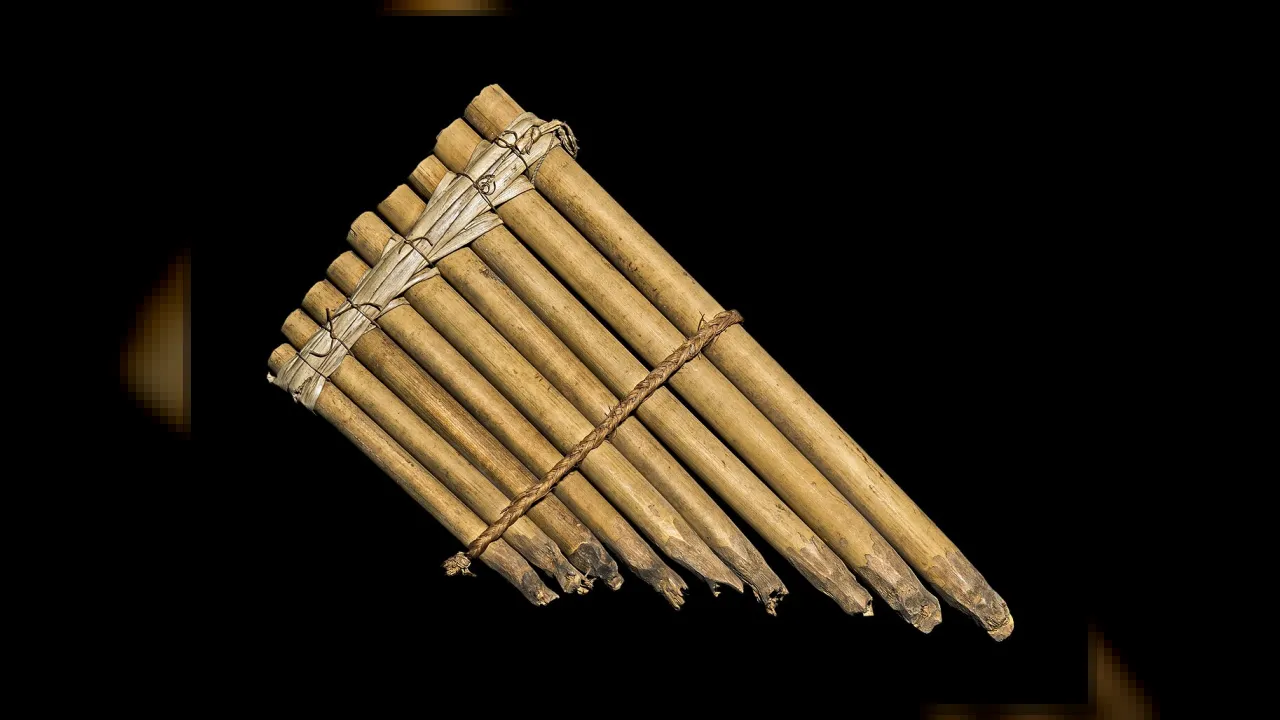
1. How many finger holes are drilled into the sides of traditional pan flute pipes?
2. Which pipes on a pan flute sing the highest notes?
🤯 Mind-Blowing Fact • Grade 2
High in the Andes Mountains of South America, two friends often share one melody by blowing alternating notes on paired pan flutes called sikus!
✨ Word Sparks (Grade 2 Glossary)
Tap 🔊 to hear
syrinx
Ancient Greek name for the pan flute
beeswax
Natural wax dropped inside pipes for tuning
plugged
Sealed tight at the bottom end
🪝
How do you play fast melodies on a flute that has zero finger holes at all?
1
Legend of the River Reeds
Long ago in Greek myths, the nature god Pan blew across hollow marsh reeds and heard wind turn into song! Named after Pan and the nymph , similar multi-pipe flutes arose independently across the globe.
2
Sealed at the Bottom
Builders tie ten to twenty-five hollow bamboo or cane pipes together from longest to shortest. Each tube stays open at the top rim and shut at the bottom with natural cane knots, corks, or .
3
Beeswax Tuning Trick
Dropping tiny pellets of into a pipe shortens the air space inside, raising its pitch until every note rings in tune!
1. What happens to a pan flute pipe's pitch when a maker drops a little beeswax into the bottom?
2. What are traditional pan flutes called in the Andes Mountains of South America?
🤯 Mind-Blowing Fact • Grade 3
In Mozart's beloved opera The Magic Flute, the cheerful bird-catcher Papageno carries a five-pipe pan flute onstage as his signature calling card!
✨ Word Sparks (Grade 3 Glossary)
Tap 🔊 to hear
stopped pipe
Tube open on top and sealed below
nai
Curved Romanian concert style of pan flute
half step
Musical distance from one key to neighbor
🪝
Why does plugging the bottom of a bamboo pipe make its note jump one whole octave deeper?
1
Echoes Across Continents
Close your eyes as a breathy, velvety melody echoes like wind sweeping across mountain canyons. Thousands of years before modern orchestras existed, ancient artisans in Peru, Greece, and China all discovered the magic of bundling hollow reeds by length.
2
The Stopped-Pipe Octave Surprise
Try a quick experiment in your mind: blow across a hollow straw with its bottom open, then seal the bottom shut with your finger. Instantly, the note drops one full octave lower! Because each pan-flute pipe is stopped at the bottom, sound waves must bounce down and all the way back up—stretching to four times the pipe's length!
3
Curved Arcs for Speed
In Romania, master builders curve twenty-two hardwood or bamboo pipes into a graceful arc called a . That curve lets a player pivot the head smoothly to dart across octaves at lightning speed!
4
Tilting for Flats and Sharps
Need a sharp or flat note not built into the row? Tilting the pipes slightly toward the lower lip shades the rim opening and bends any pitch downward by a !
1. How does sealing the bottom of a pan flute pipe change its pitch compared to an open pipe of the same length?
2. How does a pan flutist play sharps or flats without any finger holes or metal keys?
🤯 Mind-Blowing Fact • Grade 4
Archaeologists in Peru unearthed ceramic and cane pan flutes at Caral and Paracas sites dating back more than four thousand years—older than the pyramids of Giza's New Kingdom neighbors!
✨ Word Sparks (Grade 4 Glossary)
Tap 🔊 to hear
hocket
Sharing one melody by alternating notes together
siku
Traditional Andean double-row bamboo pan flute
concave
Curving inward smoothly like an open bowl
🪝
How did Andean mountain communities turn two halves of a bamboo pan flute into a musical conversation of teamwork?
1
Wind Turned Into Architecture
Few sights in world music are simpler or more ingenious: no gears, springs, pads, or reeds—just a staircase of hollow river cane or seasoned bamboo bound side by side. Yet across millennia, civilizations that never met on a map independently harnessed the exact same stopped-pipe acoustics.
2
Quarter-Wave Harmonics and Breathy Shimmer
When a musician directs a focused air jet across the beveled rim of a closed-bottom pipe, alternating air vortices excite a quarter-wavelength standing wave inside the cylinder. Because the sealed floor creates a motion node and the open rim creates an antinode, the pipe reinforces odd-numbered harmonics—first, third, fifth—giving its fundamental tone a hollow, haunting warmth laced with airy edge-tone shimmer.
3
Interlocking Hocket in the Andes
High on the Andean Altiplano of Peru and Bolivia, indigenous Aymara and Quechua ensembles play the using an extraordinary cooperative technique called . Builders split the scale's alternating notes between two separate pan flutes—the six-pipe ira ('leader') and seven-pipe arka ('follower')—so neither player can perform a tune alone! Two partners must listen intently and weave alternating breaths into one seamless melody.
4
Romanian Virtuosity on the Curved Nai
Half a world away in Romania, virtuosos like Gheorghe Zamfir popularized the curved wooden nai, gluing twenty-two to thirty tubes into a base so rapid head rotations and jaw tilts unlock dazzling classical and folkloric chromatics.
1. Why are traditional Andean siku scales often divided between two separate instruments (ira and arka)?
2. Why is the Romanian nai built in a curved arc rather than a flat straight raft?
🤯 Mind-Blowing Fact • Grade 5
Two-thousand-year-old Nazca clay pan flutes from ancient Peru were molded around wet reed cores that burned away in the kiln, leaving seamlessly smooth interior air chambers still playable today!
✨ Word Sparks (Grade 5 Glossary)
Tap 🔊 to hear
end correction
Extra wave length extending slightly past rim
convergent
Distant cultures inventing similar tools independently
diatonic
Seven-note scale matching white piano keys
🪝
Why does an ancient raft of stopped bamboo cylinders obey the exact same mathematical proportions discovered by Pythagoras?
1
Acoustic Geometry Made Visible
Hold a pan flute up to the light and you are looking directly at a physical graph of musical intervals! Unlike single-tube flutes that hide pitch relationships behind complex cross-fingerings, a multi-tube syrinx lays acoustic mathematics bare: halve a stopped pipe's internal length to double its frequency (an octave), shrink it to two-thirds for a perfect fifth, or scale it to three-quarters for a perfect fourth.
2
Stopped-Cylinder Physics, End Correction, and Overtones
Organologically a set of end-blown stopped flutes without finger holes (Hornbostel-Sachs 421.112), each tube functions as a quarter-wave cylindrical resonator where fundamental frequency satisfies f = v / 4(L + ΔL), with v representing sound speed (~343 m/s), L internal length, and ΔL (~0.6 times pipe radius) accounting for acoustic radiation beyond the open rim. Because a closed node at the beeswax or nodal septum suppresses even harmonics, steady breath yields a velvety odd-harmonic spectrum (1f, 3f, 5f). Interestingly, Andean sikuri players deliberately cultivate 'tara'—a shimmering, multiphonic buzz rich in third-harmonic (twelfth) overtones created by forceful edge-jet excitation across thin-walled Arundo or Chusquea bamboo.
3
Chromatic Technique Without Keys
On a concert Romanian nai spanning G4 (~392 Hz) to G7 (~3,136 Hz) across twenty-two diatonically tuned tubes (or down to C3 on bass models), virtuosos achieve full chromaticism without moving parts. Advancing the lower jaw while tilting the tubes ~20–35 degrees toward the chin increases acoustic end-loading at the rim, smoothly lowering any pipe's resonance by 100 cents (one semitone) or more!
4
Global Convergent Evolution
Independent invention flourished across millennia: Neolithic bone and bamboo paixiao in China (attested in Marquis Yi of Zeng's 433 BCE tomb), pastoral Greek syrinxes immortalized by Ovid and Theocritus, Oceanic bundle flutes in Melanesia, and pre-Columbian Nazca slip-cast ceramic panpipes whose kiln-fired tuning remains rock-solid after two thousand years.
5
Modern Concert Hall and Cinema Voices
Propelled internationally in the twentieth century by Romanian master Gheorghe Zamfir and celebrated by Claude Debussy's solo flute homage Syrinx, the pan flute bridges prehistoric breath rituals and contemporary symphonic film scores.