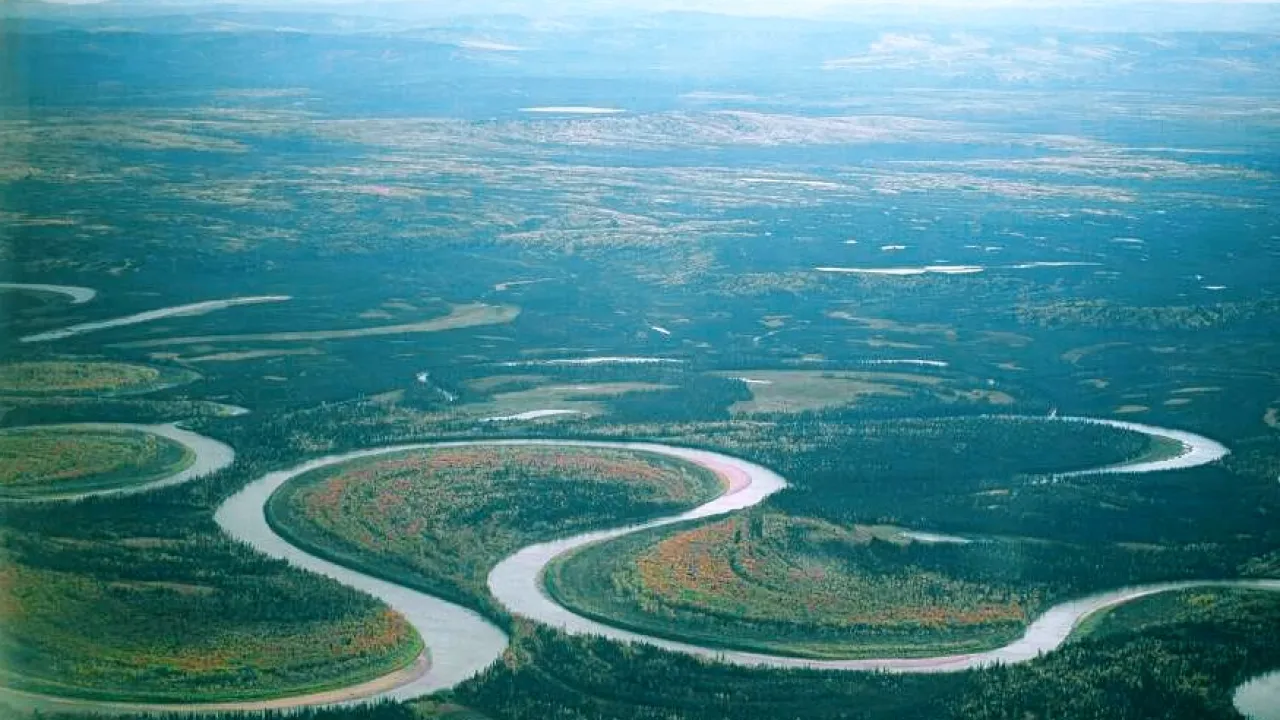
Australia calls its oxbow lakes 'billabongs,' and they stay lively watering holes even when nearby streams run low!
✨ Word Sparks (Grade 2 Glossary)
Tap 🔊 to hear
Meander
Wide winding curve in a slow valley river
Riverbank
Sloping land along the edge of a river
Flood
High water overflowing a river after heavy rain
🪝
Why do flat valley rivers wiggle like ribbons instead of running straight?
1
Big Bends Called Meanders
Watch water trickle across a nearly flat tray of sand, and watch it weave side to side! Across wide, flat valleys, rivers swing into giant curves called .
2
Fast Outside, Slow Inside
Around every curve, water races faster along the outside bank and chews away dirt. Along the slower inside bank, the river drops soft sand. Year by year, the loop grows wider and its neck grows thinner.
3
Cut Off From the River
During a big , rushing water punches straight through that narrow neck! Mud soon seals off the old bend, leaving a peaceful U-shaped oxbow lake beside the river.
1. What happens on the fast outside edge of a river bend?
2. What seals off the old river loop so it stays a separate lake?
🤯 Mind-Blowing Fact • Grade 3
Lake Chicot in Arkansas—carved six hundred years ago by the Mississippi River—is North America's largest oxbow lake at twenty-one miles long!
✨ Word Sparks (Grade 3 Glossary)
Tap 🔊 to hear
Floodplain
Flat valley land beside a river that floods
Cut Bank
Steep outer river curve worn away by erosion
Point Bar
Sandy inner river curve built up by deposition
🪝
How do erosion and deposition team up on opposite sides of the exact same river bend?
1
Wandering Across the Floodplain
High in steep mountains, creeks tumble straight downhill over boulders. Once a river reaches a flat , however, even a tiny obstacle nudges the current sideways, starting a chain of sweeping loops called meanders.
2
Cut Banks and Point Bars
Just like a runner swinging wide around a track, river water flows fastest on the outer curve. That fast water carves a steep cliff called a through erosion. Meanwhile, slower water on the inner curve drops sand to build a gently sloping beach called a .
3
Snapping the Meander Neck
As two neighboring chew closer together, only a skinny strip of land—the meander neck—separates them. Eventually, floodwaters slice right across the neck, choosing the steeper, shorter path downstream.
4
From Lake to Marsh
Silt plugs the entrances to the abandoned loop, creating a crescent-shaped oxbow lake. Without a flowing current, water lilies and reeds gradually fill the calm lake over centuries.
1. Where does a sandy point bar form along a meandering river?
2. Why does a river abandon its wide loop during a neck cutoff?
🤯 Mind-Blowing Fact • Grade 4
Because of an 1877 oxbow cutoff on the Missouri River, travelers driving out of Omaha's airport briefly cross through Carter Lake, Iowa, without ever crossing a river bridge!
✨ Word Sparks (Grade 4 Glossary)
Tap 🔊 to hear
Migrate
Slowly shift position sideways across a valley floor
Eddy Current
Swirling pocket of slower water beside fast flow
Meander Scar
Crescent marsh left after an oxbow fills in
🪝
Can a shifting river create an oxbow lake and leave a town in the wrong state without moving a single house?
1
Living Ribbons on the Landscape
Look at historical maps of the lower Mississippi or Missouri rivers, and the channels squirm across their floodplains like brightly colored ribbons! Because meandering rivers constantly erode outer cut banks and build inner point bars, their loops sideways and downstream by several meters every year.
2
Anatomy of a Meander Cutoff
As a gooseneck bend swings wider and wider, the narrow land bridge at its base shrinks. When spring snowmelt or hurricane rain swells the river, surging water breaches the neck—or scrapes through shallow flood chutes—establishing a swift, straight channel. Slower at the old loop's openings quickly drop sand and silt plugs, isolating a tranquil oxbow lake.
3
Borders Left High and Dry
When pioneers drew U.S. state boundaries along winding rivers, they did not expect oxbow cutoffs! In 1877, the Missouri River sliced through a huge loop in twenty-four hours, leaving Carter Lake, Iowa, completely surrounded by Nebraska and curving around an oxbow lake that residents still boat on today.
4
Biodiversity Hotspots on the Floodplain
Ecologically, oxbow lakes act as nurseries for river ecosystems. Calm, sun-warmed water allows plankton, dragonfly larvae, frogs, river otters, and wading herons to thrive safe from fierce river currents, before sediment and peat gradually turn the old oxbow into a crescent-shaped wetland scar.
1. How did Carter Lake, Iowa, end up on the Nebraska side of the Missouri River?
2. What eventually happens to most oxbow lakes after several centuries?
🤯 Mind-Blowing Fact • Grade 5
Laser-radar (lidar) maps of the Mississippi Alluvial Valley reveal hundreds of overlapping oxbow scars, proving the river has reworked nearly every square kilometer of its floodplain over the last ten thousand years!
✨ Word Sparks (Grade 5 Glossary)
Tap 🔊 to hear
Helical Flow
Corkscrew water current spiraling around a river bend
Sinuosity
Measurement comparing curvy river length to straight distance
Clay Plug
Dense mud deposit filling an ancient oxbow scar
🪝
How does corkscrew water motion carve symmetric loops across continents—and even across Mars and Saturn's moon Titan?
1
Helical Flow: The Engine Behind Meanders
Scan high-resolution lidar imagery of a mature floodplain, and dozens of ghostly, overlapping crescents emerge through the forest canopy like giant fingerprints. Every oxbow lake begins with —a corkscrew motion inside a low-gradient alluvial river. As water rounds a bend, centrifugal inertia piles water slightly higher against the outer concave bank, driving fast surface water outward to undercut the bank while a bottom current spirals inward to sweep sand onto the convex point bar.
2
Neck Cutoffs vs. Chute Cutoffs
Through continuous lateral erosion and point-bar accretion, meander —the ratio of channel length to straight valley length—climbs past 1.5 and sometimes exceeds 3.0. Eventually, instability triggers one of two cutoffs. In a classic neck cutoff, two adjacent cut banks erode completely through the narrow peninsula separating them; in a chute cutoff, high floodwaters scour a shortcut channel across the low ridges of an inner point bar.
3
Sediment Plugging and Lacustrine Evolution
Once the main discharge diverts down the steeper cutoff gradient, velocity at the entrances to the bypassed loop drops sharply. Suspended silt and fine sand settle at the upstream and downstream junctions, constructing natural levee plugs that sever the U-shaped basin from regular river flow and establish a lentic, or still-water, oxbow lake.
4
Ecological Succession to Clay Plugs
Over centuries to millennia, periodic overbank floods dust the isolated oxbow with fine clay while aquatic macrophytes add thick organic peat. Gradually, open water transitions into a cypress slough or reed fen and finally dries into an arcuate meander scar underlain by a dense —a compact crescent deposit that resists future river erosion.
5
Universal Physics Across Worlds
Remarkably, the fluid physics of meandering and cutoff formation operates wherever liquid flows across cohesive sediment. Planetary geologists have mapped fossilized meander cutoffs and oxbow basins carved by ancient water on Mars and active liquid-methane meanders winding across Saturn's icy moon Titan.