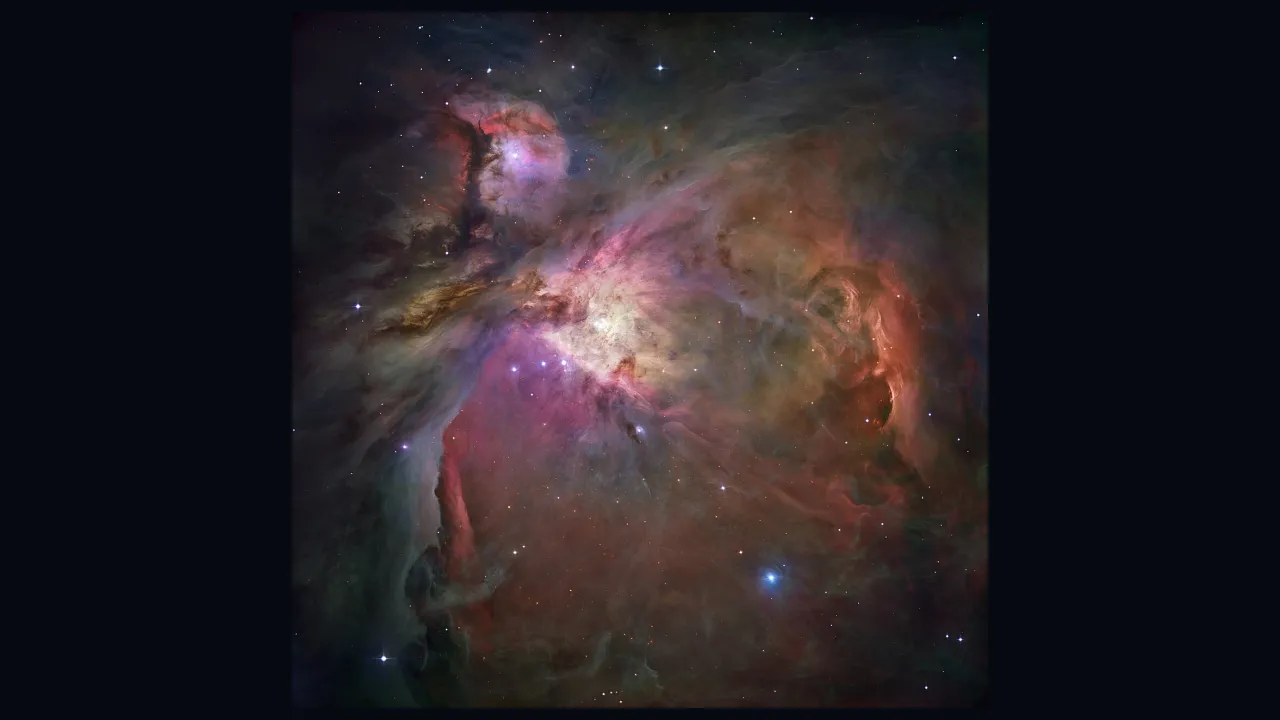
1. Where in the sky can you spot the Orion Nebula?
2. What is happening inside the colorful gas of the Orion Nebula?
🤯 Mind-Blowing Fact • Grade 2
One single star inside the Orion Nebula's Trapezium cluster shines 200,000 times brighter than our Sun!
✨ Word Sparks (Grade 2 Glossary)
Tap 🔊 to hear
binoculars
Handheld twin lenses making far things closer
Trapezium
Four bright young stars lighting Orion
cavern
A giant hollow cave-like space
🪝
Why does the middle 'star' in Orion's Sword look fuzzy through binoculars?
1
Hidden in Orion's Sword
Bundle up in winter and find the constellation Orion the Hunter. Hanging below his three-star belt is a short line called Orion's Sword. Look closely at the middle spot with —it is not a single star at all, but the glowing Orion Nebula!
2
Lit by Four Powerhouse Stars
Sitting 1,344 light-years away, the Orion Nebula stretches 24 light-years wide. At its center shine four super-hot young stars called the . Their fierce light makes the whole of gas glow pink, violet, and green!
3
Baby Solar Systems
Space telescopes zooming inside spotted over 150 flat dusty disks around young stars—brand-new solar systems under construction!
1. What lights up the huge gas cloud of the Orion Nebula from the inside?
2. What are those 150 flat dusty disks spotted around baby stars in the Orion Nebula?
🤯 Mind-Blowing Fact • Grade 3
Across Earth's winter sky, the Orion Nebula covers an area four times wider than the full Moon!
✨ Word Sparks (Grade 3 Glossary)
Tap 🔊 to hear
proplyd
Planet-forming dust disk around young star
emission nebula
Gas cloud glowing with its own light
molecular cloud
Cold dense cloud where stars form
🪝
What makes the Orion Nebula astronomers' favorite window into how our own Sun and planets formed?
1
Closest Massive Star Nursery
Cataloged by French comet hunter Charles Messier as Messier 42, the Orion Nebula sits 1,344 light-years from Earth. That makes it the closest massive star-forming cloud to our Solar System—giving telescopes a front-row seat to watch stars spark to life!
2
Carving a Glowing Bowl
The Orion Nebula is actually a huge blister carved into the side of an even bigger dark . At its heart blazes the Trapezium cluster, led by a monster star forty times heavier than our Sun whose stellar winds hollowed out a 24-light-year glowing bowl.
3
Pancake Disks Called Proplyds
When the Hubble Space Telescope peered into Messier 42, it photographed over 150 dark, teardrop-shaped silhouettes nicknamed . Each proplyd is a spinning disk of planet-building dust surrounding a newborn star less than a million years old!
4
Free-Floating Worlds
Using infrared vision, the James Webb Space Telescope also uncovered dozens of Jupiter-sized worlds drifting freely through the nebula without any parent star at all!
1. Why is the Orion Nebula such an important laboratory for astronomers?
2. What surprising objects did the James Webb Space Telescope find drifting through the Orion Nebula without stars?
🤯 Mind-Blowing Fact • Grade 4
In 2023, JWST detected methyl cation (CH3+) inside an Orion Nebula planet-forming disk—a cornerstone carbon molecule that kickstarts complex organic chemistry!
✨ Word Sparks (Grade 4 Glossary)
Tap 🔊 to hear
recombine
Electrons rejoining atoms and releasing light
O-type star
Hottest, brightest, most massive star class
organic chemistry
Chemistry built around carbon-based molecules
🪝
How did four newborn stars turn a pitch-black cloud into a glowing neon theater 24 light-years wide?
1
Blister on the Orion Molecular Cloud
Although Messier 42—the Orion Nebula—shines vividly in winter skies 1,344 light-years away, it represents just one sunlit corner of the vast, invisible Orion Molecular Cloud Complex spanning hundreds of light-years. Less than two million years ago, gravity collapsed dense pockets of cold gas into thousands of young stars, peeling back the front wall of the dark cloud toward Earth.
2
Powerhouse Theta-1 Orionis C
Right at the nebula's center gleams the Trapezium cluster, dominated by Theta-1 Orionis C—a scorching radiating 200,000 solar luminosities! Its torrent of extreme ultraviolet photons strips electrons off surrounding hydrogen and oxygen atoms. As electrons , hydrogen glows ruby red and doubly ionized oxygen shimmers teal green.
3
Teardrop Proplyds Under Fire
Hubble's sharp cameras revealed over 150 protoplanetary disks—proplyds—caught inside Theta-1 Orionis C's blistering glare. Intense radiation boils outer gas off these pancake-shaped disks, sweeping them into glowing comet-like teardrops while rocky planetesimals race against time to assemble inside before the gas evaporates!
4
JWST's Infrared Treasure Chest
Peering straight through thick dust walls like the famous Orion Bar with infrared eyes, NASA's James Webb Space Telescope detected vital carbon-bearing organic molecules inside baby planet-forming disks alongside mysterious free-floating paired planetary-mass worlds nicknamed JuMBOs—reshaping theories of how stars and giant planets form.
1. Why are many protoplanetary disks in the Orion Nebula shaped like glowing teardrops?
2. What causes the vivid red and teal-green colors in visible-light images of the Orion Nebula?
🤯 Mind-Blowing Fact • Grade 5
Within the next 100,000 years, radiation and stellar winds from the Trapezium will blow away most of the Orion Nebula's remaining gas, leaving behind a sparkling open cluster like the Pleiades!
✨ Word Sparks (Grade 5 Glossary)
Tap 🔊 to hear
H II region
Cloud of glowing ionized hydrogen gas
photodissociation
Starlight splitting molecules into separate atoms
isotope
Atom variety revealing cosmic birth clues
🪝
Why do astronomers suspect our own Solar System formed inside a bustling, high-radiation nursery much like the Orion Nebula?
1
First Photographed Deep-Sky Marvel
Recorded through a telescope by French scholar Nicolas-Claude Fabri de Peiresc in November 1610 and immortalized in September 1880 when American pioneer Henry Draper captured history's first astrophotograph of any nebula, Messier 42 sits 412 parsecs (1,344 light-years) away—measured to better than two-percent precision using Very Long Baseline Array radio parallax. Spanning roughly 24 light-years across Orion's Sword, this bustling cradles around 2,800 young stellar objects within the dense Orion Nebula Cluster.
2
Photoionization and the Orion Bar
Nearly eighty percent of the nebula's ionizing ultraviolet photons pour from one powerhouse multiple-star system inside the central Trapezium: Theta-1 Orionis C, whose primary O6peV star blazes at 39,000 kelvins and 200,000 solar luminosities. Where its expanding blister of 10,000-kelvin ionized plasma slams into the dense, cold background Orion A molecular cloud, it carves a steep sunlit escarpment called the Orion Bar—an iconic region where ultraviolet radiation strips apart molecules layer by layer.
3
Proplyds Racing Against Photoevaporation
Combined Hubble optical imaging and ALMA millimeter-wave dust surveys of Messier 42's 150-plus proplyds reveal external photoevaporation boiling off several Earth masses of gas every thousand years—demonstrating that gas-giant planetary cores must accrete remarkably fast inside clustered stellar nurseries before ultraviolet winds disperse their fuel.
4
Organic Chemistry and JuMBOs in JWST Data
In 2023, JWST spectroscopy of irradiated proplyd d203-506 delivered the first interstellar detection of methyl cation (CH3+), proving moderate ultraviolet light actually jump-starts essential carbon-based astrochemistry. Simultaneously, wide-field NIRCam mosaics uncovered dozens of free-floating Jupiter-Mass Binary Objects (JuMBOs) orbiting each other without parent stars, challenging textbook star-and-planet formation boundaries.
5
Clues to Solar System Origins
Isotopic daughter products of short-lived radioactive aluminum-26 and iron-60 locked inside primitive chondritic meteorites confirm our own infant Solar System was enriched by massive Trapezium-like neighbor stars 4.57 billion years ago before migrating into a tranquil galactic orbit.