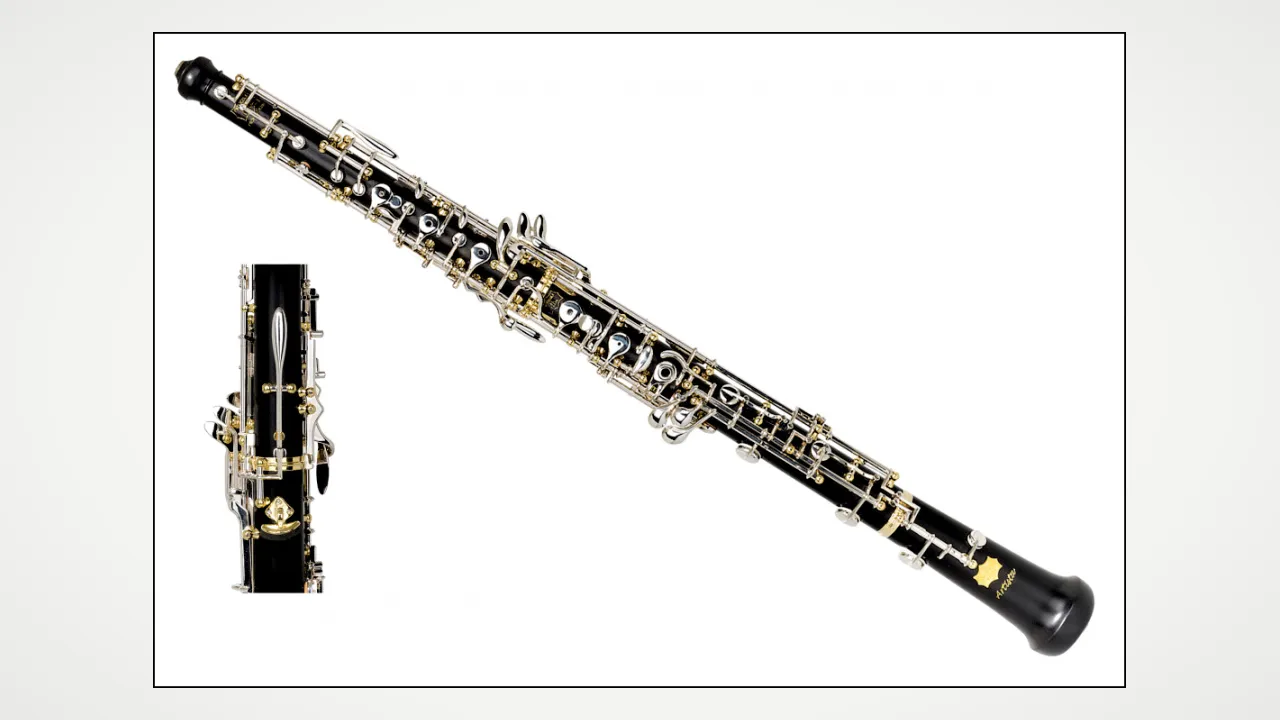
1. How many thin strips of cane buzz together at the top of an oboe?
2. What special job does the oboe perform right before an orchestra concert begins?
🤯 Mind-Blowing Fact • Grade 2
Most professional oboe players spend hours every week carving, scraping, and tying their own custom reeds with tiny knives!
✨ Word Sparks (Grade 2 Glossary)
Tap 🔊 to hear
cone
Shape starting narrow and widening toward bottom
staple
Small corked metal tube holding reed blades
solo
Melody played by one musician shining alone
🪝
How can an instrument with no mouthpiece at all make such a rich, singing sound?
1
Waking Up the Concert Hall
Imagine ninety musicians chattering and warming up onstage until one clear, glowing note floats effortlessly above the crowd. Instantly, violins twist their pegs and flutes slide their joints to match the unmistakable voice of the oboe.
2
The Secret of the Double Reed
Unlike a clarinet, an oboe has no plastic or rubber mouthpiece at the top. Instead, two paper-thin blades of cane are tied with colorful thread onto a tiny corked tube, buzzing together whenever the player blows.
3
From Playful Ducks to Graceful Swans
Inside its dark wooden body, the narrow air tunnel widens slowly like a . That shape gives the oboe a lively voice that waddles as the Duck in Peter and the Wolf and glides through Swan Lake.
1. Which character does the oboe play in Prokofiev's musical story Peter and the Wolf?
2. Why don't oboists buy one reed and use it forever?
🤯 Mind-Blowing Fact • Grade 3
Because so little air escapes through the tiny double reed, oboists often have to breathe OUT stale air before inhaling a fresh breath!
✨ Word Sparks (Grade 3 Glossary)
Tap 🔊 to hear
hautbois
French name meaning high or loud wood
shawm
Loud Renaissance ancestor of the modern oboe
overtones
Higher ringing pitches coloring a musical note
🪝
Why does blowing through an opening narrower than a grain of rice take more control than filling a giant tuba?
1
Tiny Opening, Mighty Presence
Take a deep breath and try exhaling through a gap thinner than a dime! That is the thrilling challenge every oboist masters. Even though only a trickle of air enters its double reed, the oboe's shimmering tone carries to the back balcony.
2
From French Hautbois to Modern Oboe
During the 1650s in France, court instrument makers Jean Hotteterre and Michel Danican Philidor tamed a loud outdoor horn called the for indoor concerts. They named their refined creation —French for high wood—which English speakers pronounced oboe!
3
Conical Bore Resonance
Peek inside the sixty-five-centimeter grenadilla wood body and you will see a narrow conical bore just four millimeters wide at the top, expanding gently toward the bell. Because it is cone-shaped, the air column vibrates with warm, singing and jumps cleanly by octaves.
4
The Orchestra's Tuning Anchor
Since the 1700s, orchestras have tuned to the oboe's concert A because its rich harmonics slice clearly through room noise and its narrow bore holds steady pitch.
1. What does the oboe's original French name, hautbois, literally mean?
2. What unusual breathing habit must oboists practice during long melodies?
🤯 Mind-Blowing Fact • Grade 4
Changes in mountain altitude or weather humidity affect cane fibers so strongly that touring oboists scrape different reed shapes for Denver than for sea-level cities!
✨ Word Sparks (Grade 4 Glossary)
Tap 🔊 to hear
partials
Individual harmonic frequencies blended inside one tone
Conservatoire
Standard modern French key system on oboes
back-pressure
Air resistance felt blowing against narrow openings
🪝
How did seventeenth-century French woodworkers turn a deafening street instrument into the orchestra's most expressive storyteller?
1
A Thread of Air Under High Pressure
Place two curved slivers of giant Mediterranean grass face-to-face, wrap them tightly onto a corked brass tube, and blow with focused abdominal pressure. Instantly, those twin blades clap open and shut hundreds of times per second, launching the bittersweet, unmistakably human cry of the oboe across the stage.
2
Conical Acoustics and Rich Harmonics
Why does an oboe sound poignant and penetrating while a flute of the exact same length sounds breezy and pure? Whereas a clarinet uses a uniform cylinder that suppresses even harmonics, the oboe's narrow conical bore—expanding from roughly four millimeters at the reed socket to sixteen millimeters at the bell—supports a complete harmonic series of both odd and even . Those strong upper harmonics give its concert A (440 Hz) laser-like clarity for tuning an orchestra.
3
Taming the Shawm at Versailles
For centuries, European towns echoed with outdoor shawms whose stiff reeds blasted parade music at ear-splitting volume. Around 1657 at King Louis XIV's French court, makers Jean Hotteterre and Michel Danican Philidor narrowed the bore, divided the body into three tunable joints, and let players grip the naked double reed directly between cushioned lips for delicate expression.
4
Artisan Reed Making and Nineteenth-Century Keys
In nineteenth-century Paris, Guillaume Triébert and François Lorée perfected the complex key system boasting forty-five interlocking levers. Even today, every serious oboist doubles as a master woodworker, scraping Arundo donax cane to hundredths of a millimeter so Tchaikovsky's Swan Lake theme can soar.
1. How does the oboe's narrow conical bore shape its harmonic sound compared to a cylindrical clarinet?
2. Where was the modern indoor oboe refined from the Renaissance shawm during the 1650s?
🤯 Mind-Blowing Fact • Grade 5
On many oboe notes, acoustic spectrum analyzers show that the second and third harmonics actually ring louder than the fundamental pitch itself!
✨ Word Sparks (Grade 5 Glossary)
Tap 🔊 to hear
harmonic series
Whole-number multiples of a fundamental sound frequency
Bernoulli effect
Fast airflow drop in pressure pulling blades shut
fork fingering
Closing lower holes below an open hole
🪝
Why does a truncated wooden cone driven by two microscopic cane blades command the tuning ritual of every symphony orchestra on Earth?
1
One Note That Unites Ninety Musicians
Moments before the conductor steps onto the podium, backstage chatter dissolves as the principal oboist rises—or remains calmly seated at center stage—and floats an unwavering A4 at 440 Hz into the hall. Neither the loudest nor the largest instrument onstage, the oboe anchors this centuries-old ritual through sheer acoustic physics and historical lineage.
2
Double-Reed Valve and Conical Impedance
Classified organologically as a double-reed conical aerophone, the modern concert oboe spans approximately 65 centimeters across three joints of dense Dalbergia melanoxylon (grenadilla). Sound originates in two symmetrical gouged, folded, and hand-scraped blades of Arundo donax cane bound onto a cork-sleeved metal tube called a staple. Under high intra-oral breath pressure, Bernoulli suction snaps the twin blades closed hundreds of times per second. Because this pressure-controlled valve feeds a narrow conical bore—expanding from ~4.2 millimeters beneath the reed well to ~16 millimeters at the flared bell—the closed cone behaves acoustically like an open pipe: it sustains both odd and even harmonics and overblows cleanly at the octave across a compass from B-flat3 (~233.1 Hz) to A6 (1,760 Hz).
3
Why Harmonics Outshine Fundamental Volume
Spectral analysis reveals a fascinating surprise: on many middle-register oboe notes, the second, third, and fourth harmonics carry greater acoustic energy than the fundamental frequency itself! That dense cluster of upper partials between 880 and 3,000 Hz penetrates orchestral ambient noise effortlessly, enabling string, brass, and wind players alike to lock onto pitch beats with pinpoint accuracy.
4
From Hotteterre's Hautbois to Triébert's Conservatoire System
Forged around 1657 by Jean Hotteterre and Michel Danican Philidor for Jean-Baptiste Lully's court ensembles under Louis XIV, the baroque hautbois originally sported just two keys and cross-fingered tone holes. Across nineteenth-century Paris, the Triébert family and François Lorée systematically engineered six progressive models culminating in the 45-key Conservatoire system, complete with semi-automatic octave vents and resonance fork keys.
5
Vocal Pathos Across Four Centuries
Because oboists sculpt reed tips down to tolerances thinner than 0.05 millimeters, every player cultivates an intensely personal sound. From Johann Sebastian Bach's weeping cantata sinfonias and Beethoven's Eroica Funeral March to Tchaikovsky's Swan Lake, Ravel's Le Tombeau de Couperin, and Ennio Morricone's Gabriel's Oboe, no woodwind speaks with deeper lyrical intimacy.