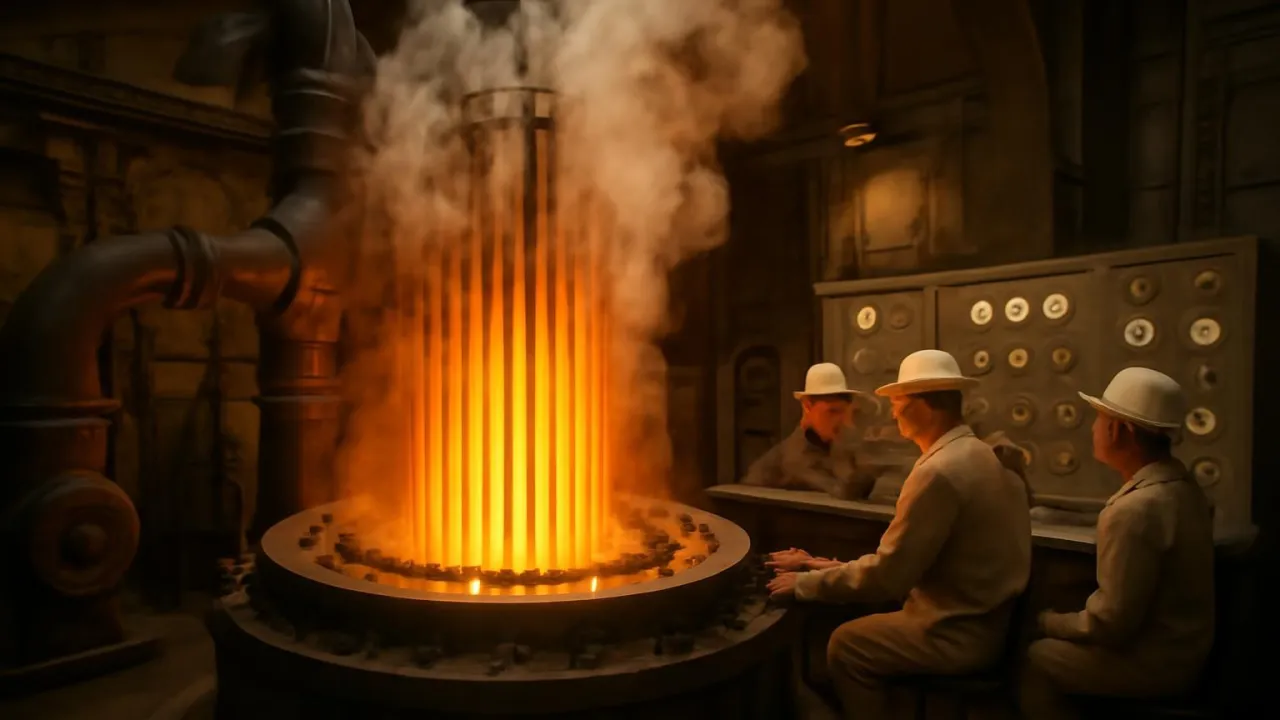
A nuclear reactor can run for years before it needs more fuel.
✨ Word Sparks (Grade 2 Glossary)
Tap 🔊 to hear
uranium
A special rock for making power
turbine
A wheel that spins to make energy
control room
Where people watch and guide machines
🪝
Can you imagine hearing pipes hiss and seeing steam swirl in a giant room?
1
The Humming Machine
Deep inside a power plant, a huge machine hums and glows with energy. People in white coats watch blinking lights and turn big dials to keep everything safe. This amazing place is where electricity for whole neighborhoods begins its journey.
2
Tiny Pieces, Big Heat
Special rocks called are placed in the machine’s middle. When tiny pieces called atoms break apart, they make a lot of heat and steam. The hot steam rushes through long pipes and feels very warm.
3
Spinning Up Power
The steam spins a giant wheel called a , which makes electricity for homes and schools. Thanks to this machine, lights and computers can work all day and night. It’s a powerful way to help people everywhere.
Nuclear reactors can run for years without needing new fuel.
✨ Word Sparks (Grade 3 Glossary)
Tap 🔊 to hear
fission
Breaking atoms to make energy
core
The center part of the reactor
chain reaction
One split atom makes more split
🪝
What if you could turn invisible pieces into huge bursts of energy?
1
The Secret Inside Atoms
Inside every atom, there are even tinier parts called protons and neutrons. When a uranium atom splits in a reactor, it’s called nuclear . This splitting releases a lot of heat and energy. Scientists control this reaction very carefully.
2
How the Reactor Works
Fuel rods full of uranium are placed deep inside the reactor . When atoms split, they start a , making more atoms break apart. The heat from this reaction turns water into steam. Thick concrete walls keep the energy safely inside.
3
Making Electricity for Cities
The steam rushes through pipes to spin a turbine. The turbine’s spinning motion generates electricity for thousands of homes and schools. Nuclear reactors can work day and night without stopping.
4
A Powerful Invention
The first nuclear reactor was built in 1942 by Enrico Fermi and his team. Their invention changed how the world makes electricity. Nuclear power plants now help many countries have cleaner energy. Scientists always work to make reactors safer and even more powerful.
A single nuclear reactor can power over a million homes at once.
✨ Word Sparks (Grade 4 Glossary)
Tap 🔊 to hear
radiation
Invisible energy from splitting atoms
control rods
Metal rods that slow the reaction
generator
A machine that makes electricity
🪝
Can you imagine a machine that unlocks the hidden power inside rocks?
1
Unlocking Atomic Energy
Every uranium atom holds an enormous amount of energy in its nucleus, the atom’s center. In a nuclear reactor, scientists use a process called fission to split these nuclei apart. When a neutron hits a uranium nucleus, it breaks, releasing heat and more neutrons. This chain reaction is carefully controlled to keep the reactor safe and steady.
2
How the Reactor Core Works
Fuel rods packed with uranium are arranged inside the reactor’s core, surrounded by water. made of special metals can be moved in or out to absorb neutrons and control the reaction. The heat from fission turns water into high-pressure steam, which is kept inside strong, thick walls for safety. The entire system is designed to prevent from escaping.
3
Turning Heat Into Electricity
The hot, pressurized steam rushes through pipes to spin a giant turbine. As the turbine spins, it drives a that produces electricity for entire cities. Nuclear reactors can generate huge amounts of power without creating air pollution or greenhouse gases.
4
Changing the World’s Energy
The first nuclear reactor was built in 1942 at the University of Chicago by Enrico Fermi and his team. This invention started a new era in energy production, making it possible to power cities with very little fuel. Today, nuclear reactors provide about 10% of the world’s electricity, helping countries reduce pollution and fight climate change.
2. Why are nuclear reactors important for the environment?
🤯 Mind-Blowing Fact • Grade 5
The energy from splitting one uranium atom is over a million times greater than burning a single carbon atom.
✨ Word Sparks (Grade 5 Glossary)
Tap 🔊 to hear
uranium-235
A special kind of uranium used for fission
electromagnetic induction
Turning movement into electricity with magnets
fusion
Joining atoms together to make energy
🪝
What if you could harness the energy inside every atom to power entire cities?
1
The Physics of Nuclear Fission
At the heart of a nuclear reactor lies the process of nuclear fission, where nuclei are bombarded by neutrons, causing them to split into smaller nuclei, additional neutrons, and a tremendous amount of heat energy. This chain reaction is self-sustaining but must be carefully regulated to prevent overheating or runaway reactions. Control rods made of materials like boron or cadmium absorb excess neutrons, allowing operators to fine-tune the rate of fission. The energy released from just one kilogram of uranium-235 equals about 24 million kilowatt-hours, far exceeding the output from burning fossil fuels. This powerful process is what makes nuclear reactors such efficient sources of electricity.
2
Engineering the Reactor Core
The reactor core contains hundreds of fuel rods, each packed with uranium oxide pellets, arranged in a precise geometric pattern to maximize efficiency and safety. Surrounding the core, a coolant—usually water—removes the intense heat generated by fission and carries it to a heat exchanger. The reactor vessel is built from thick steel and reinforced concrete, designed to withstand high pressures and contain radiation. Multiple safety systems, including emergency shutdown mechanisms and backup cooling pumps, ensure the reactor can be quickly stabilized in any situation. Engineers continually monitor temperature, pressure, and radiation levels from a central control room.
3
Transforming Heat Into Usable Power
The heat from the reactor turns water into high-pressure steam, which is directed to spin massive turbines connected to generators. As the turbines rotate, they convert mechanical energy into electrical energy through . A single large nuclear reactor can produce over 1,000 megawatts of electricity, enough to supply power to more than a million homes. Unlike fossil fuel plants, nuclear reactors emit no carbon dioxide during operation, making them a key technology for reducing greenhouse gas emissions. The efficiency and reliability of nuclear power have made it a cornerstone of modern energy systems worldwide.
4
Historical Impact and Global Reach
The first controlled nuclear chain reaction was achieved in 1942 at the University of Chicago under the leadership of physicist Enrico Fermi, marking the dawn of the atomic age. Since then, nuclear reactors have been built in over 30 countries, providing about 10% of the world’s electricity. They have enabled nations to reduce dependence on fossil fuels, improve air quality, and develop advanced technologies for medicine, industry, and space exploration. However, the technology also requires careful management of radioactive waste and strict safety protocols to prevent accidents. International cooperation and scientific research continue to improve reactor designs and address environmental concerns.
5
The Future of Nuclear Energy
Innovations such as small modular reactors, advanced safety systems, and new fuel types promise to make nuclear power even safer and more sustainable. Scientists are also exploring reactors, which could one day provide nearly limitless clean energy by fusing atoms instead of splitting them. As the world seeks solutions to climate change and growing energy needs, nuclear reactors remain a vital part of the global energy mix. Their ability to produce large amounts of reliable, carbon-free electricity makes them essential for powering cities, industries, and even future space missions. The story of the nuclear reactor is a remarkable example of how science and engineering can unlock the hidden power of nature.