1. What famous shape did New Horizons photograph shining brightly on Pluto's surface?
2. How long did it take speedy New Horizons to zoom past the Moon after launch?
🤯 Mind-Blowing Fact • Grade 2
New Horizons carries a tiny capsule holding ashes of astronomer Clyde Tombaugh—the young farm boy turned scientist who discovered Pluto in 1930!
✨ Word Sparks (Grade 2 Glossary)
Tap 🔊 to hear
hibernation
power-saving sleep mode during long travel
Charon
Pluto's biggest moon, half Pluto's width
Arrokoth
snowman-shaped icy world past Pluto
🪝
Why did New Horizons take 'space naps' during its nine-year race out to Pluto?
1
Fuzzy Dot to Crisp World
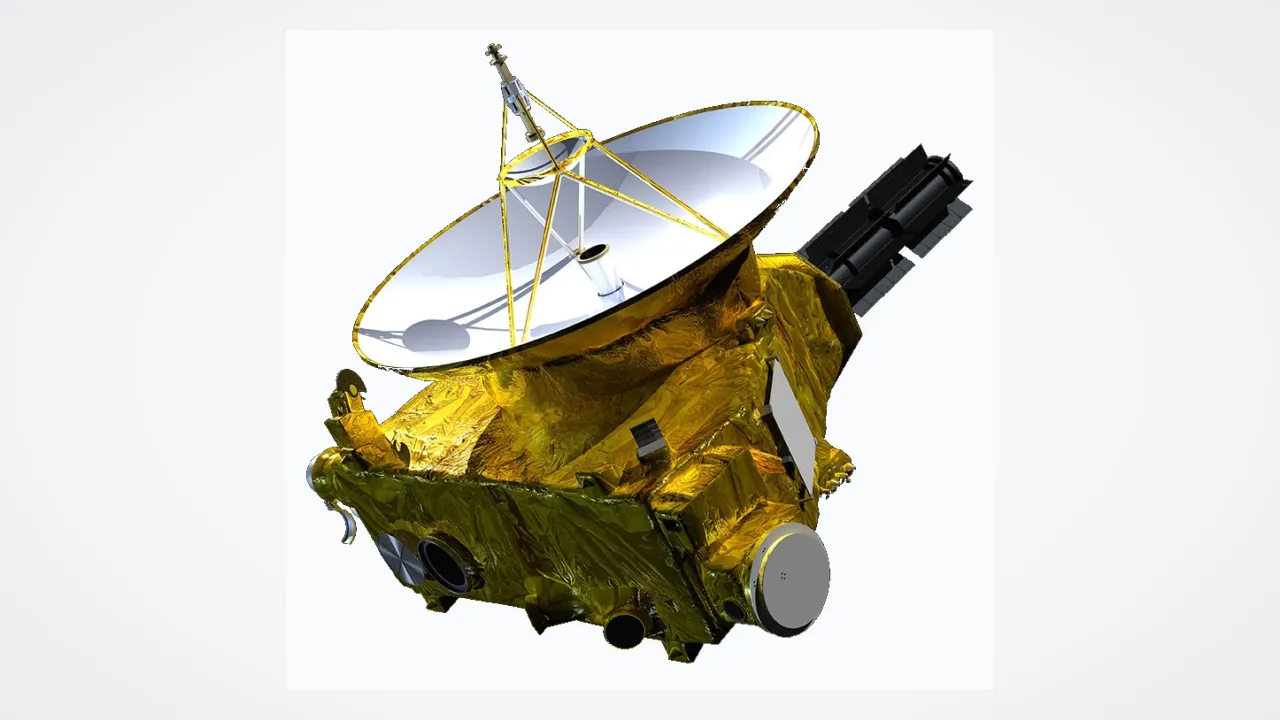
Even through the powerful Hubble Space Telescope, tiny Pluto three billion miles away looked like a blurry pixelated smudge! Launched in January 2006, the grand-piano-sized New Horizons probe raced outward to see Pluto up close for the very first time.
2
Hibernating Across Billions of Miles
To keep its instruments fresh for nine years, engineers put New Horizons into electronic '' naps for months at a time, waking it briefly for Jupiter's 2007 gravity boost and annual health checks.
3
July 2015 Flyby Magic
Sweeping 7,800 miles above Pluto on July 14, 2015, New Horizons revealed blue sky hazes, 11,000-foot water-ice mountains, big moon , and later a snowman-shaped Kuiper Belt rock named !
1. Why did mission controllers put New Horizons into 'hibernation' during much of its long cruise?
2. Whose ashes are riding aboard New Horizons past Pluto and into deep space?
🤯 Mind-Blowing Fact • Grade 3
On Pluto, water ice is frozen harder than granite bedrock, strong enough to build 11,000-foot mountain ranges while softer nitrogen ice flows slowly like glaciers through valleys!
✨ Word Sparks (Grade 3 Glossary)
Tap 🔊 to hear
Sputnik Planitia
smooth nitrogen-ice glacier forming Pluto's heart
planetesimal
ancient small building block of planets
bit rate
speed of digital computer data transmission
🪝
Why couldn't New Horizons slow down to orbit Pluto—and why did sending its photos home take sixteen months?
1
Too Fast to Brake!
Picture hurtling across three billion miles at over 30,000 miles per hour! Carrying enough rocket fuel to slam on the brakes at tiny Pluto would have made New Horizons way too heavy to launch fast in the first place. Instead, scientists planned one intense, automated flyby.
2
Active Glaciers Instead of Dead Craters
Before July 14, 2015, many scientists guessed freezing Pluto—at minus 380 degrees Fahrenheit—would be an ancient, crater-covered iceball. Surprise! Pluto's bright heart, , turned out to be a smooth, crater-free sea of churning nitrogen ice framed by Rocky-Mountain-tall blocks of water ice!
3
Trickling Data Across Three Billion Miles
From Pluto's distance, radio signals moving at light speed took 4.5 hours one way, trickling data at just 1,000 to 2,000 bits per second—taking sixteen full months to beam every Pluto photo home!
4
Farthest Encounter at Arrokoth
On New Year's Day 2019, four billion miles from Earth, New Horizons photographed Arrokoth—a pristine two-lobed untouched since the Solar System's birth!
1. Why did New Horizons zip right past Pluto instead of entering orbit around it?
2. How did scientists know Pluto's bright heart glacier Sputnik Planitia is geologically young and active?
🤯 Mind-Blowing Fact • Grade 4
When New Horizons launched in January 2006, its second flyby target Arrokoth hadn't even been discovered yet—astronomers found it with the Hubble Space Telescope eight years later in 2014!
✨ Word Sparks (Grade 4 Glossary)
Tap 🔊 to hear
convection
warm material rising while cool sinks
contact binary
two space lobes gently fused together
autonomous
operating smartly without live human steering
🪝
How can a tiny world three billion miles from the Sun power active nitrogen glaciers and towering ice volcanoes?
1
Precision Navigation Through a Cosmic Keyhole
Built by the Johns Hopkins Applied Physics Laboratory and led by Principal Investigator Alan Stern, the 478-kilogram New Horizons spacecraft threaded a 60-by-90-mile navigation target window beside Pluto after a 3-billion-mile journey—arriving just 72 seconds early! Because round-trip radio commands took nine hours, New Horizons executed hundreds of pre-programmed observations completely autonomously while sweeping past Pluto and its five moons: Charon, Nix, Hydra, Kerberos, and Styx.
2
Convection Powered by Radioactive Warmth
How does tiny Pluto stay geologically alive where sunlight is 1,000 times fainter than on Earth? Slow radioactive decay inside Pluto's rocky core releases gentle internal warmth! Beneath Sputnik Planitia's miles-thick nitrogen ice sheet, warmer ice rises in polygonal bubbles 20 miles wide before cooling and sinking—like cosmic lava lamps—while gravity anomalies hint at a slushy ammonia-rich liquid water ocean deep underground!
3
Blue Hazes and Charon's Red Polar Cap
Looking backward as Pluto eclipsed the Sun, cameras captured twenty delicate blue atmospheric haze layers of tholin particles settling onto the landscape. Even moon Charon sported a four-mile-deep canyon and a reddish north pole stained by methane escaping from Pluto!
4
Contact Binary Arrokoth (2019)
Steering toward a target discovered by Hubble in 2014—meaning its destination wasn't even known when New Horizons launched!—the probe imaged 22-mile-long Arrokoth at 43.4 AU, proving early planetesimals coalesced gently through pebble-cloud collapse rather than violent crashes.
1. What powers the slow-churning polygonal nitrogen ice cells inside Pluto's heart glacier?
2. What did Arrokoth's smooth, uncrushed two-lobe 'snowman' shape reveal about how planets formed?
🤯 Mind-Blowing Fact • Grade 5
All seven scientific cameras, spectrometers, and particle detectors aboard New Horizons run on just 28 watts of electricity combined—less power than a single old-fashioned living-room lightbulb!
✨ Word Sparks (Grade 5 Glossary)
Tap 🔊 to hear
binary system
two worlds orbiting shared balance point
true polar wander
planet crust rolling to rebalance weight
zodiacal dust
faint inner-solar-system comet dust glow
🪝
How did New Horizons prove that dwarf planets in the Kuiper Belt—the Solar System's 'Third Zone'—rival inner rocky worlds in geologic complexity?
1
Record C3 Launch Energy and Jovian Rehearsal
Departing Cape Canaveral on January 19, 2006 atop an Atlas V 551 with a Star 48B solid third stage, the 478-kilogram New Horizons spacecraft achieved a heliocentric velocity of 16.26 kilometers per second—the highest launch characteristic energy ever imparted directly from Earth. Thirteen months later, a Jupiter gravity assist added 4 kilometers per second while letting New Horizons' seven ultra-low-power instruments—consuming just 28 watts combined!—capture the first close-up movie of a 330-kilometer volcanic plume erupting from Io's Tvashtar volcano.
2
Cryogeology of the Pluto-Charon Binary
Sweeping 12,500 kilometers above Pluto at 13.78 kilometers per second on July 14, 2015, the Ralph multicolor imager, Alice UV spectrometer, and LORRI telescopic camera unveiled astonishing active cryogeology across the Pluto-Charon binary—whose center of mass lies outside Pluto in open space! Beyond Sputnik Planitia's Rayleigh-Benard nitrogen convection cells and floating water-ice massifs, New Horizons identified putative cryovolcanic domes Wright Mons and Piccard Mons rising four to seven kilometers high, sculpted bladed methane 'penitentes' across Tartarus Dorsa, and a tenuous 10-microbar nitrogen atmosphere cooled unexpectedly by hydrogen cyanide radiation so atmospheric escape ran a hundredfold slower than pre-flyby models.
3
True Orbital Alignment of Sputnik Planitia
Geophysicists noticed Sputnik Planitia sits squarely opposite tidally locked Charon along Pluto's tidal axis—implying a dense subsurface ammonia-water ocean beneath an thinned ice shell caused '' that rolled the giant basin to the equator!
4
Cold Classical Kuiper Belt Object Arrokoth
Targeting cold classical Kuiper Belt object 486958 Arrokoth at 43.4 AU on January 1, 2019 from just 3,500 kilometers away, New Horizons resolved two flattened lenticular lobes—Ultima and Thule—fused seamlessly at speeds below a few meters per second, coated in methanol ice and complex organic macromolecular solids.
5
Mapping the Outer Heliosphere and Cosmic Background
Now past 60 AU and cruising at 13.8 kilometers per second, New Horizons measures interstellar pickup ions, maps Kuiper Belt dust extending surprisingly far outward, and images the cosmic optical background free from inner glare.