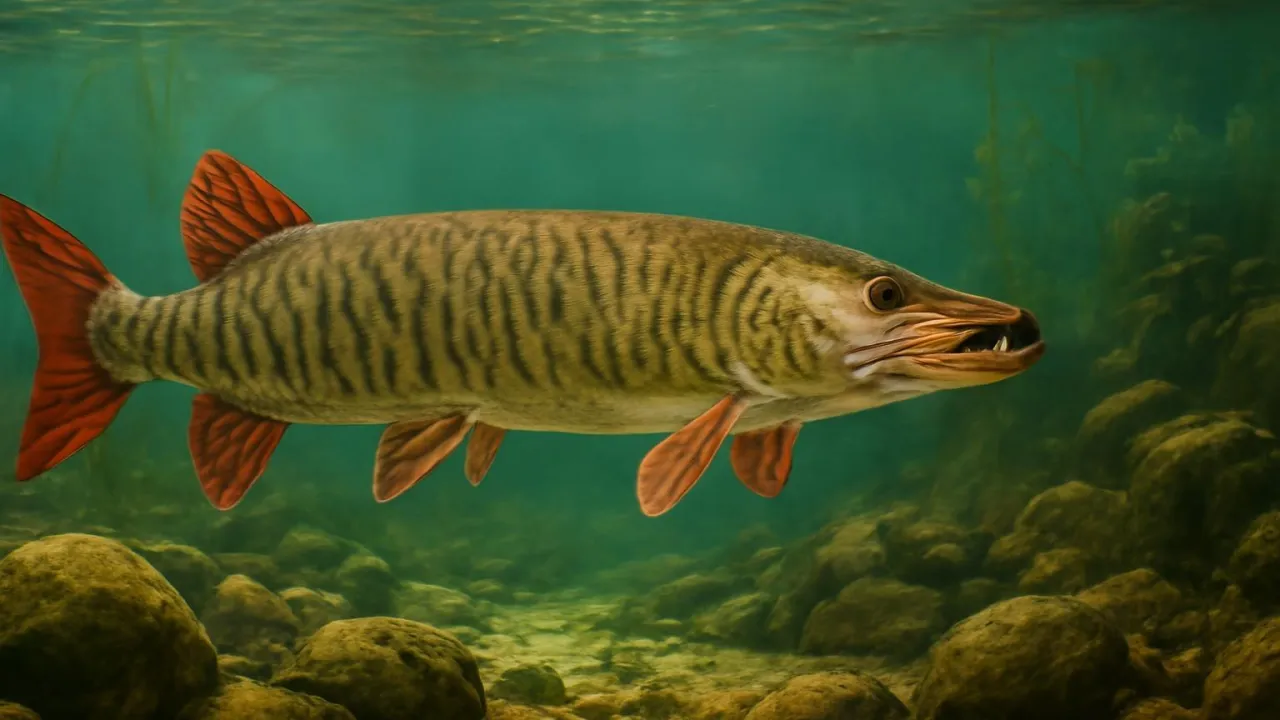
Muskellunge can strike prey with lightning speed, faster than many other fish!
✨ Word Sparks (Grade 3 Glossary)
Tap 🔊 to hear
camouflage
Colors or patterns that help hide an animal
predator
An animal that hunts other animals for food
adaptation
A body feature that helps survival
🪝
Did you know muskellunge are called the 'fish of ten thousand casts' by anglers?
1
Muskellunge Habitat and Camouflage
Muskies live in freshwater lakes and rivers across North America. Their bodies are patterned with spots and stripes that provide . This helps them blend into plants and shadows underwater. Camouflage protects muskies from and helps them sneak up on prey.
2
Life Cycle and Growth
Muskellunge eggs hatch into tiny fry that hide in shallow water. As they grow, muskies develop strong muscles and sharp teeth. These help them become powerful . Muskies can grow up to six feet long and weigh over 30 pounds.
3
Physical Features and Adaptations
The muskellunge’s long, slender body allows it to swim quickly through water. Its sharp teeth are perfect for gripping slippery fish. Muskies have dorsal fins near their tails that help with sudden turns. These features make muskies excellent ambush .
4
Hunting and Diet
Muskies hunt by hiding among plants and waiting for prey to come close. They eat fish, frogs, and small mammals. Their quick bursts of speed help them catch food before it escapes. Muskies play an important role as top in their ecosystem.
1. What helps muskies hide from prey and predators?
2. Why do muskies have sharp teeth?
🤯 Mind-Blowing Fact • Grade 4
Muskellunge can accelerate from rest to top speed in less than a second to catch prey!
✨ Word Sparks (Grade 4 Glossary)
Tap 🔊 to hear
apex predator
The top hunter in an ecosystem
nutrient cycling
Movement of nutrients in nature
spawn
When fish lay eggs to make babies
🪝
How does the muskellunge’s body help it survive in North American waters?
1
Habitat and Geographic Range
Muskellunge inhabit freshwater lakes and rivers primarily in the northern United States and Canada. They prefer clear waters with abundant aquatic vegetation, which provides shelter and hunting grounds. The presence of plants causes muskies to develop camouflage patterns that blend with their surroundings. This adaptation increases their survival and hunting success.
2
Physical Adaptations and Hunting
The muskellunge’s elongated body and powerful muscles enable sudden bursts of speed to ambush prey effectively. Sharp, backward-pointing teeth prevent prey from escaping once caught. Their dorsal fins near the tail help with quick turns during hunting chases. These physical traits create a highly efficient predator in freshwater ecosystems.
3
Role in the Ecosystem
As , muskies regulate populations of smaller fish and amphibians, maintaining ecological balance. Their hunting controls prey numbers, which affects food webs and . Human activities such as fishing and habitat changes impact muskellunge populations. Conservation efforts aim to protect their habitats and ensure sustainable populations.
4
Life Cycle and Growth Patterns
Muskellunge in spring, laying thousands of eggs in shallow, vegetated areas. The fry hatch and hide in plants to avoid predators. Muskies grow rapidly during their first years, developing strong teeth and muscles for hunting. Their long lifespan allows them to reproduce multiple times, supporting population stability.
Muskellunge can swim up to 35 miles per hour, making them one of the fastest freshwater fish!
✨ Word Sparks (Grade 5 Glossary)
Tap 🔊 to hear
Esocidae
The family of fish muskellunge belong to
acceleration
How fast something speeds up
catch-and-release
Fishing then letting fish go free
🪝
What makes the muskellunge one of North America’s most formidable freshwater predators?
1
Scientific Classification and Distribution
The muskellunge, scientifically known as Esox masquinongy, belongs to the family. It is native to freshwater ecosystems in the northern United States and Canada, particularly in the Great Lakes region. Its distribution spans clear lakes and slow-moving rivers with abundant aquatic vegetation. This habitat preference supports its ambush hunting strategy and camouflage.
2
Physiological Mechanics and Hunting Strategy
Muskellunge possess a streamlined, elongated body that reduces water resistance, allowing rapid . Their muscular tails provide powerful thrusts for sudden bursts of speed, reaching up to 35 miles per hour. Sharp, backward-curving teeth firmly grasp slippery prey, preventing escape. Dorsal and anal fins positioned near the tail enhance maneuverability during high-speed chases.
3
Conservation Status and Human Impact
Although muskellunge populations remain stable in many areas, overfishing and habitat degradation threaten some populations. Conservation programs promote fishing and habitat restoration to maintain sustainable muskellunge numbers. Understanding muskies’ ecological role helps balance human recreation with species preservation. Their status is monitored by fisheries agencies across North America.
4
Botanical and Ecological Interactions
Muskellunge rely heavily on aquatic plants for cover, which serve as both hunting grounds and spawning sites. These plants contribute to oxygen levels and nutrient cycling in freshwater ecosystems. The muskellunge’s presence influences prey fish behavior and population dynamics, impacting the entire food web. Maintaining healthy aquatic vegetation is crucial for muskellunge survival.
5
Quantitative Comparisons and Records
Adult muskellunge can grow up to 6 feet (1.8 meters) and weigh over 30 pounds (13.6 kilograms). They can accelerate from rest to top speed in under one second, reaching speeds near 35 miles per hour (56 kilometers per hour). These speeds surpass many other freshwater fish predators. Muskies’ longevity can reach 15 years or more, allowing multiple breeding cycles.