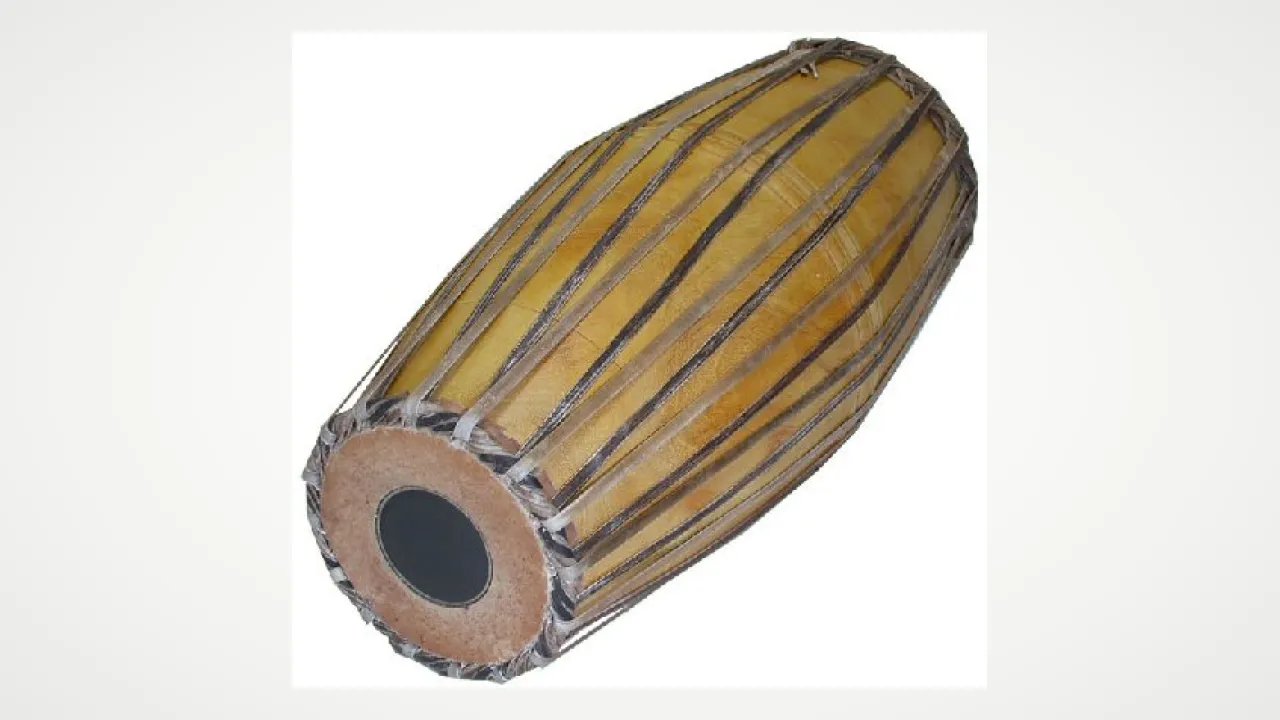
2. Why does a player press wet wheat dough onto the wider left drumhead before a show?
🤯 Mind-Blowing Fact • Grade 2
Tiny pieces of dried reed grass are tucked right between the leather layers of the right drumhead to give certain mridangam strokes a crisp, sparkling buzz!
✨ Word Sparks (Grade 2 Glossary)
Tap 🔊 to hear
Sanskrit
Classical ancient language of India
seasoned
Dried slowly so wood stays strong and crack-free
semolina
Coarse wheat grain mixed with water for paste
🪝
Why does the ancient Sanskrit name of this wooden drum actually mean 'body of clay'?
1
Ancient Rhythms Carved in Stone and Wood
Thom-tha-kita-thaka! Visit thousand-year-old temple walls in South India and you will see stone carvings of dancers and musicians playing a sleek barrel drum laid sideways across their laps! That honored instrument is the mridangam.
2
From Ancient Clay to Jackfruit Wood
Its name comes from ancient words meaning 'clay body,' because the very earliest mridangams thousands of years ago were shaped from baked earth! Today, artisans hollow out a single log of jackfruit wood and lace two layered leather heads tightly together with long buffalo-hide straps.
3
Permanent Black Spot, Fresh Left Paste
On the smaller right head sits a permanent black spot that rings like a bright bell, while the larger left head gets a fresh dab of wet dough before every concert!
1. Why does the word 'mridangam' translate from Sanskrit as 'body of clay'?
2. How is a mridangam held while performing in a South Indian Carnatic concert?
🤯 Mind-Blowing Fact • Grade 3
During a Carnatic concert's thrilling drum feature—called a Tani Avartanam—the singers and violinists pause their melodies while the mridangam soloist weaves breathtaking mathematical rhythm puzzles for fifteen minutes or more!
✨ Word Sparks (Grade 3 Glossary)
Tap 🔊 to hear
Carnatic
Classical music tradition of southern India
karanai
Permanent black harmonic tuning spot on right head
konnakol
South Indian art of spoken vocal percussion
🪝
How can stacking three cut-out leather rings on one end of a hollow log unlock more than a dozen distinct tone colors?
1
Rhythmic Pillar of Carnatic Music
Tha-ka-dhi-mi, tha-ka-jhu-nu! In South Indian concerts and graceful Bharatanatyam classical dance, one horizontal barrel drum anchors every soaring melody and intricate footstep: the mridangam! Both ends share a single hollow jackfruit-wood air chamber, meaning every strike on the left subtly breathes against the skin on the right.
2
Multi-Layer Leather Engineering
Neither head is just a plain single sheet of skin! On the smaller right head (valanthalai), builders layer goat, cow, and buffalo hides trimmed into neat concentric rings, crowned in the center with a permanent black paste spot called the made of iron-rich stone powder and cooked rice. Tapping the outer leather ring, inner skin, or black spot produces totally different bell-like harmonic tones!
3
Coupled Resonance Inside the Barrel
Meanwhile, pressing damp semolina dough onto the wider left head (thoppi) drops its pitch precisely an octave below the right head! Using wooden wedges and a tuning stone, the player taps the braided leather rim until the drum matches the singer's exact tonic pitch.
4
Konnakol: Vocal Percussion Mathematics
percussionists also master —performing dazzling mathematical rhythm solos at lightning speed using spoken syllables alone!
1. What happens inside a mridangam because both drumheads share one hollow wooden barrel?
2. What is 'konnakol' in South Indian musical tradition?
🤯 Mind-Blowing Fact • Grade 4
Different concert singers sing in different key ranges—so professional mridangam players own several drums of slightly different lengths and diameters to match high 'female-pitch' or lower 'male-pitch' concerts perfectly!
✨ Word Sparks (Grade 4 Glossary)
Tap 🔊 to hear
asymmetrical
Having two sides unequal in size or shape
radially
Arranged like wheel spokes pointing from center
subdivide
Split steady beats into smaller equal parts
🪝
Why is a mridangam barrel carved slightly asymmetrical—and why do players tuck sixteen tiny bits of reed grass inside its leather layers?
1
Two Thousand Years of Acoustic Mastery
Mentioned in ancient Tamil epics like the Silappatikaram and sculpted across medieval Chola stone temples, the South Indian mridangam is far more than a rhythmic timekeeper—it is an acoustic marvel whose coupled membranes sing clear harmonic overtones alongside thunderous bass!
2
Asymmetrical Jackfruit Shell and Reed Buzz
Examine a concert mridangam closely—measuring 55 to 62 centimeters long depending on whether it accompanies higher-pitched female/flute soloists or lower-pitched male vocalists—and you notice its hollowed jackfruit-wood barrel bulges slightly off-center toward the wider left bass head! Connecting both ends are continuous buffalo-rawhide straps (vaar) tensioning triple-layered leather heads. On the smaller right head, artisans slide sixteen tiny slivers of dried reed stem between the outer buffalo-hide ring and inner goatskin layer. When struck with crisp finger snaps (chapu), those reeds set up a delicate, shimmering sympathetic buzz that helps high harmonics carry across large halls!
3
Five Harmonic Modes and Coupled Air Physics
Just as C.V. Raman demonstrated in his famous physics papers, the right head's permanent black karanai spot—ground from manganese-iron stone (kittan) and boiled rice—aligns circular drum vibrations into five pure harmonic overtones! Simultaneously, moist wheat semolina pressed onto the left thoppi tunes its fundamental one octave lower, letting both heads converse across one shared air column.
4
Tani Avartanam and Mathematical Talas
Guided by masters like Palghat Mani Iyer and Umayalpuram K. Sivaraman, mridangam artists beats into threes, fours, fives, sevens, and nines during thrilling solo exchanges!
1. Why are tiny slivers of dried reed grass tucked radially between the leather layers of the right head?
2. Why do concert mridangam soloists keep multiple drums of different barrel lengths (such as 22-inch vs. 24-inch)?
🤯 Mind-Blowing Fact • Grade 5
In Sir C.V. Raman's 1920 laboratory photos of a vibrating mridangam head dusted with fine white sand, the sand leaped automatically into crisp geometric star-and-ring Chladni lines proving pure third, fourth, and fifth harmonics!
✨ Word Sparks (Grade 5 Glossary)
Tap 🔊 to hear
annular
Shaped like a flat ring around a circle
polyrhythm
Layering contrasting beat subdivisions at the same time
sruti
Foundational tonic reference pitch in Carnatic music
🪝
How did ancient South Indian artisans engineer coupled bimodal air-membrane acoustics, harmonic Chladni nodal alignment, and polyrhythmic gati mathematics inside a single jackfruit log?
1
Sovereign Percussion of the Carnatic Stage
Revered in South Indian tradition as the 'Deva Vadya' (instrument of the celestials) and traced through Sangam Tamil literature and Chola temple iconography, the mridangam—classified organologically as a double-headed barrel membranophone (211.222.1)—stands among the most acoustically sophisticated drums ever conceived.
2
Composite Membranes and Five-Harmonic Karanai Physics
Turned on a lathe from a single seasoned block of Artocarpus heterophyllus (jackfruit wood) roughly 55 to 62 centimeters long with an asymmetrical waist offset toward the bass end, the shell couples two multi-ply apertures (~16–18 centimeters right valanthalai; ~19–21 centimeters left thoppi) via a continuous 12-to-15-meter buffalo-hide lacing strap (vaar) threaded through forty-eight perimeter eyelets. On the valanthalai, an outer water-buffalo damper ring (meetttu thol) overlies an inner goatskin membrane—separated by sixteen radially inserted straw reeds that impart micro-transient brilliance—while the center carries a permanent, radially tapered black patch (karanai or soru) compounded from finely pulverized ferromanganese slag (kittan) and boiled rice starch. As Sir C.V. Raman's Chladni sand-pattern experiments revealed, this central mass loading and annular edge damping reorganize inharmonic Bessel modes so that up to nine degenerate modes converge into five exact integer harmonics (1f through 5f)!
3
Vibro-Acoustic Air Coupling and Gumki Bass
Unlike separate twin tabla shells, both mridangam membranes enclose a single internal air cavity! Applying moistened coarse wheat semolina (ravai) centrally—or modern acoustic elastomer putty—onto the three-ring buffalo/goatskin left thoppi lowers its resonance precisely an octave below the right tonic (), enabling low-frequency acoustic coupling across the barrel and supple wrist-glided pitch inflections (gumki).
4
Split-Finger Strokes and Nadai Polyrhythms
Using wooden tension blocks and a striking stone (kallu) against the braided hoop to lock pitch within fractions of a semitone, virtuosi execute split-finger strokes—such as Nam, Din, Araichapu, and lightning-fast Gumki-Tha—across Carnatic music's 35 Suladi Sapta Talas and five rhythmic subdivisions (nadais/gatis of 3, 4, 5, 7, and 9 pulses per beat), culminating in geometric korvai and mora cadences.
5
Tanjore Versus Pudukkottai Schools and Modern Masters
Shaped into modern concert brilliance by the lyrical Tanjore school (Narayanaswami Appa) and intricate Pudukkottai school (Manpoondia Pillai), twentieth-century titans Palghat Mani Iyer, Palani Subramania Pillai, Vellore Ramabhadran, Karaikudi Mani, and Umayalpuram K. Sivaraman carried Carnatic percussion onto global stages.