🇺🇸 U.S. HISTORY
🏛️ Space Exploration & Scientific Milestone • Apollo 11 (July 20, 1969)
VA History & Social Science SOL K.1, 1.2, 2.4, VS.1–VS.10, USI & USII
Moon Landing (July 20, 1969)
One Giant Leap: Humanity's First Footprints on Another World
Grade 5 • Advanced • 310 words
⏳ Era / StatehoodJuly 20, 1969 (Apollo 11 Launched July 16, Splashed Down July 24)
🗺️ Region / Capital240,000 Miles from Kennedy Space Center, FL to the Moon's Sea of Tranquility
📜 Key MilestoneAstronauts Neil Armstrong, Buzz Aldrin & Michael Collins completed humanity's first lunar landing
⚡ Historical SparkUnited 400,000 scientists, engineers, and Virginia NASA Langley mathematicians to turn humanity's oldest dream into reality
🤯 Mind-Blowing Fact • Grade 1
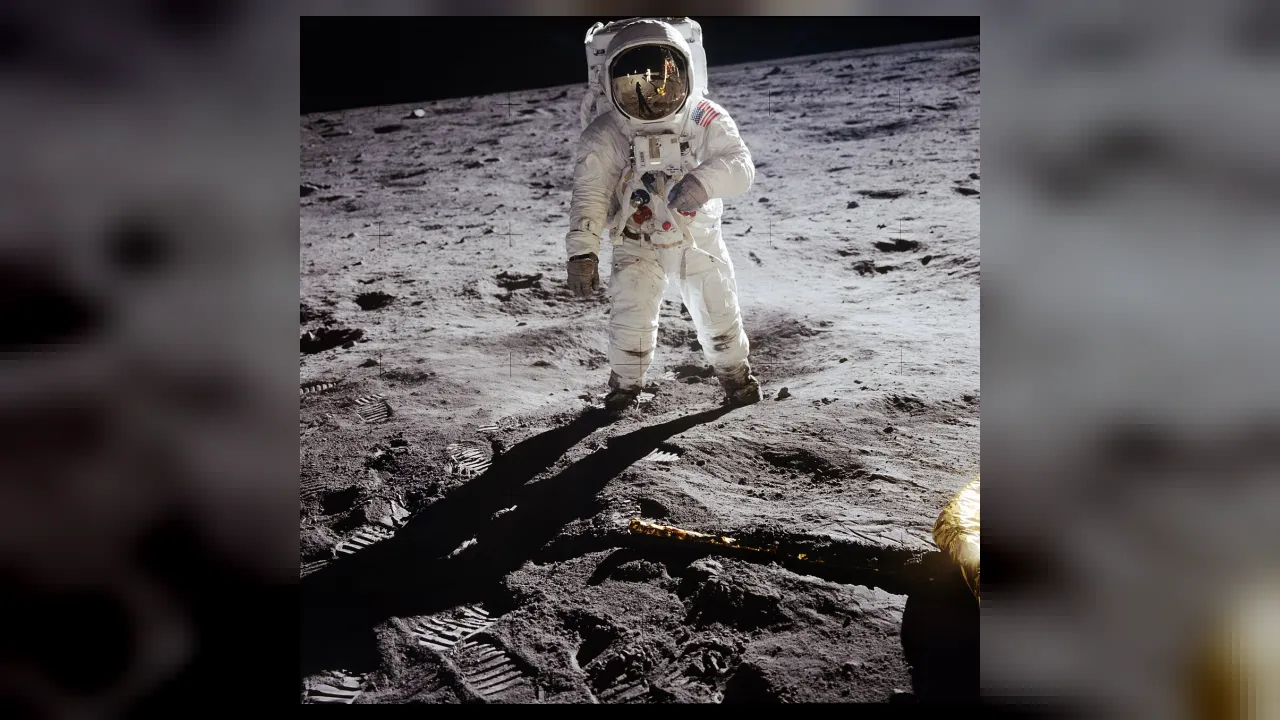
Because the Moon has no wind or rain to wash dust away, Neil Armstrong's and Buzz Aldrin's bootprints are still sitting crisp and clear on the Moon right now!
✨ Word Sparks (Grade 1 Glossary)
Tap 🔊 to hear
astronaut
Trained explorer who travels into outer space
lunar
Having to do with Earth's Moon
orbit
Curved path circling around a moon
🪝
What was it like to bounce in puffy white spacesuits on the dusty gray Moon?
1
Blastoff on Apollo 11!
Three, two, one—liftoff! Giant orange flames push the tall Saturn V rocket into the sky. Three brave zoom toward the glowing Moon.
2
The Eagle Has Landed
On July 20, 1969, a small lander named Eagle touches down safely. Neil Armstrong climbs down the ladder and presses the first bootprint into Moon dust!
3
Safe Splashdown Home
Buzz Aldrin joins him to collect shiny Moon rocks while Michael Collins above. Soon all three splash down safely in the blue ocean!
1. Who was the very first person to step onto the surface of the Moon on July 20, 1969?
2. Why are the Apollo 11 footprints still on the Moon decades later?
🤯 Mind-Blowing Fact • Grade 2
When Neil Armstrong safely landed the Eagle on the Moon after dodging a boulder-filled crater, he had less than thirty seconds of landing fuel left in the tank!
✨ Word Sparks (Grade 2 Glossary)
Tap 🔊 to hear
module
Separate spacecraft section built for special jobs
crater
Bowl-shaped dent on the Moon's surface
gravity
Invisible pull holding feet to the ground
🪝
How did 600 million people on Earth watch astronauts walk on the Moon live on television?
1
A Bold Goal for the 1960s
Look up at the bright full Moon tonight—it sits nearly a quarter-million miles away! In 1961, President John F. Kennedy challenged America to land an astronaut on the Moon and return safely before the decade ended.
2
Touchdown With Seconds of Fuel Left
Launched atop a 363-foot Saturn V rocket on July 16, 1969, Apollo 11 reached lunar orbit three days later. While Michael Collins piloted Columbia overhead, Neil Armstrong steered the lander Eagle past boulders to a smooth spot, calling out: 'The Eagle has landed!'
3
One Small Step
Watched on snowy black-and-white TVs by six hundred million people worldwide, Armstrong stepped onto the Sea of Tranquility saying, 'That's one small step for a man, one giant leap for mankind.'
1. What was the name of the four-legged lunar lander that carried Neil Armstrong and Buzz Aldrin down to the Moon?
2. Which Apollo 11 astronaut orbited the Moon solo in the command module Columbia to make sure his crewmates could get home?
🤯 Mind-Blowing Fact • Grade 3
Skilled seamstresses at Playtex in Delaware sewed the Apollo 11 spacesuits by hand out of twenty-one protective layers, accurate to one sixty-fourth of an inch!
✨ Word Sparks (Grade 3 Glossary)
Tap 🔊 to hear
trajectory
Exact curved flight path through outer space
seismometer
Instrument measuring tiny ground shakes or moonquakes
tranquility
Peaceful quietness without storms or loud noise
🪝
Did you know astronauts practiced landing on the Moon right in Hampton, Virginia?
1
Practicing in Virginia First
Hear rocket thrusters roar beneath a giant steel A-frame gantry in Hampton, Virginia! Before Apollo 11 ever left Earth, Neil Armstrong and fellow astronauts practiced flying in one-sixth Moon gravity at NASA Langley Research Center's Lunar Landing Research Facility, while mathematician Katherine Johnson calculated exact spacecraft trajectories.
2
Riding the Mighty Saturn V
On July 16, 1969, the 363-foot Saturn V—taller than the Statue of Liberty—thundered off Launch Pad 39A in Florida. Four hundred thousand engineers, seamstresses who hand-stitched twenty-one-layer spacesuits, and technicians made every switch work.
3
Science on the Sea of Tranquility
On July 20, 1969, Armstrong and Buzz Aldrin spent over two hours outside on the Sea of . They set up a to measure 'moonquakes,' placed a laser mirror scientists still bounce beams off today, and gathered forty-seven pounds of ancient Moon rocks.
4
We Came in Peace
Before blasting back up to rejoin Michael Collins, they left a metal plaque on Eagle's leg reading: 'We came in peace for all mankind.'
1. How did NASA Langley Research Center in Hampton, Virginia help make the Apollo 11 Moon landing succeed?
2. What peaceful message was engraved on the plaque Apollo 11 left on the Moon?
🤯 Mind-Blowing Fact • Grade 4
Software engineer Margaret Hamilton invented the term 'software engineering' while designing the fault-tolerant Apollo computer code that kept the '1202' alarm from aborting the Moon landing!
✨ Word Sparks (Grade 4 Glossary)
Tap 🔊 to hear
rendezvous
Planned meeting of two spacecraft in orbit
gantry
Tall steel framework supporting rockets or test craft
retroreflector
Special mirror bouncing laser beams straight back
🪝
How did a Virginia engineer's 'Lunar Orbit Rendezvous' idea and a tiny computer save Apollo 11?
1
Solving the Rocket Weight Puzzle
Picture NASA Langley aerospace engineer John Houbolt standing before skeptical directors in 1961 with a bold math insight! Landing a single giant rocket directly on the Moon and launching the whole ship back to Earth would require an impossibly heavy booster. Instead, Houbolt championed 'Lunar Orbit '—sending a lightweight bug-like Lunar Module down to the surface while the main Command Module waited in lunar orbit.
2
400,000 Minds Behind Three Astronauts
Fulfilling President Kennedy's May 1961 goal required testing through Projects Mercury and Gemini, plus Virginia mathematician Katherine Johnson's ultra-precise navigation equations connecting lunar orbit to Earth splashdown. Software pioneer Margaret Hamilton and her MIT team also programmed the Apollo Guidance Computer—which had far less memory than a modern wristwatch—to prioritize critical tasks automatically.
3
Program Alarms Over the Crater
Minutes before touchdown on July 20, 1969, '1202' computer overload alarms flashed inside Eagle! Thanks to Hamilton's clever error-recovery software and twenty-six-year-old Houston guidance officer Steve Bales calling 'Go!', Neil Armstrong manually flew past a football-field-sized crater studded with boulders to land safely with twenty-five seconds of fuel remaining.
4
Scientific Treasures From Another World
Armstrong and Buzz Aldrin collected 21.5 kilograms (47.5 pounds) of basaltic lunar rock, deployed a laser-ranging , and reunited cleanly with Michael Collins—splashing down in the Pacific Ocean on July 24, 1969, and inspiring spin-off inventions from cordless tools to water purifiers.
1. What smart mission design championed at NASA Langley in Virginia made the Moon landing possible with a single Saturn V rocket?
2. How did Margaret Hamilton's Apollo Guidance Computer software save the landing when '1202' alarms sounded?
🤯 Mind-Blowing Fact • Grade 5
Scientists at observatories on Earth still bounce laser pulses off the mirror array Neil Armstrong and Buzz Aldrin placed on the Moon in 1969—measuring that the Moon slowly spirals 3.8 centimeters (1.5 inches) farther from Earth every year!
✨ Word Sparks (Grade 5 Glossary)
Tap 🔊 to hear
regolith
Powdery layer of crushed rock covering Moon
suborbital
Reaching space briefly without circling Earth completely
telemetry
Radio data beamed back from distant spacecraft
🪝
How did America go from fifteen minutes of human spaceflight in May 1961 to walking on the Moon just eight years and two months later?
1
Cold War Space Race and Kennedy's Challenge
When President John F. Kennedy stood before Congress on May 25, 1961, proposing to land an American on the Moon before 1970, NASA had logged just fifteen minutes of human flight aboard Alan Shepard's Freedom 7. Driven by peaceful scientific competition during the Cold War Space Race, Project Apollo mobilized 400,000 engineers, scientists, mathematicians, and skilled tradespeople across 20,000 universities and industrial contractors.
2
Saturn V Physics and Langley's Orbital Math
Escaping Earth's gravity at 25,000 miles per hour required the three-stage Saturn V rocket, generating 7.5 million pounds of thrust at liftoff. Equally crucial were intellectual breakthroughs at Virginia's NASA Langley Research Center: John Houbolt's Lunar Orbit Rendezvous architecture, realistic reduced-gravity tethered flight simulators in Hampton, and orbital mechanics verified by mathematician Katherine G. Johnson to synchronize the Lunar Module's ascent from the Moon back to the orbiting Command Module.
3
Descent to Mare Tranquillitatis
Launched July 16, 1969, Commander Neil Armstrong, Lunar Module Pilot Edwin 'Buzz' Aldrin, and Command Module Pilot Michael Collins entered lunar orbit seventy-six hours later. On July 20, undocking the spidery Grumman-built Lunar Module Eagle, Armstrong and Aldrin relied on MIT's priority-interrupt flight software—led by Margaret Hamilton—to overcome radar-data '1202' and '1201' executive overflows, touching down at 20:17 UTC on Mare Tranquillitatis (the Sea of Tranquility) with twenty-five seconds of hover propellant remaining.
4
Lunar Geology and Global Broadcast
At 10:56 p.m. EDT, an estimated 650 million viewers—nearly one-fifth of humanity—watched live relayed through tracking dishes in Australia and California as Armstrong stepped onto the fine, angular . Over a 2.5-hour extravehicular activity, the crew deployed a passive seismic experiment, a solar-wind collector, and a laser retroreflector array (which still measures the Moon drifting 3.8 centimeters away from Earth each year!), collecting 21.55 kilograms of 3.7-billion-year-old volcanic basalts.
5
Lasting Scientific and Technological Legacy
After blasting off from Eagle's descent stage, docking with Collins in Columbia, and splashing down safely in the Pacific on July 24, 1969, Apollo 11 inaugurated five subsequent lunar landings (Apollo 12, 14, 15, 16, and 17) and catalyzed miniature integrated circuits, satellite telecommunications, solar cells, and modern planetary science.