🇺🇸 U.S. HISTORY
🏛️ Civil Rights Nonviolent Milestone • 1955–1956
VA History & Social Science SOL K.1, 1.2, 2.4, VS.1–VS.10, USI & USII
Montgomery Bus Boycott
How 381 Days of Walking Changed America's City Buses
Grade 5 • Advanced • 308 words
⏳ Era / StatehoodDecember 5, 1955 – December 20, 1956 (381 Days)
🗺️ Region / CapitalMontgomery, Alabama
📜 Key Milestone40,000+ residents walked and carpooled until the Supreme Court outlawed bus segregation
⚡ Historical SparkLaunched Dr. Martin Luther King Jr. onto the national stage and proved peaceful community action can overturn unjust laws
🤯 Mind-Blowing Fact • Grade 1
Today you can step right inside the actual green-and-cream Montgomery city bus where Rosa Parks sat, preserved at The Henry Ford Museum in Michigan!
✨ Word Sparks (Grade 1 Glossary)
Tap 🔊 to hear
boycott
Peacefully stop buying or riding something unfair
courage
Doing what is right despite feeling scared
carpool
Neighbors sharing car rides to help out
🪝
Could walking to work and school for a whole year change an unfair city rule?
1
Rosa Parks Stays Seated
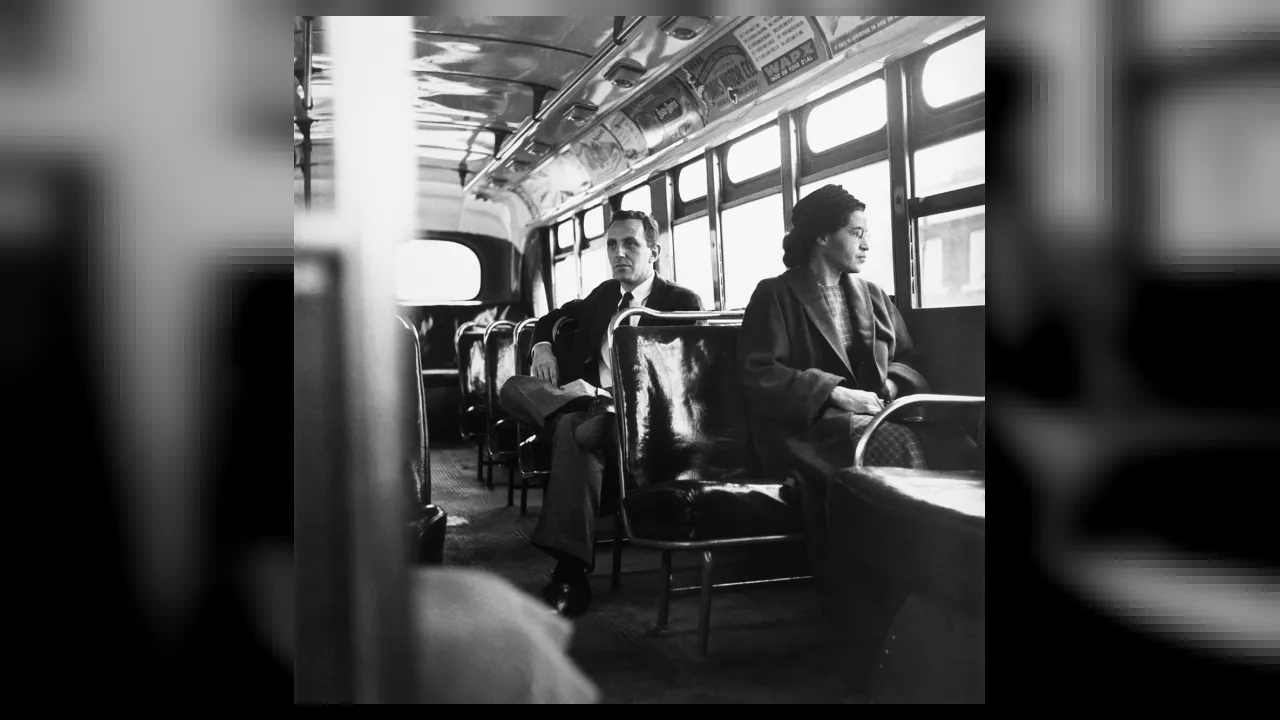
Screech! A city bus stops in Montgomery, Alabama on December 1, 1955. Brave seamstress Rosa Parks calmly refuses to give up her seat to an unfair rule.
2
Walking Together
After Rosa Parks was arrested, young pastor Martin Luther King Jr. helped lead a peaceful bus . Thousands of neighbors walked and shared car rides instead!
3
Fair Seats for Everyone
Empty buses rolled past for over a year. At last, the Supreme Court ruled everyone could sit anywhere on the bus!
1. Who calmly refused to give up her bus seat in Montgomery, Alabama on December 1, 1955?
2. How did citizens in Montgomery protest unfair bus rules peacefully?
🤯 Mind-Blowing Fact • Grade 2
Nine months before Rosa Parks's arrest, brave fifteen-year-old high schooler Claudette Colvin had also refused to give up her Montgomery bus seat after studying the Constitution in school!
✨ Word Sparks (Grade 2 Glossary)
Tap 🔊 to hear
dignity
Being worthy of respect and fair treatment
nonviolent
Solving unfair problems peacefully without hurting anyone
fare
Money paid for a bus or taxi ride
🪝
How did forty thousand people get to work in rain and heat without riding a single city bus?
1
An Unfair Bus Rule
Imagine paying the exact same dime to ride a city bus, yet being told to stand in the back so someone else can take your seat! On December 1, 1955, civil rights secretary and seamstress Rosa Parks bravely stayed seated in Montgomery, Alabama.
2
Flyers and Carpools Overnight
College professor Jo Ann Robinson stayed up all night mimeographing 35,000 flyers urging a one-day bus boycott. When packed churches chose twenty-six-year-old Dr. Martin Luther King Jr. to lead them, the community decided to keep walking until buses treated every rider with !
3
381 Days to Victory
Neighbors organized three hundred carpool station wagons, Black taxi drivers charged ten-cent bus , and grandmothers walked miles in worn shoes. After 381 days, the U.S. Supreme Court ended bus segregation!
1. Exactly how many days did the Montgomery Bus Boycott last?
2. Who stayed up all night printing 35,000 flyers to launch the first day of the boycott?
🤯 Mind-Blowing Fact • Grade 3
Supporters from across the United States and around the world mailed crates of sturdy walking shoes to Montgomery churches to replace soles worn thin during the 381-day boycott!
✨ Word Sparks (Grade 3 Glossary)
Tap 🔊 to hear
association
Group organized for a shared community goal
dispatch
System sending cars promptly where riders wait
ordinance
Local law passed by a city government
🪝
Why did empty city buses and a court case called Browder v. Gayle team up to win equal seating?
1
More Than Tired Feet
Listen to rain splashing on Montgomery sidewalks on Monday morning, December 5, 1955, as city buses rumble past almost completely empty! People sometimes say Rosa Parks stayed seated only because her feet ached, yet she later explained: 'The only tired I was, was tired of giving in.'
2
The Montgomery Improvement Association
Community leaders formed the Montgomery Improvement and elected Dr. Martin Luther King Jr. as president. Speaking with inspiring calm, Dr. King urged everyone to practice nonviolent love, patience, and constitutional citizenship.
3
A Rolling Dispatch Network
Because African Americans made up seventy-five percent of Montgomery's bus riders, the bus company lost thousands of dollars daily. Meanwhile, volunteers ran forty-eight pickup stations with three hundred donated cars, and supportive clubs nationwide mailed thousands of pairs of walking shoes!
4
Victory in Browder v. Gayle
While boycotters walked, four courageous women—including teenager Claudette Colvin and Aurelia Browder—challenged the bus law in federal court. On December 20, 1956, U.S. Supreme Court marshals delivered the order ending Montgomery bus segregation forever.
1. About what percentage of Montgomery's daily bus passengers before the boycott were African American?
2. Which federal court case officially struck down Montgomery's segregated bus laws in 1956?
🤯 Mind-Blowing Fact • Grade 4
Before Montgomery's carpool system even had walkie-talkies or computers, volunteer dispatchers moved thirty thousand riders every day with clockwork precision across forty-eight neighborhood corners!
✨ Word Sparks (Grade 4 Glossary)
Tap 🔊 to hear
logistics
Detailed planning keeping big operations running smoothly
affirm
Confirm and uphold an earlier court decision
seasoned
Experienced through years of dedicated practice
🪝
How did decades of quiet preparation turn one evening arrest in Montgomery into a nationwide civil rights movement?
1
Preparation Meets Courage on Cleveland Avenue
Picture forty-two-year-old Rosa Parks boarding Cleveland Avenue Bus No. 2857 after a long shift tailoring clothes at Montgomery Fair department store on December 1, 1955! Far from an accidental protester, Mrs. Parks was a NAACP chapter secretary who had investigated civil rights injustices for over a decade. When driver James Blake ordered four Black riders in the middle section to stand for one white passenger, three stood—and Rosa Parks remained calmly seated.
2
Women Organizers and a New Young Voice
Bailed out by labor leader E.D. Nixon, Parks inspired Jo Ann Robinson's Women's Political Council to distribute 35,000 boycott leaflets overnight. That Monday evening, five thousand citizens overflowed Holt Street Baptist Church to hear twenty-six-year-old newcomer Rev. Martin Luther King Jr. weave Christian ethics, Mahatma Gandhi's nonviolent resistance, and American constitutional ideals into one unforgettable call for justice.
3
Logistics of a 381-Day Boycott
Sustaining a boycott of over forty thousand commuters across thirteen months took brilliant organization. Churches raised funds for 'rolling churches'—station wagons running precise schedules across forty-eight dispatch hubs—while elder Mother Pollard famously told Dr. King, 'My feets is tired, but my soul is rested.'
4
Constitutional Triumph
Attorney Fred Gray filed Browder v. Gayle on behalf of Aurelia Browder, Claudette Colvin, Susie McDonald, and Mary Louise Smith. Affirming that 'separate but equal' violated the Fourteenth Amendment on public transit too, the U.S. Supreme Court's ruling took effect on December 20, 1956—and the next morning, Rosa Parks and Dr. King rode the front row of an integrated Montgomery bus.
1. Which two major traditions did Dr. Martin Luther King Jr. blend in guiding the Montgomery Bus Boycott?
2. What civic role had Rosa Parks already served for years before December 1, 1955?
🤯 Mind-Blowing Fact • Grade 5
Ten years before Montgomery, Gloucester County, Virginia native Irene Morgan refused to give up her Greyhound bus seat in 1944—winning the 1946 U.S. Supreme Court case Morgan v. Virginia that banned segregation on interstate buses!
✨ Word Sparks (Grade 5 Glossary)
Tap 🔊 to hear
litigation
Resolving legal rights disputes through official courts
intrastate
Happening entirely inside a single state's borders
solidarity
Deep unity among people sharing common purpose
🪝
Why did the Montgomery Bus Boycott succeed only when grassroots economic pressure and federal constitutional litigation worked hand in hand?
1
Years of Groundwork Before December 1955
Long before December 1, 1955, Montgomery's Women's Political Council—led by Alabama State College professor Jo Ann Robinson—had petitioned city commissioners to stop humiliating bus practices, such as forcing Black riders to pay at the front door, exit, and re-board through the rear door. Earlier in 1955, brave teenagers Claudette Colvin (age fifteen) and Mary Louise Smith (age eighteen) were arrested for refusing to yield seats, giving attorney Fred Gray and Brotherhood of Sleeping Car Porters leader E.D. Nixon a clear view of the legal battle ahead.
2
Rosa Parks and Mass Mobilization
When respected NAACP secretary Rosa Parks refused driver James Blake's order to vacate a middle-row seat on Cleveland Avenue Bus 2857, Montgomery's Black community rallied with near-100-percent on December 5, 1955. Forming the Montgomery Improvement Association (MIA), residents elected twenty-six-year-old Ph.D. graduate Rev. Martin Luther King Jr., whose eloquence framed peaceful protest as the highest expression of American democracy.
3
Resilience Under Pressure
Despite retaliatory arrests under an old anti-boycott statute, insurance cancellations on carpool vehicles, and even the bombing of Dr. King's and E.D. Nixon's porches, boycotters refused every urge toward violence. Supported by strategist Bayard Rustin and fundraising networks like In Friendship, the MIA operated a parallel transit fleet costing $3,000 a week while municipal transit revenues plunged.
4
Irene Morgan's Precedent and Browder v. Gayle
Economic boycotts alone could not repeal state segregation statutes. Building on Virginia trailblazer Irene Morgan's 1946 Supreme Court victory outlawing segregation on interstate buses (Morgan v. Virginia) and 1954's Brown v. Board of Education, attorney Fred Gray filed Browder v. Gayle in federal district court. A three-judge panel ruled 2–1 that city bus segregation violated the Fourteenth Amendment's Equal Protection Clause, and the U.S. Supreme Court summarily affirmed on November 13, 1956.
5
Blueprint for the Southern Christian Leadership Conference
When federal marshals served the final mandate on December 20, 1956, ending the 381-day boycott, Montgomery provided a proven blueprint: disciplined nonviolent mass action paired with constitutional —inspiring the 1957 founding of the Southern Christian Leadership Conference (SCLC).