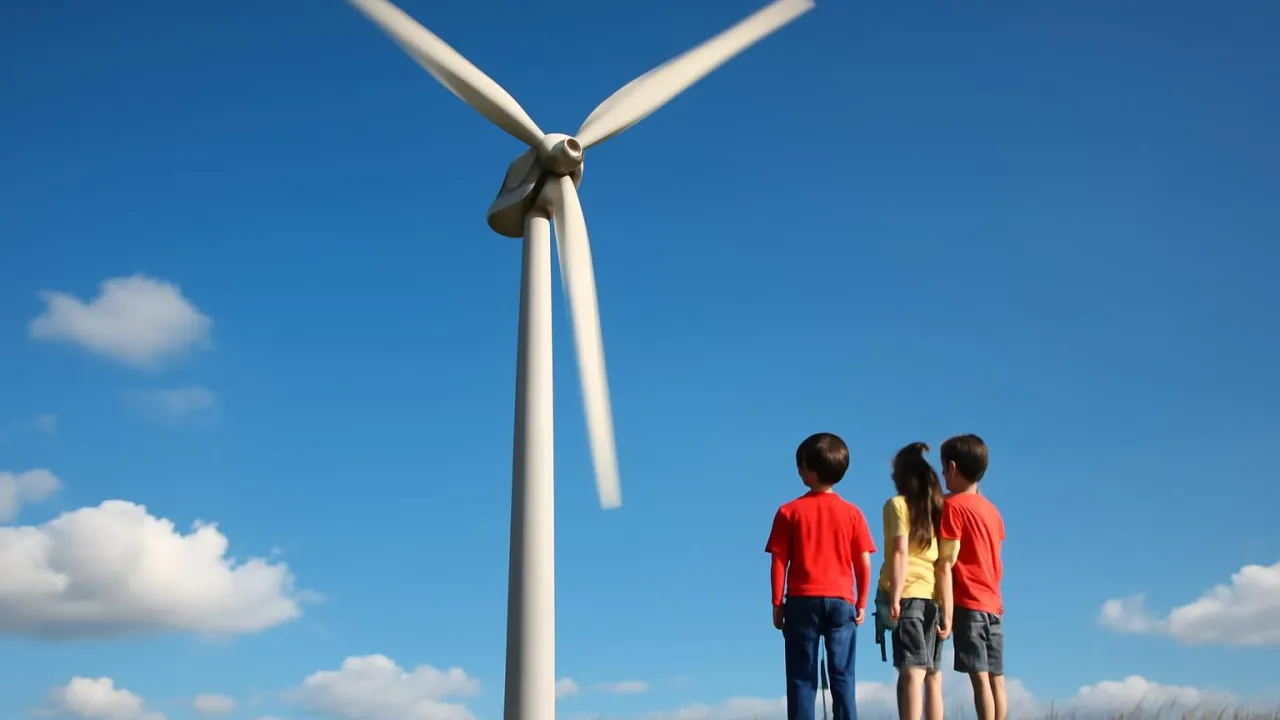
Have you ever heard the whoosh of spinning wind blades?
1
Blades That Catch the Wind
Tall white turbines stand on windy hills and fields. Their long blades spin quickly when the wind blows. The blades are shaped to catch moving air and turn easily.
2
Making Electricity from Air
As the blades spin, they turn a special machine inside called a . The generator changes the spinning energy into for homes and schools. People use this clean power every day.
3
Helping the Earth
Wind turbines do not make smoke or when they work. They help keep our air clean and safe for everyone. That is why many countries build wind farms today.
1. What does a generator do inside a wind turbine?
2. Why do people like wind power?
🤯 Mind-Blowing Fact • Grade 3
The world’s largest wind turbine has blades longer than a football field!
✨ Word Sparks (Grade 3 Glossary)
Tap 🔊 to hear
lift
The force that pushes things up or around
generator
A machine that turns motion into electricity
rotation
The act of spinning around a center
🪝
What if you could turn invisible wind into bright electric light?
1
How Wind Turbines Work
Modern wind turbines have three long blades attached to a tall tower. When the wind blows, it creates a force called that spins the blades around. The spinning blades turn a shaft connected to a inside the turbine. The generator uses magnets and coils to turn the spinning motion into electricity.
2
The Science of Spinning Blades
The blades are shaped like airplane wings to catch the wind efficiently. As wind flows over the curved surface, it causes the blades to spin faster. This movement is called , and it creates mechanical energy. The faster the wind blows, the more energy the turbine can make.
3
Wind Farms Around the World
Many wind turbines are built together in groups called wind farms. These farms are often found on open plains or near the ocean where wind is strong. Wind farms can make enough electricity to power whole towns and cities. They help people use less fossil fuel energy.
4
Clean Energy for the Future
Wind turbines do not create pollution or greenhouse gases when they make electricity. Using wind energy helps protect the earth and keeps the air cleaner for everyone. More countries are building wind farms to fight climate change. Wind turbines are a big part of our clean energy future.
1. Why are wind turbine blades shaped like airplane wings?
2. What is a wind farm?
🤯 Mind-Blowing Fact • Grade 4
Some offshore wind turbines are as tall as the Washington Monument!
✨ Word Sparks (Grade 4 Glossary)
Tap 🔊 to hear
aerodynamic
Shaped to move easily through air
nacelle
The box on top holding the generator
electromagnetic induction
Making electricity by moving magnets and coils
🪝
Can you imagine a field of giant spinning blades quietly making electricity from thin air?
1
Engineering the Modern Wind Turbine
Modern wind turbines are tall, sleek machines with three long, blades attached to a central hub. When wind flows over the blades, it creates lift, causing them to rotate around a horizontal axis. This rotation turns a shaft inside the , which houses a generator that converts mechanical energy into electrical energy. The generator uses the principle of , where moving magnets and coils produce electricity.
2
Design for Maximum Efficiency
Engineers carefully design the shape and angle of the blades to maximize energy capture from the wind. The blades are made from lightweight materials like fiberglass or carbon fiber to spin easily and resist strong gusts. Turbines are often placed on tall towers to reach stronger, steadier winds above the ground. Some turbines can even turn to face the wind, using sensors and motors to track its direction.
3
Wind Farms and Global Impact
Wind turbines are usually grouped together in wind farms, which can be found on land or offshore in the ocean. Wind farms can generate enough electricity to power thousands or even millions of homes and businesses. Countries like Denmark, the United States, and China have built large wind farms to reduce their reliance on fossil fuels. Wind energy is now a key part of the world’s plan to fight climate change.
4
Benefits and Challenges
Wind turbines produce clean energy without releasing greenhouse gases or air pollution, helping protect the environment. However, engineers must solve challenges like making turbines quieter and safer for birds and bats. New designs are being tested to make turbines more efficient and less expensive to build. The future of wind power looks bright as technology keeps improving.
2. What is one challenge engineers face with wind turbines?
🤯 Mind-Blowing Fact • Grade 5
A single rotation of a giant offshore wind turbine’s blades can power a home for two days!
✨ Word Sparks (Grade 5 Glossary)
Tap 🔊 to hear
kinetic energy
Energy from motion, like moving air
alternating current
Electricity that changes direction back and forth
yaw motor
A machine that turns the turbine to face the wind
🪝
What if the invisible movement of air could power entire cities with just the spin of a blade?
1
The Physics Behind Wind Turbines
Modern wind turbines harness from moving air by using aerodynamic blades designed with precision engineering. As wind flows over the curved surface of each blade, it creates a pressure difference—higher pressure on one side and lower on the other—generating lift and causing the blades to rotate. This rotational mechanical energy is transferred through a main shaft to a generator housed in the nacelle. Inside the generator, electromagnetic induction occurs: spinning magnets move past coils of copper wire, generating (AC) electricity. The amount of energy produced depends on wind speed, blade length, and turbine height.
2
Engineering Marvels: Size, Materials, and Design
Today’s largest wind turbines can stand over 260 meters tall, with blades exceeding 100 meters in length—each blade longer than a Boeing 747’s wingspan. The blades are constructed from lightweight, high-strength materials like fiberglass-reinforced epoxy or carbon fiber composites, allowing them to withstand powerful gusts while minimizing weight. Turbines are mounted on tall towers to capture higher, more consistent wind speeds, and many models feature and sensors that automatically rotate the nacelle to face the wind. Advanced computer systems monitor performance and adjust blade pitch for optimal efficiency and safety.
3
From Single Turbines to Global Wind Farms
Wind turbines are rarely used alone; instead, they are grouped in wind farms that can be found on land or offshore. Offshore wind farms, built in shallow coastal waters, take advantage of stronger, steadier winds and can generate enormous amounts of electricity. The world’s largest wind farms, like the Gansu Wind Farm in China and the Hornsea Project in the United Kingdom, produce enough power for millions of homes. In 2022, global wind capacity surpassed 900 gigawatts, making wind one of the fastest-growing sources of renewable energy worldwide.
4
Environmental Impact and Engineering Challenges
Wind turbines generate electricity without burning fossil fuels, emitting greenhouse gases, or producing air pollution, making them a vital part of the fight against climate change. However, engineers must address challenges such as reducing noise, minimizing harm to birds and bats, and ensuring turbines can withstand extreme weather. Ongoing research explores new blade shapes, recyclable materials, and floating offshore platforms to expand wind energy’s reach and reduce its environmental footprint.
5
The Future of Wind Power
As technology advances, wind turbines are becoming more efficient, cost-effective, and adaptable to different environments. Innovations like vertical-axis turbines, bladeless designs, and smart grid integration promise to make wind energy even more accessible. Countries worldwide are investing in wind power to meet clean energy goals, create jobs, and build a more sustainable future. The story of the modern wind turbine is one of creativity, engineering, and the endless power of the wind.