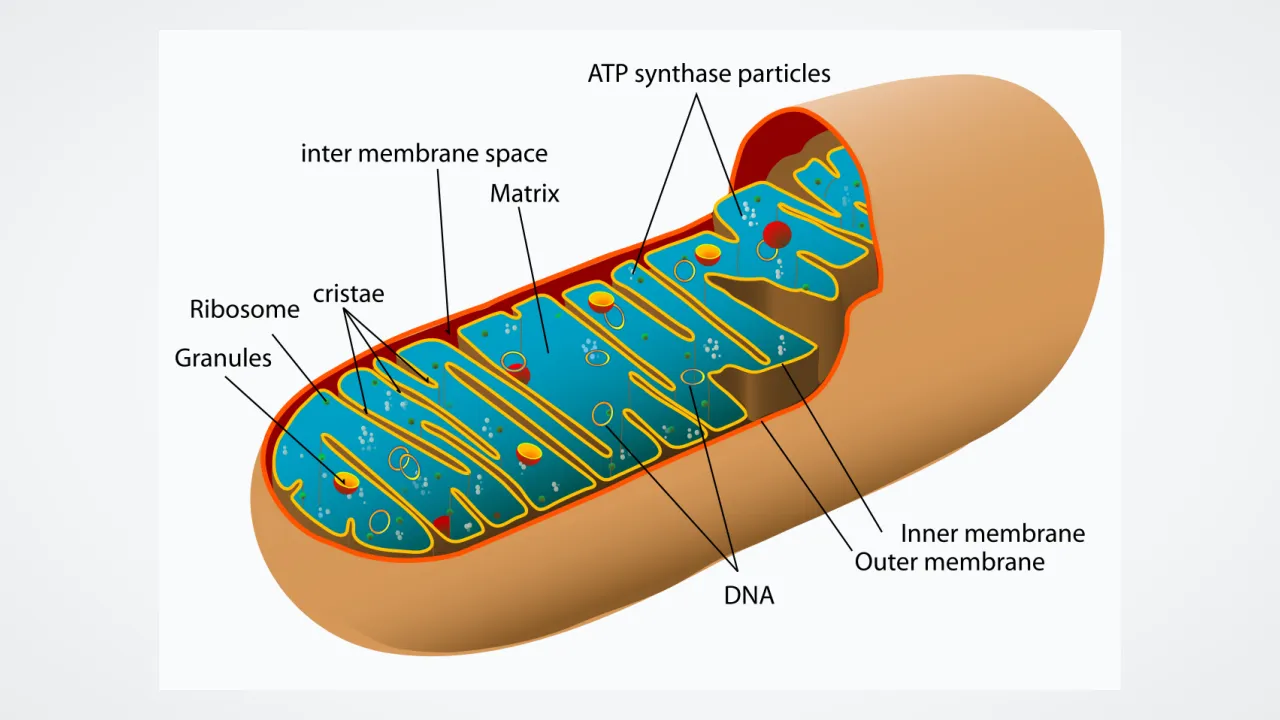
1. What two things do mitochondria combine to make energy for your cells?
2. Why do heart muscle cells hold thousands more mitochondria than quiet skin cells?
🤯 Mind-Blowing Fact • Grade 2
Every day, your mitochondria recharge and recycle a stack of ATP energy molecules equal to your entire body weight!
✨ Word Sparks (Grade 2 Glossary)
Tap 🔊 to hear
ATP
Rechargeable energy molecule powering every living cell
Organelle
Tiny specialized part working inside a cell
Inner Membrane
Wavy folded layer where ATP gets made
🪝
What if every cell in your body used rechargeable microscopic coins to pay for every blink, thought, and heartbeat?
1
Powerhouses With Folded Ribbons
Peek inside a mitochondrion and you will see two membranes! Its outer coat is smooth like a jellybean, while its inner layer folds back and forth like wavy ribbons to create extra workspace.
2
Recharging ATP Energy Coins
Cells cannot plug into a wall outlet, so mitochondria charge tiny chemical battery packs called ! Whenever you wiggle your toes, blink, or solve a puzzle, cells spend ATP and send the empty packs right back to mitochondria for recharging.
3
A Secret DNA Surprise
Amazingly, mitochondria carry their very own tiny circle of DNA—and every person inherits theirs directly from their mom!
1. Why is the inner membrane of a mitochondrion folded into so many wavy loops?
2. Which parent do all humans inherit their mitochondrial DNA from?
🤯 Mind-Blowing Fact • Grade 3
Tiny ATP synthase turbines inside your mitochondria spin at over seven thousand revolutions per minute—faster than a racing car engine!
✨ Word Sparks (Grade 3 Glossary)
Tap 🔊 to hear
Cellular Respiration
Process turning food and oxygen into ATP
Cristae
Shelf-like inner folds inside a mitochondrion
ATP Synthase
Spinning molecular turbine building fresh ATP fuel
🪝
Why do scientists believe your mitochondria were once free-swimming bacteria two billion years ago?
1
Cellular Respiration in Action
Every time you exhale warm air and mist up a cold window, you are seeing mitochondria at work! Through a process called , mitochondria combine broken-down sugars and fats with inhaled oxygen—producing water, exhaled carbon dioxide, and glowing stores of Adenosine Triphosphate, or ATP.
2
Cristae and Spinning Turbines
Inside the mitochondrion, deep inner folds called hold thousands of microscopic rotary motors named . Like miniature hydroelectric waterwheels, these motors spin round and round to snap a third phosphate group onto ADP, locking fresh energy into ATP!
3
Growing When You Exercise
Because mitochondria can divide in two all by themselves, regular running, swimming, or biking tells muscle cells to build even more mitochondria—boosting your stamina!
4
An Ancient Partnership
Clues like circular DNA and bacteria-sized ribosomes revealed a thrilling origin story: billions of years ago, an ancient cell teamed up with an oxygen-breathing bacterium that evolved into today's mitochondria!
1. What gas do your mitochondria produce as a harmless leftover that your lungs breathe right out?
2. What happens inside your leg muscles when you practice regular aerobic exercise like running or biking?
🤯 Mind-Blowing Fact • Grade 4
With oxygen powering your mitochondria, one molecule of glucose yields about fifteen times more ATP energy than cells can squeeze out without oxygen!
✨ Word Sparks (Grade 4 Glossary)
Tap 🔊 to hear
Krebs Cycle
Enzyme loop harvesting high-energy electrons from food
Electron Transport Chain
Protein relay pumping protons across inner cristae
Endosymbiosis
Ancient partnership where one cell lived inside another
🪝
How does a mitochondrion pump tiny hydrogen protons behind a microscopic dam just like a hydroelectric power station?
1
From Sugar to the Citric Acid Cycle
Energy extraction happens step by step rather than in one wild burst! First, enzymes in the cell's cytoplasm split one six-carbon glucose molecule in half. Those halves enter the mitochondrion's central matrix, where a wheel of enzymes—called the Citric Acid Cycle or —strips away high-energy electrons and releases carbon dioxide.
2
The Electron Transport Chain Dam
Next comes the main event along the folded cristae! Shuttle molecules hand those high-energy electrons down a relay team of four protein complexes called the . As electrons bucket-brigade toward waiting oxygen atoms, the complexes pump positively charged hydrogen ions (protons) into the narrow gap between the inner and outer membranes—building pressure like water behind a dam.
3
Spinning ATP Synthase Motors
Crowded protons rush back inward through rotary ATP synthase turbines, spinning their central axle so each turn snaps phosphate onto ADP—yielding roughly thirty to thirty-two ATP molecules from a single glucose molecule!
4
Lynn Margulis and Endosymbiosis
In 1967, biologist Lynn Margulis championed endosymbiotic theory, showing how double membranes, independent binary fission, bacterial-style ribosomes, and circular mitochondrial DNA prove mitochondria descended from ancient oxygen-using alphaproteobacteria sheltered inside early ancestral cells over a billion years ago.
1. What drives the spinning motion of ATP synthase turbines inside mitochondria?
2. Which scientist championed endosymbiotic theory to explain why mitochondria have their own circular DNA?
🤯 Mind-Blowing Fact • Grade 5
Newborn babies stay cozy using 'brown fat' packed with special mitochondria that short-circuit their proton dams on purpose to turn fuel directly into gentle warmth instead of ATP!
✨ Word Sparks (Grade 5 Glossary)
Tap 🔊 to hear
Chemiosmosis
Using proton gradients across membranes to build ATP
Oxidative Phosphorylation
Oxygen-powered ATP production along mitochondrial cristae
Thermogenin
Brown-fat mitochondrial channel turning proton flow into heat
🪝
Why was Peter Mitchell's idea that cells run on proton electricity dismissed as impossible—before winning the 1978 Nobel Prize?
1
Dynamic Networks: Fusion, Fission, and Biogenesis
Textbooks often draw mitochondria as solitary peanut-shaped capsules—from Greek mitos (thread) and chondrion (granule)—yet live-cell microscopy reveals a constantly shifting tubular network! Guided by metabolic demand, mitochondria fuse together to share enzymes and divide via dynamin-related fission proteins, reaching densities of five thousand organelles (nearly forty percent of cell volume) inside ventricular cardiomyocytes while remaining completely absent from mature erythrocytes.
2
Chemiosmosis and the Proton-Motive Force
Inside the mitochondrial matrix, pyruvate oxidation and Hans Krebs's tricarboxylic acid cycle load NADH and FADH2 carriers with energetic electrons. Along invaginated inner-membrane cristae, Respiratory Complexes I through IV pass electrons sequentially to molecular oxygen (O2), reducing it cleanly to water while pumping protons into the intermembrane space. In 1961, British biochemist Peter Mitchell proposed chemiosmotic coupling: this electrochemical proton-motive force—not a mystery chemical intermediate—drives !
3
World's Smallest Rotary Nano-Machine
In 1997, Paul Boyer and John E. Walker earned the Nobel Prize for resolving F1Fo-ATP synthase—a mushroom-shaped nano-turbine just ten nanometers wide. As protons stream through its membrane-embedded Fo ring, the central gamma stalk rotates in 120-degree steps at over one hundred turns per second, mechanically flexing catalytic F1 subunits to synthesize roughly sixty kilograms of recharged ATP across your body every day!
4
Brown Fat Thermogenesis and Maternal Genomes
Newborn infants and cold-adapted mammals deploy a clever twist inside brown adipose tissue: a channel protein called (UCP1) lets protons bypass ATP synthase smoothly, releasing their stored energy straight as cozy non-shivering body warmth! Meanwhile, human mitochondrial DNA (mtDNA)—a compact 16,569-base-pair circular genome encoding 37 essential genes—inherits maternally, allowing anthropologists to trace ancient human migrations.
5
Guardians of Cellular Longevity
Beyond bioenergetics, mitochondria buffer intracellular calcium waves, synthesize heme iron rings for hemoglobin, and regulate orderly cellular self-renewal whenever worn-out tissues need replacement.