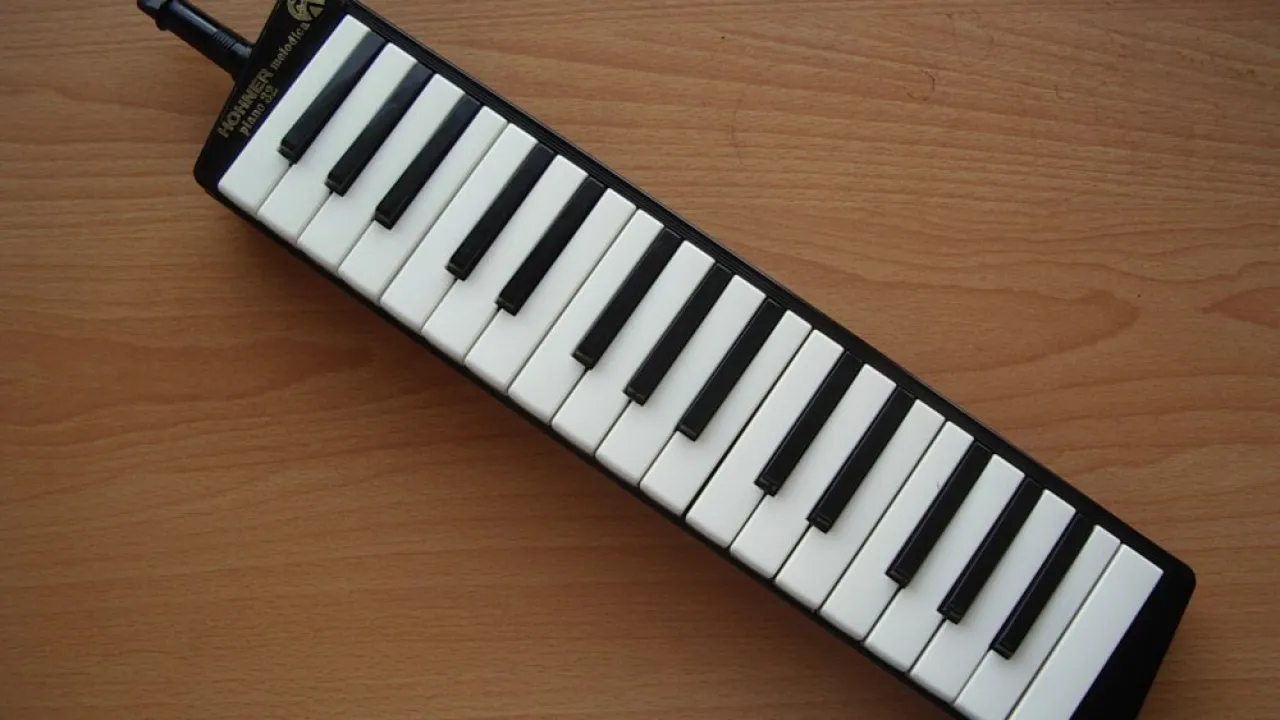
1. What happens if you press melodica keys without blowing into the mouthpiece?
2. What special musical superpower does a melodica have that a flute or trumpet does not?
🤯 Mind-Blowing Fact • Grade 2
At the far end of every melodica sits a small spring button that blows out tiny drops of breath moisture with one quick puff!
✨ Word Sparks (Grade 2 Glossary)
Tap 🔊 to hear
swell
Grow smoothly louder and fuller in sound
chamber
Enclosed hollow space holding pressurized air
fade
Grow gradually quieter until disappearing
🪝
Why does this colorful classroom favorite show up on stage with Grammy-winning jazz and reggae stars?
1
Born from Harmonicas and Accordions
In the late 1950s, the German instrument company Hohner combined the brass reeds of a harmonica with a neat miniature piano keyboard. Suddenly, keyboard players could carry three octaves of music in a small zippered case!
2
Hidden Air Chamber
Blowing into the mouthpiece fills a sealed underneath all the keys with waiting air. Pressing any black or white key lifts a padded trapdoor so air rushes across that note's matching brass free reed.
3
Shaping Every Breath
Unlike a real piano whose notes always away after a hammer strike, a melodica note can start whisper-soft and louder and louder as you blow harder! Every song feels personal and expressive.
1. How can a melodica do something with a long held note that an acoustic grand piano cannot?
2. Why is there a little push-button drain valve on the bottom corner of a melodica?
🤯 Mind-Blowing Fact • Grade 3
Pressing four or five melodica keys at once takes way more breath than playing one note—because four open valves let air escape four times as fast!
✨ Word Sparks (Grade 3 Glossary)
Tap 🔊 to hear
dub
Jamaican reggae style rich in bass and echo
phosphor bronze
Springy copper alloy used for musical reeds
crescendo
Gradual steady increase in musical loudness
🪝
How did a Jamaican musician turn a humble school melodica into a legendary sound heard around the world?
1
Precursors from the 1800s
Long before modern plastic keyboards existed, nineteenth-century Italian and French makers built wooden hand-blown reed keyboards called harmoniflutes. In 1958, Hohner streamlined that clever idea into the lightweight modern melodica.
2
Exhale-Only Precision
While a harmonica plays notes both inhaling and exhaling, a melodica responds only when blowing outward. That means each key needs just one phosphor-bronze or brass free reed, keeping the thirty-two- or thirty-seven-key frame light enough to hold in one hand via a rear strap.
3
Augustus Pablo and Reggae Dub
In 1970s Kingston, Jamaica, visionary musician Augustus Pablo carried an alto melodica into recording studios. Bathed in warm tape echo over deep basslines, its smoky, horn-like voice became an unforgettable signature of roots reggae and !
4
Jazz and Classroom Hero
From Japanese school ensembles calling it a pianica to Grammy-winning jazz improvisers like Jon Batiste, this pocket wind-keyboard brings chordal harmony and singing breath control onto every kind of stage.
1. Why must a player blow much more air when holding a five-note chord than when playing a single melody note?
2. Which Jamaican artist made the melodica famous in 1970s reggae and dub music?
🤯 Mind-Blowing Fact • Grade 4
Brazilian multi-instrumentalist Hermeto Pascoal and American bandleader Jon Batiste both turned the humble melodica into a fiery virtuoso jazz solo instrument!
✨ Word Sparks (Grade 4 Glossary)
Tap 🔊 to hear
windchest
Pressurized air box beneath organ or melodica keys
flutter-tonguing
Rolling the tongue rapidly while blowing wind
diaphragm
Dome muscle under lungs controlling breath power
🪝
Can you actually bend pitches on a keyboard instrument that has fixed piano keys?
1
Hybrid of Windchest and Keyboard
Watch a jazz soloist stride to the front of the stage cradling a sleek black melodica: their right hand snakes through dazzling bebop keyboard runs while their , tongue, and throat sculpt every phrase like a saxophonist! Acoustically, your lungs replace the mechanical bellows of an accordion, supplying direct bio-pneumatic control to thirty-seven chromatic free reeds.
2
Secret Pitch Bending on Fixed Keys
Most listeners assume piano keys lock a player into rigid pitches—yet experienced melodica virtuosos regularly bend blue notes downward by a half step! By barely cracking a key valve open a millimeter while dropping the jaw to enlarge oral resonance, restricted airflow starves and slows the vibrating reed so the pitch scoops expressively into tune.
3
Tonguing, Fluttering, and Vibrato
Because breath travels straight from mouth to , woodwind articulations work effortlessly: crisp 'tu-ku' double-tonguing fires machine-gun staccatos, rolled 'rrr' adds gritty growls, and pulsing air creates warm vocal vibrato across sustained chords.
4
Soprano, Alto, and Wooden Concert Models
Modern makers craft everything from bright classroom sopranos and mellow three-octave alto models (F3 to F6) to resonant mahogany- and walnut-bodied concert melodicas, alongside deep baritone and bass versions whose woody low reeds rumble like miniature parlor reed organs in acoustic ensembles.
1. How do advanced melodica players bend a note's pitch downward despite having fixed piano keys?
2. Which woodwind technique lets a melodica player articulate rapid notes faster than fingers alone could repeat a key?
🤯 Mind-Blowing Fact • Grade 5
Composer Steve Reich wrote an entire hypnotic minimalist piece in 1966 called 'Melodica' after dreaming its interlocking rhythmic patterns the night before!
✨ Word Sparks (Grade 5 Glossary)
Tap 🔊 to hear
plenum
Sealed chamber filled with higher-pressure air
cents
Tiny pitch units dividing one half-step into hundredths
unidirectional
Flowing or operating in one single direction
🪝
How does coupling a pressurized common windchest to cantilevered brass reeds bridge the expressive gap between woodwinds and polyphonic keyboards?
1
Organology of the Mouth-Blown Keyboard Aerophone
Imagine the harmonic architecture of an organ fused directly to the respiratory intimacy of an oboe. Assigned to Hornbostel-Sachs 412.132 (sets of free reeds with keyboard), the modern melodica—commercialized by Hohner in Trossingen in 1958 after nineteenth-century European precursors such as the French harmoniflute and Italian clavietta—channels exhaled lung pressure into a sealed chamber spanning two to three chromatic octaves.
2
Plenum Aerodynamics and Polyphonic Impedance
Standard thirty-seven-key alto/tenor models span F3 (174.6 hertz) to F6 (1,396.9 hertz), mounting phosphor-bronze or brass tongues onto shared corrosion-resistant plates. Depressing any spring-tensioned key pivots a padded pallet off its exhaust port, establishing a pressure differential that sets that closing free reed into self-sustained oscillation. Because all thirty-seven ports draw from a single shared , adding chord voices lowers chamber impedance proportionally, requiring continuous respiratory compensation to maintain pitch stability.
3
Microtonal Valve Shading and Formant Interaction
Although free reeds are strongly governed by their mechanical mass and stiffness, blowing through a short rigid mouthpiece couples the player's vocal tract directly to the windchest. Combining fractional key depression (throttling boundary-layer airflow across the reed slot) with lowered jaw resonance retards reed oscillation by up to fifty to one hundred —enabling blues inflections impossible on pianos or accordions.
4
Material Acoustics: ABS vs. Hardwood Chassis
While classroom models (such as Yamaha's Pianica and Suzuki's Melodion) mold lightweight ABS polymer chambers that accentuate crisp upper harmonics between 2,000 and 4,000 hertz for ensemble clarity, artisanal concert models encased in walnut, mahogany, or beechwood—often featuring tapered brass reeds—dampen high-frequency plastic buzz to project warm, bandoneon-like chamber richness.
5
Pedagogical Pillar and Studio Icon
Simultaneously teaching millions of East Asian schoolchildren breath support alongside keyboard harmony, illuminating Steve Reich's minimalist scores, sparking Hermeto Pascoal's polyrhythmic improvisations, and defining Augustus Pablo's Kingston dub masterpieces, the melodica proves that mechanical simplicity and profound artistry go hand in hand.