1. Which body parts get their natural color from melanin?
2. How does melanin help your skin on a bright sunny day?
🤯 Mind-Blowing Fact • Grade 2
Even bright blue eyes do not actually contain blue paint—they just have very little melanin in front, scattering light the same way the sky looks blue!
✨ Word Sparks (Grade 2 Glossary)
Tap 🔊 to hear
melanocyte
arm-shaped skin cell that makes melanin pigment
ultraviolet
invisible high-energy rays shining from the sun
bundle
a small packet holding things tightly together
🪝
Did you know people with very light skin and very dark skin have almost the same number of color cells?
1
Octopus-Shaped Color Makers
Step into warm morning sunlight! Down at the bottom of your outer skin live star-shaped cells with long reaching arms called . Their big job is making a protective natural pigment called melanin.
2
Sharing Protective Packages
pack melanin into tiny and pass them along their arms to neighboring skin cells. Inside each neighbor cell, the pigment gathers right over the center like a shady beach umbrella.
3
One Human Family Rainbow
Almost everyone has roughly the same number of ! Darker skin tones simply make larger, fuller melanin , while lighter skin tones make smaller, lighter ones.
1. Why do people around the world have different natural skin tones?
2. Why should everyone still wear sunscreen outdoors?
🤯 Mind-Blowing Fact • Grade 3
Melanin isn't just for humans—octopuses squirt clouds of melanin-rich dark ink to escape predators, and birds weave melanin into wing feathers to make them tougher!
✨ Word Sparks (Grade 3 Glossary)
Tap 🔊 to hear
eumelanin
dark brown-to-black form of melanin pigment
pheomelanin
reddish-yellow form of melanin found in hair
melanosome
microscopic capsule carrying melanin between skin cells
🪝
How can just two kinds of melanin create jet-black hair, fiery red curls, and golden-brown freckles?
1
Two Shades in Nature's Palette
Look closely at strands of black, brown, blond, and red hair! Amazingly, your body mixes almost all human hair and skin shades using just two forms of melanin. produces rich brown and black tones, while adds warm reddish and golden-yellow hues.
2
Delivery Along Cellular Arms
Down in the deepest row of your epidermis, each branching melanocyte connects to about thirty-six surrounding keratinocytes. It packs fresh pigment inside tiny capsules called and slides them outward into neighboring skin cells.
3
Shielding Precious DNA
Once inside a skin cell, park right above the cell's nucleus—the vault holding your DNA instructions. When invisible ultraviolet rays beam down from the sun, melanin absorbs their energy and turns it into harmless warmth.
4
Why Tanned Skin Darkens
When sunlight hits your skin, cells send a chemical signal asking melanocytes to build extra melanin umbrellas, gradually darkening skin to guard against future rays.
1. Which form of melanin gives bright red hair its warm copper color?
2. Where do melanosomes park after entering a skin cell?
🤯 Mind-Blowing Fact • Grade 4
Tiny patches of melanin even sit inside your inner ear and deeper brain regions, where scientists found they help protect delicate nerve cells from chemical stress!
✨ Word Sparks (Grade 4 Glossary)
Tap 🔊 to hear
tyrosinase
key enzyme that builds melanin from amino acids
dendritic
having long branching arms like tree twigs
folate
essential B-vitamin protected from sunlight by melanin
🪝
Why does hair slowly turn silver-gray as people grow older, while eyes keep their color?
1
Inside the Epidermal Melanin Unit
Step from cool shade into blazing noon sunshine, and invisible ultraviolet radiation immediately bombards your skin! Stationed along the basal layer of your epidermis at roughly 1,000 to 2,000 cells per square millimeter, melanocytes operate as microscopic biochemical factories. Using an enzyme called , they convert the amino acid tyrosine into light-absorbing melanin polymers.
2
Supranuclear Caps Against UV Damage
One melanocyte extends slender arms to supply roughly thirty-six keratinocytes, forming an epidermal melanin unit. Transferred melanosomes assemble into dome-shaped supranuclear caps directly atop each keratinocyte nucleus. Eumelanin dissipates over ninety-nine percent of absorbed UV radiation as gentle heat, preventing rays from snapping DNA rungs.
3
Iris Colors and Silver Hair
Inside your eyes, iris melanocytes keep their melanosomes for life: thick front melanin yields brown eyes, moderate pigment creates hazel or green, and sparse front melanin scatters short blue wavelengths via Tyndall scattering. Hair follicles, however, rebuild pigment with every new growth cycle. Over decades, follicle melanocyte stem cells gradually retire, leaving new keratin strands clear—which reflect light as shimmering silver or white!
4
Sunlight Geography Around Earth
Across thousands of generations, human populations adapted brilliantly to local sunlight: melanin-rich skin near the equator shielded vitamins and DNA from intense UV, while lighter skin closer to the poles admitted scarce winter UV-B rays needed to make vitamin D.
1. Why does human hair turn gray or white with age?
2. How did human skin tones adapt to different latitudes around the globe?
🤯 Mind-Blowing Fact • Grade 5
Eumelanin converts dangerous ultraviolet photon energy into harmless microscopic warmth in under a picosecond—one-trillionth of a second—making it faster than almost any synthetic sunscreen molecule!
✨ Word Sparks (Grade 5 Glossary)
Tap 🔊 to hear
photoprotector
substance shielding living cells from light damage
biopolymer
large chain molecule built naturally by cells
albinism
genetic trait where cells produce little melanin
🪝
How does a single enzyme transform an ordinary protein building block into a broad-spectrum radiation shield?
1
Biochemistry of a Broadband Photoprotector
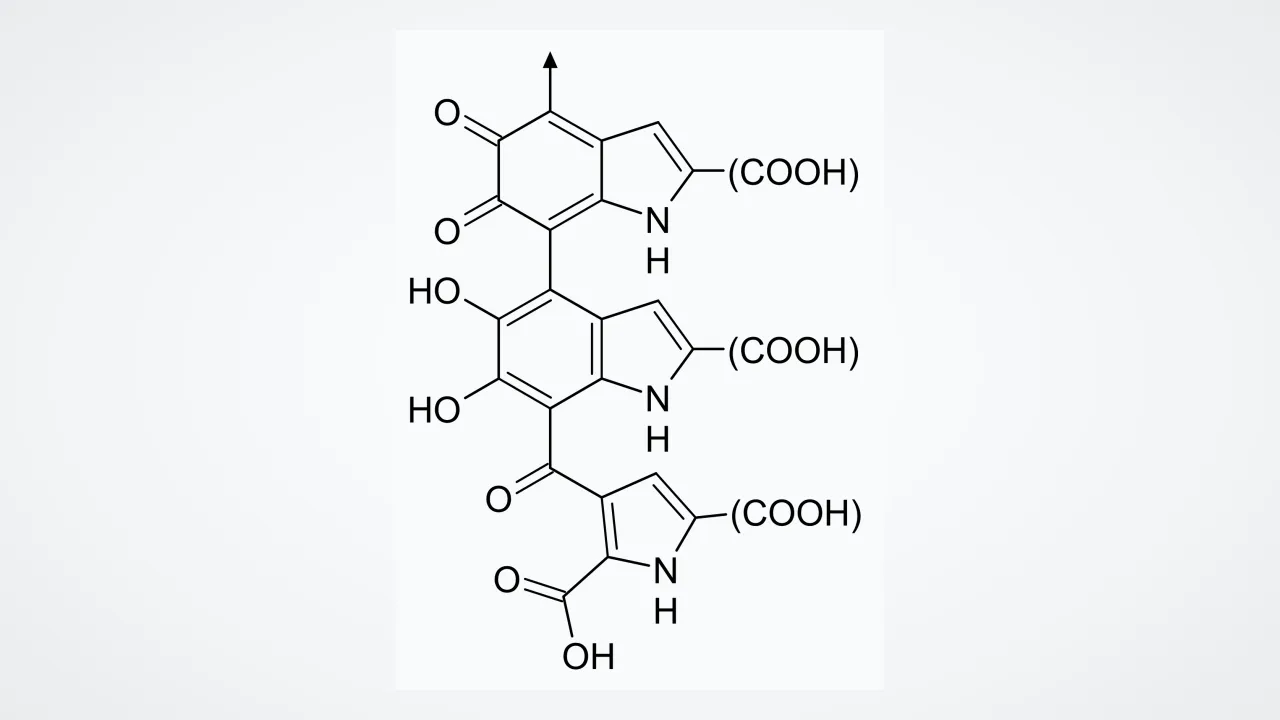
Unlike ordinary dyes that absorb only one narrow slice of light, melanin is a complex engineered to drink in wavelengths spanning visible light and high-energy ultraviolet radiation. Synthesized within specialized organelles called melanosomes inside neural-crest-derived melanocytes, melanin begins with the amino acid L-tyrosine. Driven by the copper-containing enzyme tyrosinase, tyrosine oxidizes into dopaquinone before branching into dark, insoluble eumelanin or sulfur-rich reddish pheomelanin.
2
Ultrafast Energy Dissipation
When an ultraviolet photon strikes DNA directly, it can fuse neighboring thymine bases into harmful dimers. Supranuclear caps of eumelanin intercept up to 99.9 percent of incoming UV photons first and convert their electromagnetic energy into harmless vibrational heat in less than one-trillionth of a second—far faster than destructive free radicals can form.
3
Genetics of Melanosome Packaging
Remarkably, biopsies from pale Scandinavian skin and deeply pigmented West African skin reveal virtually identical melanocyte densities—roughly 1,200 to 1,500 cells per square millimeter. Variations in genes such as MC1R, SLC24A5, and OCA2 instead regulate tyrosinase activity and melanosome size: darkly pigmented skin packs large, single, slow-degrading eumelanosomes throughout all epidermal layers, whereas lightly pigmented skin forms smaller clustered packets.
4
Albinism and Vitiligo Insights
Studying pigment variations illuminated dermatology: inherited mutations disabling tyrosinase cause oculocutaneous , leaving skin, hair, and irises with normal cell counts but minimal pigment, while autoimmune loss of patchy melanocytes produces vitiligo. Beyond skin and eyes, neuromelanin granules inside the brain's substantia nigra safely bind excess iron ions to shield dopaminergic neurons across decades.
5
Nina Jablonski's Global UV Map
Using NASA satellite ultraviolet measurements in 2000, anthropologist Nina Jablonski and geographer George Chaplin proved mathematically that ancestral human skin pigmentation tracks global UV intensity more closely than any other climate variable—uniting folate preservation and vitamin D3 synthesis into one elegant story of human adaptation.