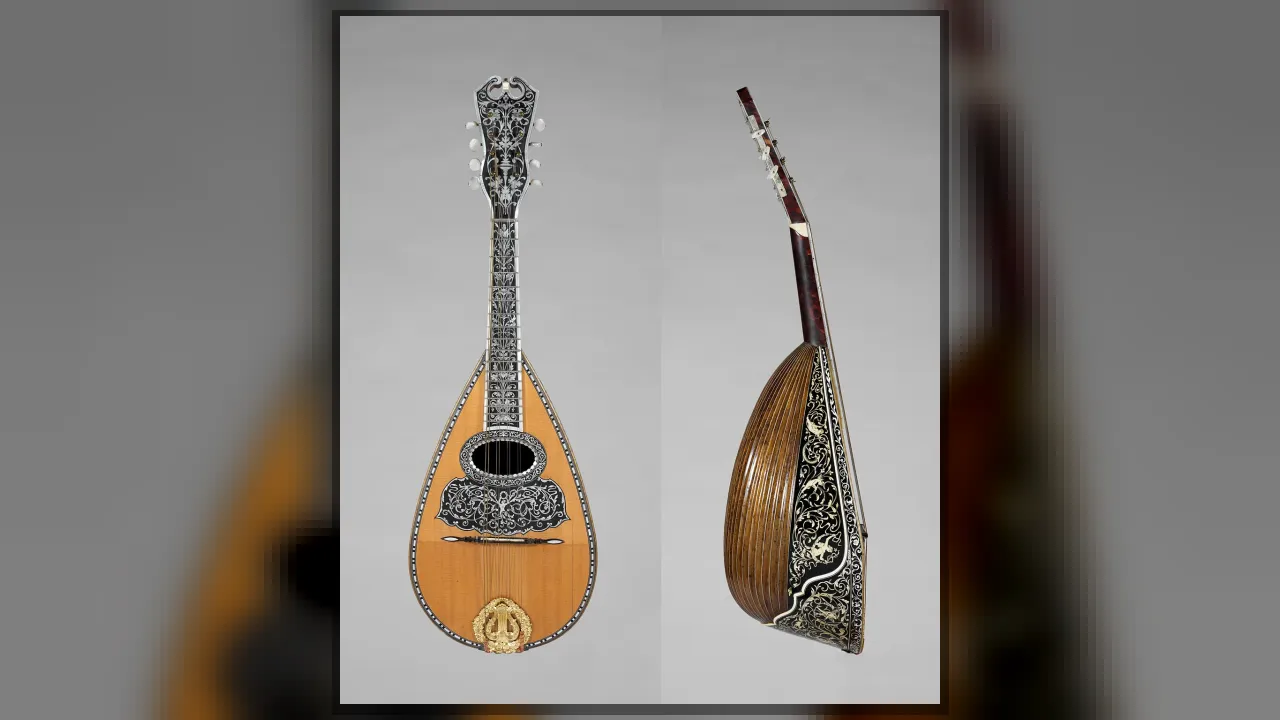
1. How are the eight strings arranged on a mandolin?
2. Which bowed orchestral instrument shares the exact same G–D–A–E tuning as a mandolin?
🤯 Mind-Blowing Fact • Grade 2
Composers Antonio Vivaldi, Wolfgang Amadeus Mozart, and Ludwig van Beethoven all loved the mandolin so much that they wrote special music just for it!
✨ Word Sparks (Grade 2 Glossary)
Tap 🔊 to hear
tremolo
Rapid up-and-down picking sustaining one note
scroll
Decorative curled spiral carved into wood
plectrum
Small flat pick held to strike strings
🪝
How can a plucked instrument sing a long, smooth note without using a bow at all?
1
Sunshine Over Italian Canals
Listen to a fast, shimmering trill that sounds like sunlight sparkling on rippling water! Born in Italy centuries ago, the mandolin packs big, cheerful volume into a wooden body about two feet long.
2
Round Bowls and Carved Tops
Italian classical mandolins have deep, rounded backs glued from striped wooden ribs like half a melon. American bluegrass mandolins look more like small violins, with arched spruce tops, curvy f-holes, and fancy wooden !
3
The Secret of Tremolo
Because eight steel strings pull tightly across a short neck, single plucks die away quickly. To hold out a dreamy melody, musicians rock their wrist rapidly up and down across one string pair in a technique called !
1. What does a mandolin player do to make one note ring out long and smooth?
2. How is a traditional Italian bowlback mandolin shaped on the back?
🤯 Mind-Blowing Fact • Grade 3
In a bluegrass band with no drummer, the mandolin's crisp muted 'chop' chord on beats two and four acts just like a snappy snare drum!
✨ Word Sparks (Grade 3 Glossary)
Tap 🔊 to hear
course
Pair of adjacent strings played as one
archtop
Curved wooden instrument top carved like violin
fifths
Musical interval spanning five scale letter steps
🪝
How do eight short strings pack as much pulling force as a full-size steel-string guitar?
1
Double Courses, Double Sparkle
What would happen if every string on a violin split into steel twins and gained metal frets? Strike a chord with a stiff plectrum on a mandolin and hear crystalline high resonance slice cleanly across an entire room!
2
Four Courses Under High Tension
Musicians call each twin pair of strings a . Tuned in from G3 up to a bright E5, all eight steel strings pull across a short fourteen-inch scale with roughly one hundred sixty pounds of tension!
3
Bowlbacks, Flatbacks, and Archtops
Different body designs shape its acoustic voice. Italian bowlbacks project sweet ringing trebles through an oval soundhole, Celtic flatbacks offer warm midrange, and carved spruce-and-maple with twin f-holes fire punchy volume.
4
Shimmering Tremolo and Snappy Chops
In folk and classical pieces, smooth wrist tremolo mimics a singing voice. In bluegrass bands, muting four-finger chords right after strumming creates a crisp percussive 'chop' on off-beats like a snare drum!
1. What do musicians call each close pair of matching strings on a mandolin?
2. What rhythmic job does the mandolin's muted 'chop' chord often perform in a bluegrass band?
🤯 Mind-Blowing Fact • Grade 4
On classical Neapolitan bowlback mandolins, the spruce top bends downward at a sharp angle right behind the bridge so tight steel strings press down into the wood instead of ripping the bridge forward!
✨ Word Sparks (Grade 4 Glossary)
Tap 🔊 to hear
bowlback
Mandolin with rounded ribbed wooden back shell
unison
Two voices or strings sounding identical pitch
serenade
Expressive outdoor musical piece honoring a listener
🪝
How did eighteenth-century Naples artisans and a 1920s Michigan acoustic engineer create two completely different mandolin bodies that both thrive today?
1
Twin Traditions, One Singing Compass
Close your eyes as an Italian shimmers with liquid tremolo, then open them to see an Appalachian bandleader snapping percussive off-beat chords on an instrument with a carved scroll and violin f-holes! Across three centuries, two distinct architectural branches turned eight tightly stretched steel strings into a global treasure.
2
Neapolitan Bowlbacks of the 1740s
Earlier Baroque mandolinos carried gentle gut strings plucked with fingertips. Around the 1740s in Naples, Italy, the Vinaccia family of luthiers strengthened a deep, fluted rosewood body and angled the thin spruce soundboard sharply downward behind the bridge—a clever kink called a cant that resisted heavier brass and steel string tension while inspiring concertos by Vivaldi and in Mozart's Don Giovanni.
3
Orville Gibson and Lloyd Loar's Archtop Revolution
At the dawn of the twentieth century in Kalamazoo, Michigan, luthier Orville Gibson abandoned fragile glued ribs in favor of carving arched spruce tops and maple backs like fine violins. In 1922, acoustic engineer Lloyd Loar perfected the legendary Gibson F-5 mandolin by tuning the f-hole air chamber, internal tone bars, and elevated fretboard to project punchy midrange across loud halls.
4
Physics of Unison Beating
Why pair strings instead of using four single wires? Striking two steel strings tuned to virtually identical frequencies excites twice the bridge energy while microscopic phase differences between the twins produce a lively, shimmering acoustic warmth single strings cannot match.
1. Why does striking a pair of unison steel strings sound richer than plucking just one single string?
2. Which acoustic engineer perfected the carved-top, f-hole F-5 mandolin in 1922?
🤯 Mind-Blowing Fact • Grade 5
Just like violins have larger cousins—viola, cello, and double bass—the mandolin family once formed complete plucked orchestras featuring mandolins, alto mandolas, deep mandocellos, and giant upright mandobasses!
✨ Word Sparks (Grade 5 Glossary)
Tap 🔊 to hear
cant
Downward angle bent into bowlback mandolin soundboard
coupled
Linked together so vibrations share energy back-and-forth
mandocello
Large eight-string mandolin family cousin tuned low
🪝
How do coupled twin-string oscillators across a compact 350-millimeter scale generate commanding acoustic projection from Vivaldi concertos to modern acoustic ensembles?
1
Soprano Brilliance Under High Tension
Sweep a heavy beveled plectrum across four paired steel courses—tuned in perfect fifths at G3 (196.0 hertz), D4 (293.7 hertz), A4 (440.0 hertz), and E5 (659.3 hertz), ascending past A6 (1,760.0 hertz) on extended fretboards—and crystalline upper partials slice cleanly above guitars and fiddles. Despite a compact 330-to-355-millimeter vibrating scale length, eight bronze-wound and plain steel strings exert roughly 700 to 760 newtons of cumulative load.
2
Coupled-String Physics and Tremolo Envelope
Acoustic analysis of double-course chordophones reveals why paired unison strings outshine single wires. When a plectrum excites both strings of a course simultaneously, initial vertical motion drives strong in-phase force into the ebony bridge; milliseconds later, slight impedance asymmetry transfers energy into anti-phase modes, prolonging luminous afterglow. Rapid wrist-driven alternation—tremolo—fuses discrete attacks into a continuous vocal envelope.
3
Neapolitan Bowlbacks and the Canted Soundboard
Evolving from gut-strung Baroque mandolinos, mid-eighteenth-century Neapolitan makers led by the Vinaccia family engineered deep vaulted resonators assembled from twenty to thirty fluted rosewood or maple ribs. Incorporating a sharp transverse bend ('') behind the bridge converted forward string pull into vertical compression across a thin, cross-barred spruce belly—a design celebrated by Beethoven, Raffaele Calace, and twentieth-century Italian soloists.
4
Carved Archtop Lutherie and Tap-Tuned Plates
Across the Atlantic, Kalamazoo founder Orville Gibson applied Cremonese violin plate-carving principles to plucked instruments in the 1890s. Acoustic physicist Lloyd Loar's 1922 Gibson Master Model F-5 refined parallel spruce tone bars, tap-tuned graduated maple and Sitka spruce plates, and violin-inspired f-holes calibrated to a crisp Helmholtz cavity resonance near D4 (around 290 hertz), championed twenty years later by bluegrass architect Bill Monroe.
5
Global Mandolin Family Voices
Beyond soprano instruments, the broader mandolin family mirrors the orchestral string quartet—encompassing the alto mandola (C3–G3–D4–A4), octave mandolin and Irish bouzouki, cello-range , and towering mandobass—while Brazilian choro virtuosos on the bandolim and contemporary innovators like Chris Thile unite Bach partitas, Celtic reels, and progressive chamber music.