🇺🇸 U.S. HISTORY
🏛️ 36th President of the United States (1963–1969)
VA History & Social Science SOL K.1, 1.2, 2.4, VS.1–VS.10, USI & USII
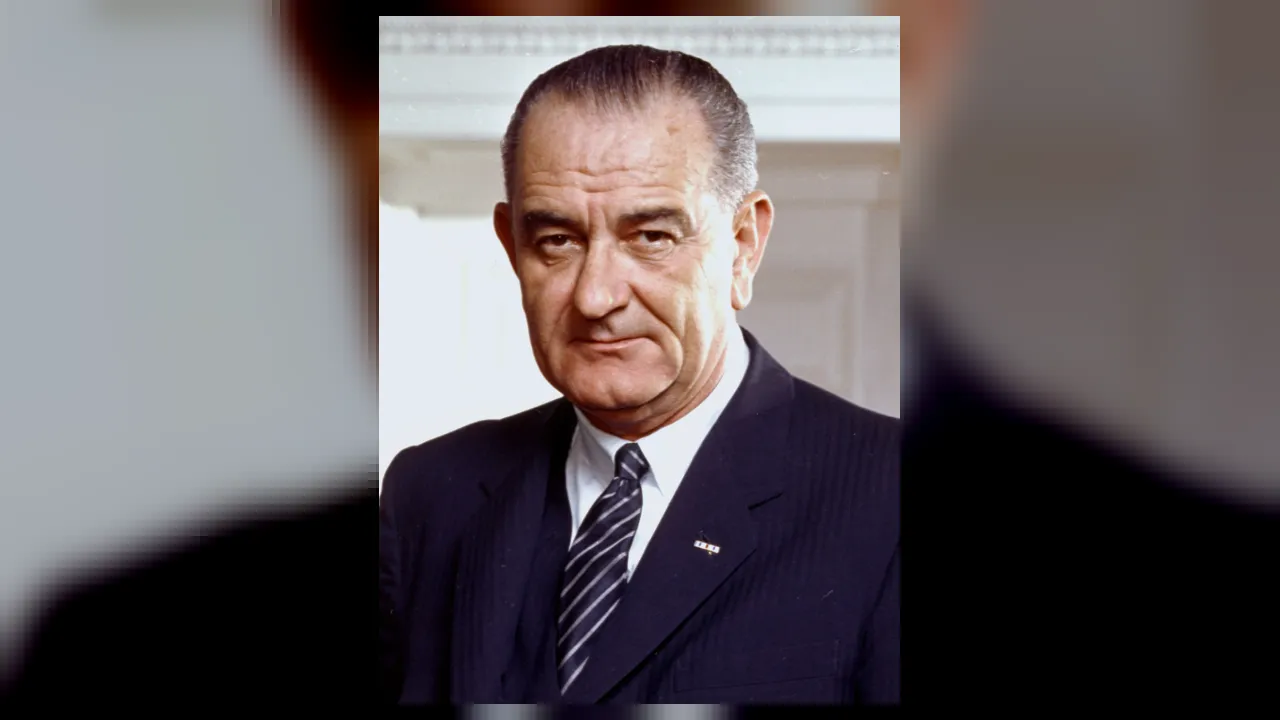
Lyndon B. Johnson
Schoolteacher Who Signed Landmark Civil Rights Laws
Grade 5 • Advanced • 416 words
⏳ Era / StatehoodPresidential Term: 1963–1969 (Born Aug 27, 1908, Texas)
🗺️ Region / CapitalStonewall, Texas (Texas Hill Country) & Washington, D.C.
📜 Key MilestoneCivil Rights Act (1964), Voting Rights Act (1965) & Head Start
⚡ Historical SparkTurned civil-rights marches into nationwide laws protecting equal access and voting
🤯 Mind-Blowing Fact • Grade 1
When Lyndon B. Johnson signed the landmark Civil Rights Act of 1964, he used more than seventy different fountain pens so he could hand them as keepsakes to helpers like Dr. Martin Luther King Jr.!
✨ Word Sparks (Grade 1 Glossary)
Tap 🔊 to hear
equal
Having the exact same rights and fair treatment
keepsake
A special item saved to remember an event
preschool
Early school helping young children get ready
🪝
How did being a schoolteacher shape our thirty-sixth president?
1
A Caring Young Teacher
Ring, ring! In a tiny Texas schoolhouse, young teacher Lyndon spent his own paycheck on playground balls and books. He wanted every child to get a fair chance!
2
Fair Laws for Everyone
When he became our thirty-sixth president, people called him LBJ. He signed big Civil Rights and Voting Rights laws so Americans of every race would be treated equally.
3
Helping Kids Learn
Remembering his Texas students, LBJ started Head Start and helped create public television—giving kids educational shows to watch and learn!
1. What job did Lyndon B. Johnson hold in Texas before entering politics?
2. What did the Civil Rights and Voting Rights laws signed by LBJ protect?
🤯 Mind-Blowing Fact • Grade 2
In 1965, President Johnson sat right beside his seventy-two-year-old first-grade teacher, Mrs. Kate Deadrich Loney, outside his tiny boyhood Texas schoolhouse to sign a major national education bill!
✨ Word Sparks (Grade 2 Glossary)
Tap 🔊 to hear
opportunity
A fair chance to learn, work, and succeed
poverty
Not having enough money for everyday needs
Medicare
Health insurance helping older Americans pay doctor bills
🪝
Why did President Lyndon B. Johnson return to his tiny childhood schoolhouse in Texas to sign an education law?
1
Lessons From the Texas Hill Country
Dust swirled outside a small school in Cotulla, Texas, where twenty-year-old Lyndon B. Johnson taught hardworking Mexican American children in 1928. Seeing how held bright students back made him vow to open doors of if he ever gained power.
2
Stepping Up and Passing Civil Rights
After decades in Congress and serving as vice president, LBJ became our thirty-sixth president on November 22, 1963, following John F. Kennedy's death. Working tirelessly with lawmakers and Dr. Martin Luther King Jr., he signed the Civil Rights Act of 1964 and Voting Rights Act of 1965.
3
Schools, Courts, and Difficult Years
LBJ launched 'Great Society' programs like Head Start, for seniors, and PBS educational television, and he appointed Thurgood Marshall as the first Black Supreme Court Justice. Later, deep divisions over the Vietnam War led LBJ not to run again in 1968.
1. Who did President Lyndon B. Johnson appoint in 1967 as the first African American Justice on the U.S. Supreme Court?
2. Who sat beside President Johnson when he signed the Elementary and Secondary Education Act in Texas in 1965?
🤯 Mind-Blowing Fact • Grade 3
President Lyndon B. Johnson owned a funny 'amphibious' car at his Texas ranch that could drive right off a dusty country road and splash across Pedernales River water like a motorboat!
✨ Word Sparks (Grade 3 Glossary)
Tap 🔊 to hear
literacy test
An unfair exam once used to block voters
outlawed
Made illegal and forbidden by official law
escalation
Rapidly increasing the size or intensity of a conflict
🪝
How did a former Senate leader persuade Congress to pass two of the most important civil-rights laws in American history?
1
From Texas Teacher to Master Lawmaker
Picture growing up on a Texas ranch without electricity or running water! Born near Stonewall, Texas, in 1908, Lyndon Baines Johnson worked his way through teachers college, taught in South Texas, and served twenty-four years in the U.S. House and Senate—learning how Congress worked better than almost anyone.
2
The Civil Rights Act of 1964
Sworn in aboard Air Force One after President Kennedy's assassination in November 1963, LBJ told Congress no memorial could honor JFK better than passing the Civil Rights bill. Signed on July 2, 1964, the Civil Rights Act segregation in restaurants, hotels, schools, and workplaces.
3
The Voting Rights Act and Great Society
In 1965, after peaceful voting-rights marchers faced mistreatment in Selma, Alabama, Johnson urged Congress to act, signing the Voting Rights Act of 1965 to ban unfair . His 'Great Society' also created Head Start, Medicare, wilderness protections, and the Public Broadcasting Act.
4
Space Progress and Vietnam Challenges
While cheering NASA's Gemini and Apollo missions—including Apollo 8 orbiting the Moon in 1968—Johnson expanded U.S. troop involvement in the Vietnam War. As the costly conflict divided Americans, LBJ chose not to seek reelection in 1968.
1. What unfair barrier to voting did the Voting Rights Act of 1965 ban?
2. Which children's television and radio network grew out of the Public Broadcasting Act signed by LBJ in 1967?
🤯 Mind-Blowing Fact • Grade 4
First Lady Claudia 'Lady Bird' Johnson championed the Highway Beautification Act of 1965 and inspired millions of wildflowers to be planted along American roadsides!
✨ Word Sparks (Grade 4 Glossary)
Tap 🔊 to hear
watershed
A major turning point that changes history afterward
filibuster
Long speeches in the Senate used to delay voting
accommodations
Public places like hotels, restaurants, theaters, and buses
🪝
Why do Virginia history classrooms study 1964 and 1965 as watershed years in fulfilling the U.S. Constitution's promise of equal citizenship?
1
Hill Country Roots and Legislative Mastery
Growing up along the Pedernales River in the rural Texas Hill Country, Lyndon B. Johnson watched families haul water from wells and farm by kerosene lamp. After graduating from Southwest Texas State Teachers College and teaching impoverished students in Cotulla, Texas, he entered Congress in 1937—bringing electricity to rural Texas farms—and rose to become one of the most persuasive Senate Majority Leaders in U.S. history.
2
Landmark Civil Rights and Voting Rights Laws
Assuming the presidency in November 1963, Johnson combined grassroots momentum from Dr. Martin Luther King Jr. and the Civil Rights Movement with bipartisan congressional coalition-building. Together with Senate leaders like Everett Dirksen and Hubert Humphrey, LBJ overcame a lengthy Senate to sign the Civil Rights Act of 1964, prohibiting discrimination in public and employment. After the 1965 Selma marches and ratification of the Twenty-Fourth Amendment abolishing poll taxes, he signed the Voting Rights Act of 1965, protecting Fifteenth Amendment voting rights nationwide.
3
The Great Society and Judicial Milestones
Winning a landslide election in 1964, Johnson proposed a 'Great Society' aimed at reducing poverty and expanding opportunity. Congress enacted Medicare and Medicaid health coverage (1965), the Elementary and Secondary Education Act, Head Start early learning, the Wilderness Act of 1964, Lady Bird Johnson's Highway Beautification Act, and the Fair Housing Act of 1968. In 1967, LBJ appointed civil-rights attorney Thurgood Marshall as the first African American U.S. Supreme Court Justice.
4
Vietnam War Strain and Stepping Aside
Foreign events increasingly overshadowed Johnson's domestic reforms. Following the 1964 Gulf of Tonkin Resolution, Johnson sent over half a million American troops to fight in the Vietnam War to prevent a communist takeover of South Vietnam. As casualties rose and public debate intensified, Johnson surprised the nation in March 1968 by declining to seek another term.
1. How did the Twenty-Fourth Amendment (1964) and the Voting Rights Act (1965) work together?
2. Which 1964 environmental law signed by President Johnson preserved millions of acres of unspoiled public land?
🤯 Mind-Blowing Fact • Grade 5
Before becoming president, as Senate Majority Leader in 1958, Lyndon B. Johnson authored and steered the National Aeronautics and Space Act through Congress—making him a founding legislative architect of NASA!
✨ Word Sparks (Grade 5 Glossary)
Tap 🔊 to hear
indelible
Lasting forever and impossible to erase or forget
succession
The legal order for filling an empty office
consensus
Broad general agreement shared across a large group
🪝
How did Lyndon B. Johnson enact the broadest domestic legislative transformation since the New Deal while confronting the tragedy of Vietnam?
1
Cotulla Classroom to Master of the Senate
Nine months teaching Mexican American children at the segregated Welhausen School in Cotulla, Texas (1928–1929), left an mark on future president Lyndon Baines Johnson. Raised in modest circumstances in the Texas Hill Country, Johnson entered the U.S. House in 1937 as an ardent New Dealer who secured rural electrification for thousands of isolated ranch families, won a U.S. Senate seat in 1948, and served six years (1955–1961) as history's most legislatively adept Senate Majority Leader before becoming John F. Kennedy's vice president.
2
Enacting the Civil Rights and Voting Rights Revolution
Sworn in aboard Air Force One at Dallas Love Field on November 22, 1963, Johnson threw his full political capital behind completing Kennedy's civil-rights agenda. Partnering with civil-rights leaders—including Dr. Martin Luther King Jr., Roy Wilkins, and James Farmer—and bipartisan lawmakers led by Senator Hubert Humphrey and Republican Minority Leader Everett Dirksen, Congress broke a sixty-day filibuster to enact the Civil Rights Act of 1964, barring discrimination in public accommodations, federally funded programs, and employment. Eight months later, responding to Selma's 'Bloody Sunday' with his stirring March 15, 1965 'We Shall Overcome' address to Congress, Johnson signed the Voting Rights Act of 1965—enforcing the Fifteenth Amendment and quadrupling Black voter registration across the Deep South within years.
3
Architecture of the Great Society
Following his 61.1 percent popular-vote landslide in 1964, Johnson submitted nearly two hundred legislative proposals to the 89th Congress to build what he termed at the University of Michigan a 'Great Society.' Landmark enactments included the Social Security Amendments of 1965 establishing Medicare for seniors and Medicaid for low-income families; the Elementary and Secondary Education Act and Higher Education Act; Project Head Start; the Immigration and Nationality Act of 1965 abolishing national-origin quotas; the Wilderness Act and Water Quality Act; the National Endowments for the Arts and Humanities; and the Fair Housing Act of 1968.
4
Constitutional Milestones and NASA Progress
Johnson's era also reshaped constitutional governance and exploration: ratification of the Twenty-Fourth Amendment (1964) abolishing federal poll taxes and the Twenty-Fifth Amendment (1967) clarifying presidential , alongside his historic 1967 appointment of Solicitor General Thurgood Marshall as the first African American Supreme Court Justice. As former Senate space committee chair, LBJ steadfastly funded NASA through Gemini and Apollo 8's historic December 1968 lunar orbit.
5
Vietnam Escalation and the Decision of 1968
Yet foreign policy unraveled Johnson's . Guided by Cold War containment doctrine after the August 1964 Gulf of Tonkin Resolution, Johnson incrementally committed more than 500,000 U.S. troops to South Vietnam. Rising casualties, inflation, and domestic unrest following the January 1968 Tet Offensive eroded public trust, prompting Johnson's dramatic March 31, 1968 announcement: 'I shall not seek, and I will not accept, the nomination of my party for another term as your President.'