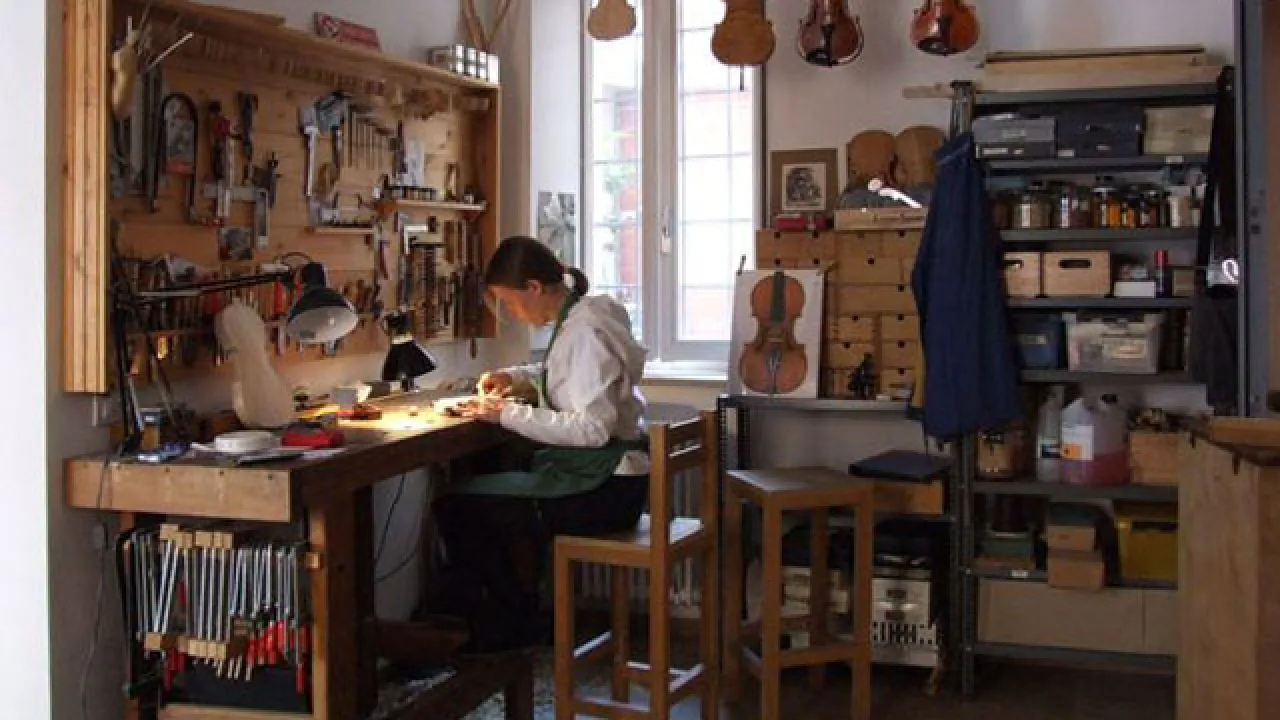
⚡ Everyday Impact SparkShapes silent planks of spruce and maple into violins, cellos, and guitars that fill concert halls with music
🤯 Mind-Blowing Fact • Grade 1
The word luthier comes from the French word for lute, an old pear-shaped string instrument!
✨ Word Sparks (Grade 1 Glossary)
Tap 🔊 to hear
Luthier
A builder who makes string musical instruments
Hollow
Having empty space on the inside
Varnish
Clear, shiny coat that protects wood
🪝
How does a flat piece of wood learn to sing?
1
Wood That Makes Music
Scrape, curl, and tap! Sweet wood shavings fall to the floor. A builds string instruments like guitars and violins. Careful hands carve thin wood into a box.
2
Bending and Gluing
Warm tools bend thin wood strips into curvy sides. Strong glue holds the top, back, and long neck together. Next comes a shiny coat of .
3
Pluck the Strings
Last, the stretches tight strings across the bridge. Pluck! The wood buzzes and sings a clear, happy note.
1. Which kind of musical instrument does a luthier build and fix?
2. Why is the body of an acoustic guitar or violin hollow inside?
🤯 Mind-Blowing Fact • Grade 2
A single handmade violin is built from more than seventy separate pieces of wood fitted together like a puzzle!
✨ Word Sparks (Grade 2 Glossary)
Tap 🔊 to hear
Tonewood
Special wood chosen for clear musical sound
Bridge
Small wooden piece holding up instrument strings
Vibration
Fast back-and-forth shaking that makes sound
🪝
Why does an instrument maker tap on raw wood planks and listen closely before cutting?
1
Listening to Tonewood
Knock, knock—ring! In a sunny workshop, a luthier holds a plank of spruce near one ear and taps it gently. Wood that rings like a clear bell is called , and it will make a violin or guitar sound rich.
2
Shaping Curves With Heat
Using tiny hand planes and sharp chisels, the luthier carves the front and back plates thin. Damp wood strips are pressed against a hot metal bending iron until they curve smoothly into the instrument's waist.
3
Setting Up the Strings
After brushing on protective varnish, the luthier fits tuning pegs, a small wooden , and tight strings. One strum sends warm dancing through the room!
1. Why does a luthier tap a piece of wood before carving it?
2. How does a luthier curve straight wooden strips into the wavy sides of a guitar?
🤯 Mind-Blowing Fact • Grade 3
Four violin strings pull on the wooden neck and top with over fifty pounds of force—about as heavy as a large dog!
✨ Word Sparks (Grade 3 Glossary)
Tap 🔊 to hear
Soundboard
Thin wooden top that amplifies string vibrations
Calipers
Measuring tool checking exact wood thickness
Amplify
To make a quiet sound much louder
🪝
How can shaving off a paper-thin curl of wood change the voice of a cello?
1
Where Woodworking Meets Physics
Curls of fragrant cedar and spruce carpet the workbench as a luthier peers through a magnifying lamp. Luthiers craft and repair stringed instruments—including violins, violas, cellos, double basses, guitars, and banjos—by blending fine woodworking with the science of sound.
2
Choosing Aged Woods
Different parts of an instrument need different trees. Luthiers often select lightweight Sitka or Alpine spruce for the top because it vibrates easily, while strong curly maple forms the back, sides, and neck to resist heavy string pull.
3
Measuring to a Fraction of a Millimeter
Using thumb planes and dial , the luthier graduates the wooden top so it is slightly thicker under the bridge and thinner near the edges. Even half a millimeter changes whether notes sound bright and punchy or warm and mellow.
4
Repairing Treasured Instruments
Many luthiers also restore centuries-old instruments using reversible hide glue, allowing repairs to be opened safely decades later without harming historic wood.
1. Why do luthiers often pair a lightweight spruce top with a hard maple neck and back?
2. Why do violin luthiers use traditional hide glue instead of permanent superglue?
🤯 Mind-Blowing Fact • Grade 4
Inside a violin, the tiny wooden sound post is held in place solely by friction and string pressure—not a single drop of glue!
✨ Word Sparks (Grade 4 Glossary)
Tap 🔊 to hear
Resonance
Deep, rich echoing of musical vibrations
Sound post
Small wooden dowel transferring vibrations inside violins
Intonation
Accuracy of musical pitch across every note
🪝
How does a tiny wooden dowel wedged inside a violin earn the poetic nickname 'the soul'?
1
Architects of Acoustic Resonance
Pluck a stretched steel string in midair and you can barely hear it three feet away, because a thin wire pushes very little air. Mount that same string onto a luthier's handcrafted guitar or violin, and the note carries to the back balcony of a concert hall. Luthiers engineer wooden chambers that capture tiny string vibrations and pump surrounding air in musical waves.
2
Bracing Patterns and Sound Posts
Inside a flat-top guitar, a luthier glues slender spruce X-braces beneath the soundboard so it will not belly upward under more than one hundred fifty pounds of string tension. Inside a violin, no glue holds the critical ''—a pencil-thin spruce dowel wedged snugly between top and back plates. Called l'âme, or 'the soul' in French, moving it by just one millimeter alters volume and tone across all four strings.
3
Fret Geometry and Intonation
Building a fretted neck demands exact math. Using the twelfth-root-of-two ratio, a luthier cuts thin slots along the fingerboard so every metal fret shortens the vibrating string by the precise fraction needed to play in tune up the neck.
4
Heritage Craft From Cremona to Appalachia
From Italian violin workshops inspired by Antonio Stradivari to Virginia's Blue Ridge Mountains—where master luthiers craft world-renowned mandolins, banjos, and acoustic guitars along the Crooked Road—instrument makers keep community music traditions thriving.
1. Why can a plucked string be heard across a concert hall only when attached to an instrument body?
2. What holds a violin's internal sound post in position?
🤯 Mind-Blowing Fact • Grade 5
Acoustical researchers discovered that the elongated f-holes evolved by seventeenth-century Italian luthiers move nearly twice as much air from their narrow edges as circular holes of the same area!
✨ Word Sparks (Grade 5 Glossary)
Tap 🔊 to hear
Quarter-sawn
Lumber cut radially for straight, stiff grain
Nodal lines
Still lines on a vibrating wooden plate
Truss rod
Steel bar reinforcing a guitar neck's straightness
🪝
How do master luthiers use glittering sand patterns and mathematical ratios to tune wood before a single string is attached?
1
Acoustic Engineering in Organic Material
Unlike factory engineers stamping identical sheets of aluminum, a luthier works with biological material where no two trees share identical density or grain stiffness. spruce—sliced radially from log center to bark—yields stiff, straight grain lines with a high speed of sound relative to weight. Before carving begins, timber seasons for years until moisture stabilizes around six to eight percent, preventing future warping.
2
Chladni Patterns and Tap-Tone Tuning
While carving an arched violin belly or bracing a classical guitar soundboard, many modern luthiers combine centuries-old tap listening with Chladni frequency testing. Sprinkling dark glitter or sand onto a carved wooden plate placed above a tone generator makes the plate vibrate at specific hertz frequencies. Sand dances away from vibrating zones and settles along motionless , revealing symmetric ring patterns when stiffness and thickness reach acoustic harmony.
3
Structural Mechanics Under Constant Load
A steel-string acoustic guitar endures roughly one hundred sixty to one hundred eighty pounds of continuous pull trying to fold the instrument in half. Luthiers counter this force with an adjustable steel embedded inside the mahogany neck and scalloped internal spruce braces beneath the top. Carving small scallops out of those braces shaves grams of mass so bass frequencies bloom without sacrificing structural safety.
4
Helmholtz Air Cavities and F-Holes
Even the shape of soundholes follows fluid physics. A guitar's round soundhole or a cello's graceful f-holes govern Helmholtz resonance—the low-frequency 'air piston' bounce of air rushing in and out of the body cavity, much like blowing across a bottle top.
5
Conservation and Custom Ergonomics
Whether humidifying a cracked three-hundred-year-old orchestral viola, designing ergonomic bevels for touring guitarists, or building electric basses with magnetic pickups, luthiers unite physics, forestry, geometry, and musical artistry in every instrument.