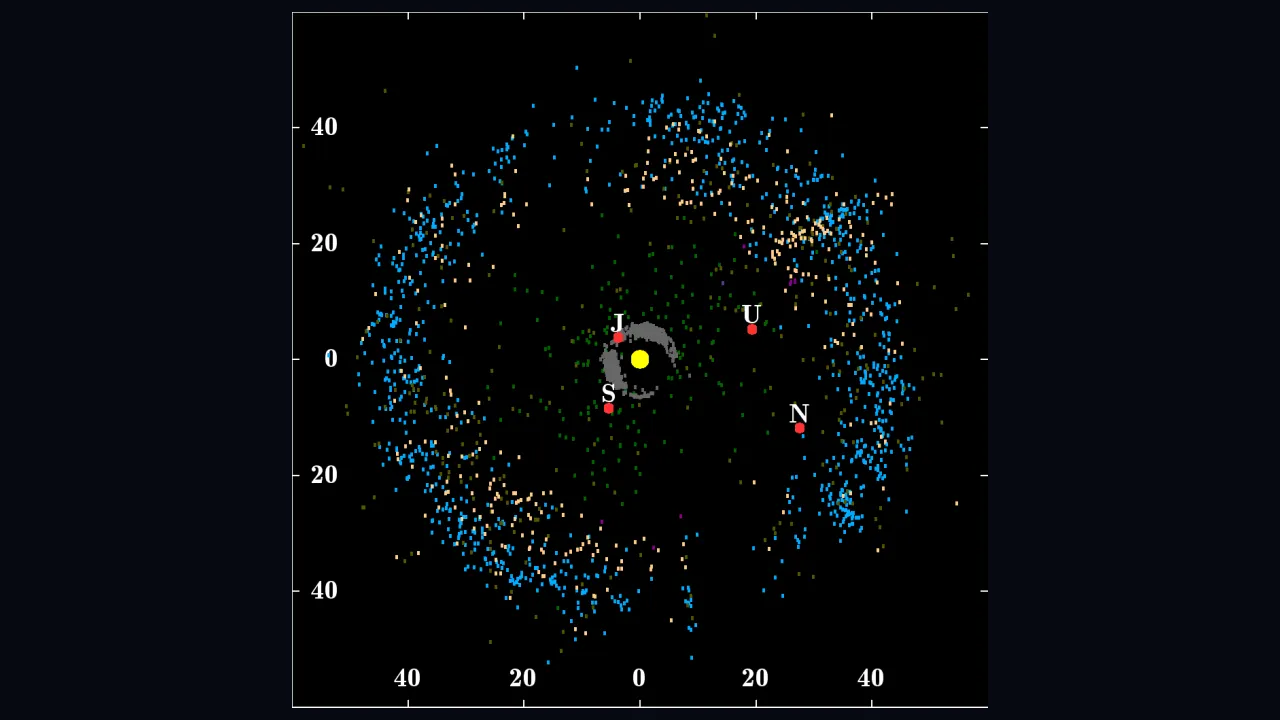
1. Where is the Kuiper Belt located in our Solar System?
2. Which famous dwarf planet lives inside the Kuiper Belt?
🤯 Mind-Blowing Fact • Grade 2
Dwarf planet Haumea spins so fast inside the Kuiper Belt—once every four hours—that it stretched itself into the shape of an American football!
✨ Word Sparks (Grade 2 Glossary)
Tap 🔊 to hear
zone
A wide region with special features in space
nudge
A gentle push that changes how something moves
telescope
A tool with lenses or mirrors to see far
🪝
Why did Pluto turn out not to be lonely at the edge of the planets?
1
A Giant Doughnut of Ice
For decades after Pluto was found in 1930, people thought it orbited alone beyond Neptune. Then in 1992, astronomers discovered another icy world nearby—and soon thousands more! Together they form a huge doughnut-shaped called the Kuiper Belt.
2
Twenty Times Wider
Compared to the rocky Asteroid Belt near Mars, the Kuiper Belt is gigantic. It stretches twenty times wider and holds way more icy worlds, including Pluto, Makemake, and egg-shaped Haumea.
3
Home of Visiting Comets
Every so often, Neptune's gravity an icy lump out of the Kuiper Belt. When it swings near the warm Sun, its ice steams into a bright comet tail!
1. How wide is the Kuiper Belt compared to the rocky Asteroid Belt?
2. What happens when an icy Kuiper Belt object gets nudged close to the warm Sun?
🤯 Mind-Blowing Fact • Grade 3
When NASA's New Horizons zoomed past twin-lobed Arrokoth 4 billion miles from Earth in 2019, it achieved the farthest spacecraft flyby of any world in history!
✨ Word Sparks (Grade 3 Glossary)
Tap 🔊 to hear
volatiles
Chemicals like methane that easily turn to gas
astronomical unit
Average distance between Earth and the Sun
flyby
A close spacecraft pass to photograph a world
🪝
How did two patient astronomers prove a hidden ring of worlds existed past Neptune?
1
Predicting an Icy Ring
Imagine suspecting that trillions of icy boulders hide in the dark beyond Neptune, yet having no camera sensitive enough to spot them! Mid-century astronomers Kenneth Edgeworth and Gerard Kuiper reasoned that our Solar System could not simply stop cleanly at Neptune's orbit. Leftover icy building blocks had to linger farther out.
2
The 1992 Breakthrough
For five years, astronomers David Jewitt and Jane Luu searched deep telescope images from Hawaii. In August 1992, they spotted 1992 QB1—later named Albion—drifting beyond Pluto! Today astronomers know hundreds of thousands of Kuiper Belt Objects wider than 60 miles orbit between 30 and 50 from the Sun.
3
Frozen Volatiles and Dwarf Worlds
Kuiper Belt bodies consist of rock mixed with frozen —substances like water, methane, and ammonia that would boil into gas near Earth. Giant members include Pluto, Makemake, and fast-spinning Haumea.
4
New Horizons Explores Up Close
NASA's New Horizons probe flew past Pluto in 2015 and double-lobed Arrokoth in 2019, revealing ancient worlds preserved in a deep freeze.
1. Who discovered the first Kuiper Belt Object after Pluto and Charon in 1992?
2. What are Kuiper Belt Objects mostly made of?
🤯 Mind-Blowing Fact • Grade 4
Hundreds of Kuiper Belt Objects travel as wide dancing pairs—equal-sized icy twins slowly orbiting an empty point in space between them!
✨ Word Sparks (Grade 4 Glossary)
Tap 🔊 to hear
circumstellar
Forming a ring all around a central star
plutino
Kuiper Belt object sharing Pluto's orbital rhythm
reclassify
Place something into a more accurate scientific group
🪝
How did Pluto's discovery of thousands of icy neighbors change the definition of a planet?
1
From Lonely Ninth Planet to Crowded Belt
Stretch past Neptune's orbit at 30 astronomical units out to roughly 50 astronomical units, and you enter a vast disk called the Kuiper Belt. Predicted by Kenneth Edgeworth in 1943 and Gerard Kuiper in 1951, this frontier remained theoretical until digital sensors allowed David Jewitt and Jane Luu to detect Albion in 1992. As surveys uncovered Makemake, Haumea, and scattered-disk giant Eris, astronomers realized Pluto was not a solitary planet, prompting its 2006 reclassification as king of the Kuiper Belt dwarf planets.
2
Plutinos and Classical Cubewanos
Neptune's gravity organizes the Kuiper Belt into distinct orbital neighborhoods. 'Classical' objects like Arrokoth glide on calm, nearly circular paths undisturbed since the Solar System's birth. Meanwhile, ''—including Pluto itself—are locked in a protective 2:3 resonance, completing two orbits for every three of Neptune's so the two worlds can never collide.
3
Nursery of Short-Period Comets
Adjacent to the main belt lies the turbulent Scattered Disk, where gravitational encounters toss icy fragments inward. These become Jupiter-family short-period comets whose orbits take less than 200 years.
4
Gentle Mergers in the Deep Freeze
When New Horizons photographed 22-mile-long Arrokoth, its two pancake-like lobes showed zero violent impact fractures—proving early planetesimals coalesced gently out of collapsing pebble clouds.
1. Why can Pluto cross inside Neptune's distance from the Sun without ever crashing into Neptune?
2. What did the smooth, uncrushed twin lobes of Arrokoth teach planetary scientists?
🤯 Mind-Blowing Fact • Grade 5
Submillimeter telescopes like ALMA routinely photograph bright 'Kuiper Belts' around distant young stars, showing what our own outer Solar System looked like four billion years ago!
✨ Word Sparks (Grade 5 Glossary)
Tap 🔊 to hear
reservoir
A huge storage region supplying comets or matter
contact binary
Two space bodies resting gently stuck together
migration
Slow inward or outward shift of planet orbits
🪝
How does the architecture of the Kuiper Belt betray an ancient migration of the giant planets?
1
Confirming the Trans-Neptunian Disk
Mid-twentieth-century theorists Kenneth Edgeworth and Gerard Kuiper recognized a sharp puzzle: why would the solar nebula's solid matter vanish abruptly past Neptune at 30 astronomical units? Furthermore, short-period comets with low orbital inclinations needed a nearby flat rather than a distant spherical shell. Following David Jewitt and Jane Luu's landmark 1992 detection of 15760 Albion using a charge-coupled device camera on Mauna Kea, astronomers unveiled a torus twenty times wider and twenty to two hundred times more massive than the Main Asteroid Belt.
2
Dynamical Populations and the Kuiper Cliff
Detailed orbital surveys split Kuiper Belt Objects (KBOs) into 'cold classical' bodies—reddish, often binary worlds on low-inclination, circular paths between 42 and 48 AU—and 'hot' populations with tilted, eccentric orbits. Intriguingly, at roughly 50 AU the density of classical objects drops precipitously at a boundary dubbed the 'Kuiper Cliff,' while resonant groups like the 2:3 Plutinos and 1:2 Twotinos cluster along invisible gravitational fences.
3
Footprints of Neptune's Outward March
How did tilted 'hot' KBOs and resonant Plutinos acquire their energized tracks? According to the Nice model of planetary dynamics, Neptune formed closer to the Sun and migrated outward as it scattered icy planetesimals. Like a snowplow sweeping pebbles uphill, Neptune's expanding orbital resonances captured Pluto and thousands of siblings, pumping up their eccentricities while leaving distant cold classical twins untouched.
4
Cryogenic Chemistry Seen by Webb and New Horizons
Infrared spectra from the James Webb Space Telescope reveal distinct compositional families across the belt: giant dwarf planets like Pluto and Makemake retain volatile methane and nitrogen frosts, mid-sized worlds preserve carbon dioxide and methanol, and primordial contact binaries like 486958 Arrokoth wear dark tholin veneers forged by eons of cosmic rays.
5
Blueprint for Extrasolar Debris Disks
When radio arrays like ALMA image dusty rings encircling young stars light-years away, astronomers are witnessing giant sibling Kuiper Belts—confirming that our icy frontier is a universal hallmark of planet formation.