🌌 COSMOS
🔭 NASA Discovery Program Space Observatory • Photometer
VA Science SOL 1.6, 4.5, 4.6 (Solar System, Stars & Space Exploration)
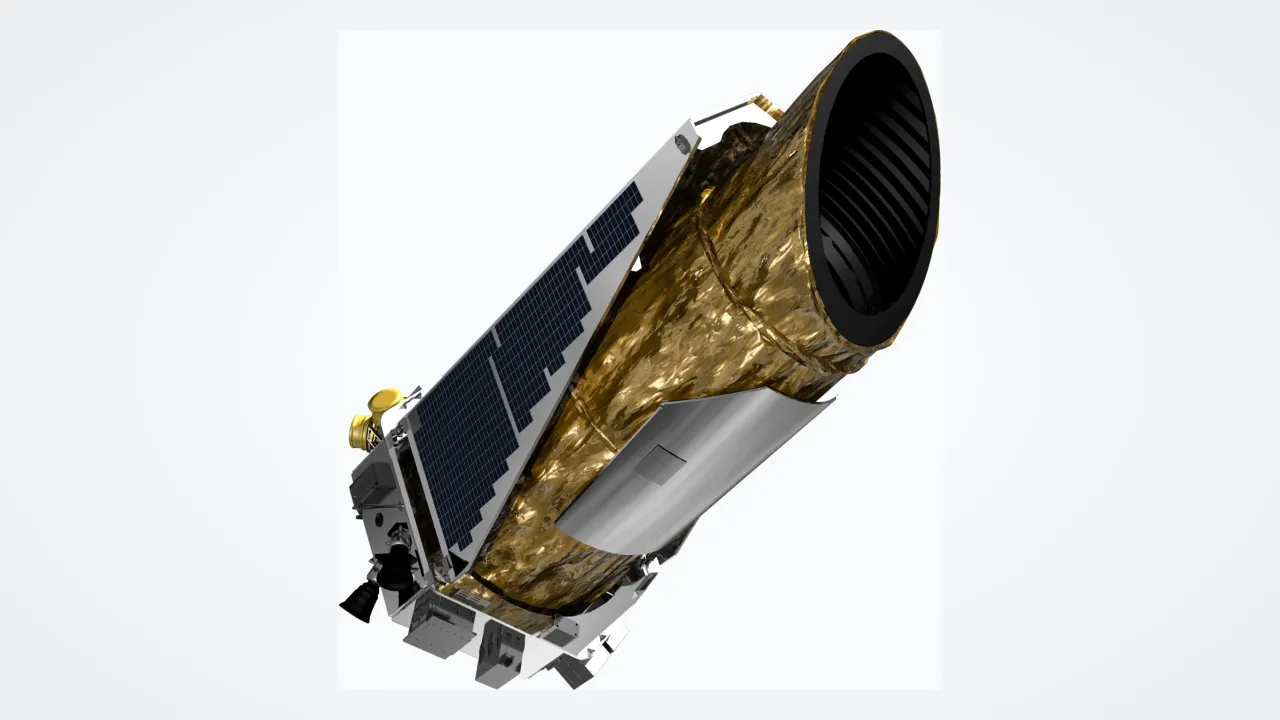
Kepler Space Telescope
Counting Distant Worlds Across Starry Skies
Grade 4 • Expanding • 204 words
🌌 Cosmic Location & DistanceEarth-Trailing Heliocentric Orbit • Trails Earth Around the Sun
🪐 Scale / Diameter15.3 ft (4.7 m) tall • 0.95 m Aperture • 2,320 lbs (1,052 kg)
☄️ Composition & Orbit95-Megapixel CCD Photometer • 372.5-Day Solar Orbit
⚡ Cosmic SparkDiscovered over 2,700 exoplanets by spotting tiny dips in starlight
🤯 Mind-Blowing Fact • Grade 1
Kepler proved that our Milky Way galaxy actually has more planets than stars!
✨ Word Sparks (Grade 1 Glossary)
Tap 🔊 to hear
planet
a big round world orbiting a star
telescope
a tool for seeing faraway space objects
dim
to grow a little less bright
🪝
How can you spot a tiny dark planet next to a super bright star?
1
Staring at the Stars
Blink! Did that faraway star just get a tiny bit dimmer? NASA sent a special camera into deep space to watch stars without blinking. It stared at one big patch of sky for years.
2
Shadows in Space
When a crosses in front of its star, it blocks a speck of light. This space caught thousands of those tiny shadows.
3
So Many Worlds
Thanks to its sharp eye, we now know space is full of ! Some are hot, some are icy, and some are rocky like Earth.
1. How did the Kepler Space Telescope find hidden planets?
2. Where did Kepler travel to do its star-watching job?
🤯 Mind-Blowing Fact • Grade 2
Kepler's light sensor was so sensitive it could spot a flea creeping across a car headlight from miles away!
✨ Word Sparks (Grade 2 Glossary)
Tap 🔊 to hear
exoplanet
a planet that orbits another distant star
orbit
the curved path around a star
sensor
a detector that measures light or heat
🪝
Could a moth flying across a bright searchlight teach us how to find new worlds?
1
A Unblinking Space Camera
Picture a tiny bug crawling across a glowing flashlight from far away. The light dips just a little! In 2009, NASA launched the Kepler Space Telescope to watch for that exact trick in deep space.
2
Watching Over 150,000 Stars
Kepler trailed behind Earth in its own around the Sun. Its giant digital camera watched more than 150,000 stars at the very same time. Whenever an crossed in front of its star, Kepler measured the tiny drop in brightness.
3
A Galaxy Packed with Planets
Over nine years, Kepler discovered more than 2,700 distant worlds! Scientists found rocky worlds, gas giants, and even planets orbiting two suns at once.
1. About how many stars did Kepler watch at the same time during its main mission?
2. What do astronomers call a planet that orbits a star outside our solar system?
🤯 Mind-Blowing Fact • Grade 3
When two of Kepler's steering wheels broke in 2013, engineers used gentle pressure from sunlight itself to balance the spacecraft for a second mission called K2!
✨ Word Sparks (Grade 3 Glossary)
Tap 🔊 to hear
transit
when a planet crosses before its star
photometer
an instrument measuring exact light brightness
habitable zone
orbital region warm enough for liquid water
🪝
How did one spacecraft change what we know about every starry night sky?
1
Hunting Worlds in the Glare
Try spotting a firefly hovering right beside a stadium spotlight! Stars shine billions of times brighter than the planets orbiting them, so distant worlds usually vanish in the glare. Launched in 2009, the Kepler Space Telescope solved this puzzle without trying to photograph the planets directly.
2
The Transit Method
Kepler used a clever technique called the method. When an exoplanet's orbit lines up edge-on with our view, the planet crosses—or transits—in front of its host star. That crossing blocks a tiny fraction of starlight at regular intervals.
3
A Giant 95-Megapixel Eye
To catch dips smaller than one part in ten thousand, Kepler carried a 95-megapixel camera. Trailing Earth around the Sun, it avoided Earth's blurry atmosphere and stared continuously toward the Cygnus constellation.
4
Searching the Habitable Zone
By timing how often a planet transited, astronomers calculated its orbit size and temperature. Kepler revealed dozens of worlds inside their star's , where liquid water could pool on rocky surfaces.
1. What does the transit method measure to detect an unseen exoplanet?
2. Why is a star's habitable zone so exciting to scientists?
🤯 Mind-Blowing Fact • Grade 4
Kepler discovered Kepler-16b, a real-life circumbinary planet where two suns set over the horizon at once!
✨ Word Sparks (Grade 4 Glossary)
Tap 🔊 to hear
light curve
a graph showing star brightness over time
reaction wheel
a spinning flywheel that steers spacecraft
aperture
the main light-gathering opening of a telescope
🪝
Before 2009, nobody knew if rocky Earth-sized planets were rare miracles or common neighbors—how did Kepler find the answer?
1
Escaping Earth's Shimmering Air
Step outside on a clear night and watch the stars twinkle. That shimmer happens because turbulent pockets of air in Earth's atmosphere bend incoming starlight. For planet hunters, twinkling air hides the tiny brightness changes caused by orbiting worlds. NASA placed the Kepler Space Telescope into an Earth-trailing solar orbit so its 0.95-meter could observe an unobstructed patch of the Milky Way.
2
Reading Planetary Light Curves
Every thirty minutes for four straight years, Kepler recorded the brightness of more than 150,000 stars near Cygnus and Lyra. Astronomers plotted these measurements as graphs called . A U-shaped dip repeating on a strict schedule signaled a transiting exoplanet. The depth of the dip revealed the planet's diameter compared to its star, while the time between dips revealed the length of its year.
3
Rescued by Sunlight
Kepler aimed itself with four spinning . After two wheels failed by 2013, the observatory could no longer hold steady on one target. Mission engineers invented an ingenious rescue plan: they angled Kepler's solar panels like a sailboat keel so the gentle push of solar photons kept the telescope steady along the ecliptic plane.
4
Rewriting Planetary Science
Before retiring in 2018 after running out of fuel, Kepler confirmed over 2,700 exoplanets—including super-Earths and mini-Neptunes unlike anything in our own solar system.
1. What two clues could astronomers learn from a planet's repeating dips in a light curve?
2. How did engineers stabilize Kepler for its K2 mission after two reaction wheels failed?
🤯 Mind-Blowing Fact • Grade 5
Even years after Kepler went silent in 2018, astronomers and machine-learning algorithms continue finding overlooked exoplanets hidden inside its archived nine-year dataset!
✨ Word Sparks (Grade 5 Glossary)
Tap 🔊 to hear
heliocentric
centered around and orbiting the Sun
photometry
precise scientific measurement of starlight intensity
circumbinary
orbiting around two stars at once
🪝
How can measuring a brightness drop of just 84 parts per million across hundreds of light-years reveal another Earth?
1
Named for a Visionary Mathematician
Four centuries after Johannes Kepler formulated the mathematical laws of planetary motion, NASA launched a spacecraft bearing his name on March 7, 2009. Rather than sweeping across constellations like Hubble, this specialized Schmidt telescope carried a single scientific instrument: a 95-megapixel array of 42 charge-coupled devices (CCDs) engineered for ultra-precise stellar .
2
Precision Photometry in Heliocentric Orbit
If an alien astronomer watched our Solar System edge-on from afar, Earth crossing the Sun's disk would dim solar output by merely 84 parts per million—roughly 0.0084 percent—for about thirteen hours once every 365 days. Detecting such subtle signals required complete isolation from Earth's reflected glow, thermal shifts, and atmospheric turbulence. Engineers therefore placed Kepler into a 372.5-day Earth-trailing orbit, allowing continuous monitoring of 150,000 main-sequence stars spanning 115 square degrees in Cygnus, Lyra, and Draco.
3
Validating Candidates and Surprising Worlds
To confirm a true exoplanet and rule out eclipsing binary stars, astronomers required at least three evenly spaced transits obeying Kepler's third law relating orbital period to semi-major axis. The resulting catalog stunned planetary scientists. The galaxy teemed with compact multi-planet systems like Kepler-11, lava-covered rocky worlds orbiting in hours, and an entire class of 'super-Earths' and 'sub-Neptunes' between one and four Earth radii—planet types completely absent around our Sun.
4
The K2 Renaissance
When a second gyroscope-like reaction wheel failed in May 2013, engineers harnessed solar radiation pressure against the spacecraft's symmetrical housing to maintain pointing stability for 80-day campaigns along the zodiacal plane. This K2 extension surveyed star clusters, white dwarfs, and distant supernovae.
5
A Lasting Cosmic Census
Decommissioned in October 2018 after exhausting its hydrazine thrusters, Kepler delivered over 2,700 confirmed exoplanets and statistical proof that roughly one in five Sun-like stars hosts an Earth-sized world in its habitable zone.