⚡ Historical SparkOnly U.S. president elected to the House of Representatives after leaving the White House
🤯 Mind-Blowing Fact • Grade 1
John Quincy Adams kept a personal diary for nearly seventy years, filling fifty-one books with American history!
✨ Word Sparks (Grade 1 Glossary)
Tap 🔊 to hear
canal
A human-made waterway built for boats to travel
telescope
A tool that makes faraway stars look close
Congress
The group of leaders who make America's laws
🪝
What if a president loved books, stars, and swimming at sunrise?
1
Growing Up With History
Splash! Every morning before sunrise, our sixth president swam in the Potomac River. His dad, John Adams, had been president too! Young John loved reading books and learning new languages.
2
Building Roads and Canals
As president, he wanted to connect America. He cheered for new roads, bridges, and waterways called . He even wanted a big national to study the night stars!
3
Always Helping People
After leaving the White House, he did not stop working. Voters chose him to serve in for seventeen more years, where he spoke up bravely for freedom.
1. Which earlier U.S. president was John Quincy Adams's father?
2. Where did John Quincy Adams work AFTER his time as president?
🤯 Mind-Blowing Fact • Grade 2
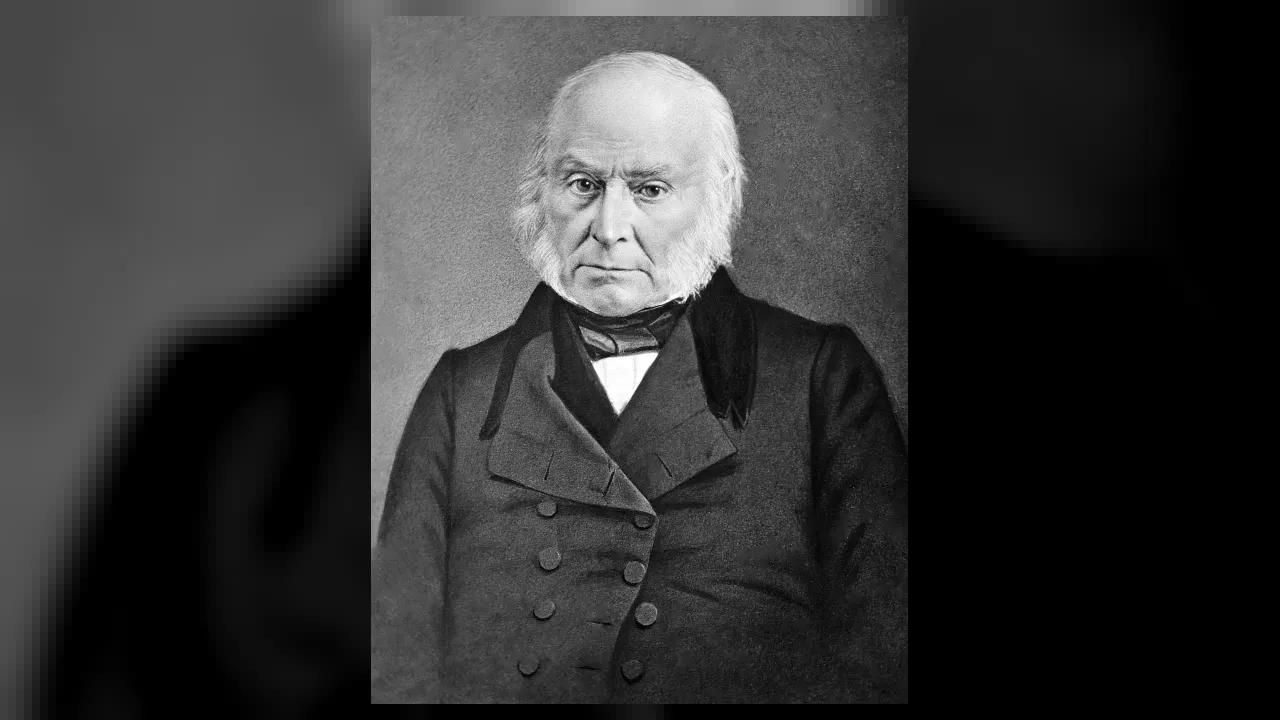
In 1843, seventy-six-year-old John Quincy Adams became the earliest U.S. president ever captured in an existing photograph!
✨ Word Sparks (Grade 2 Glossary)
Tap 🔊 to hear
abroad
In or to a foreign country overseas
astronomy
The science of studying stars, planets, and space
retire
To stop working after many years of service
🪝
How did a ten-year-old boy sailing across the stormy ocean grow up to become our sixth president?
1
A Young World Traveler
Creak, crash! Ocean waves tossed a wooden ship carrying ten-year-old John Quincy Adams to Europe with his father, John Adams. While living , young John learned French, Dutch, and German, becoming a trusted helper for American leaders.
2
The Sixth President's Big Dreams
When he became the sixth president in 1825, he dreamed of a connected, curious nation. He supported building sturdy roads and long canals so farmers could ship crops easily, and he urged Congress to fund science and .
3
A Voice for Freedom in Congress
Most presidents after leaving the White House, yet Adams ran for the House of Representatives and won! For seventeen years, he spoke boldly against slavery and helped start the famous Smithsonian museums.
1. Why did John Quincy Adams travel to Europe when he was just ten years old?
2. What famous museum group did John Quincy Adams help establish in Washington, D.C.?
🤯 Mind-Blowing Fact • Grade 3
Someone once gave John Quincy Adams a live pet alligator, which briefly splashed inside a White House bathtub!
✨ Word Sparks (Grade 3 Glossary)
Tap 🔊 to hear
diplomat
An official who represents a country abroad peacefully
treaty
A formal written peace or land agreement between nations
observatory
A special building with telescopes for watching space
🪝
Why do historians call John Quincy Adams one of the greatest diplomats in American history?
1
Trained for Public Service
Picture a teenager translating French for an American ambassador in Russia! Growing up during the American Revolution, John Quincy Adams watched history unfold firsthand. By age twenty-six, President George Washington appointed him as an official to the Netherlands.
2
Peacemaker and Secretary of State
Before becoming president, Adams served as Secretary of State under President James Monroe. He negotiated the that brought Florida into the United States and helped write the Monroe Doctrine, warning European empires not to colonize the Americas.
3
Modernizing the Young Nation
Elected as our sixth president in 1824, Adams promoted 'internal improvements' like the Chesapeake and Ohio Canal, turnpike highways, and lighthouses along the coast. He also proposed a national university and an astronomical .
4
Second Career in the House
In 1830, Massachusetts voters elected the former president to the U.S. House of Representatives. Nicknamed 'Old Man Eloquent,' he defended free speech, opposed slavery, and argued successfully before the Supreme Court to free captives aboard the ship Amistad.
1. Which major policy did John Quincy Adams help craft while serving as Secretary of State?
2. Why did people in Congress give Adams the nickname 'Old Man Eloquent'?
🤯 Mind-Blowing Fact • Grade 4
Fluent in Latin, French, German, and Dutch—and skilled in Greek, Italian, and Russian—John Quincy Adams remains the most multilingual president in U.S. history!
✨ Word Sparks (Grade 4 Glossary)
Tap 🔊 to hear
petition
A written request signed by citizens asking leaders for change
majority
More than half of the total votes cast
infrastructure
Essential roads, bridges, and canals a country needs
🪝
How did John Quincy Adams shape America's borders before his presidency and defend human freedom afterward?
1
A Childhood Witness to Revolution
Standing atop Penn's Hill in Massachusetts at age seven, young John Quincy Adams heard the distant cannon thunder of the Battle of Bunker Hill. Accompanying his father to European capitals as a boy, he mastered multiple languages and studied constitutional law at Harvard, preparing for a lifetime of civic duty.
2
Master Architect of Foreign Policy
Adams proved his diplomatic brilliance by leading negotiations for the Treaty of Ghent, ending the War of 1812. As President James Monroe's Secretary of State, he negotiated the Adams-Onis Treaty of 1819—acquiring Florida from Spain and extending America's boundary reference to the Pacific Ocean—and authored the Monroe Doctrine in 1823.
3
The Election of 1824 and Presidency
When no candidate won an Electoral College in 1824, the House of Representatives chose Adams as the sixth president under the Twelfth Amendment. In office from 1825 to 1829, he championed federal investments in canals, ports, scientific exploration, and public education, calling lighthouses 'lighthouses of the skies' when proposing observatories.
4
Defender of Civil Liberties
Returning to Washington in 1831 as a Massachusetts congressman, Adams fought for eight years to overturn the House 'gag rule' that blocked citizens' anti-slavery . At age seventy-three, he stood before the U.S. Supreme Court for nearly nine hours to win freedom for kidnapped Africans from the ship La Amistad.
1. How was John Quincy Adams chosen as president in the Election of 1824?
2. What constitutional right was Adams protecting when he fought against the House 'gag rule'?
🤯 Mind-Blowing Fact • Grade 5
During the 30th Congress in 1847–1848, eighty-year-old Representative John Quincy Adams served in the exact same chamber as thirty-eight-year-old freshman Representative Abraham Lincoln!
✨ Word Sparks (Grade 5 Glossary)
Tap 🔊 to hear
preeminent
Surpassing others in skill, importance, or achievement
demilitarized
Cleared of forts, warships, and armed military forces
bequest
Money or property left to someone in a will
🪝
What makes John Quincy Adams the vital bridge between America's Founding generation and the era of Abraham Lincoln?
1
Bridging Two Eras of the Republic
Imagine shaking hands with George Washington in your youth and serving alongside future president Abraham Lincoln in your final term in Congress! John Quincy Adams lived that extraordinary span of American history. Raised in Massachusetts by Abigail and John Adams during the Revolutionary War, he began keeping his famous diary in 1779, creating an unmatched eyewitness record of early American statecraft.
2
Continental Diplomacy and the Monroe Doctrine
Widely regarded by historians as America's Secretary of State (1817–1825), Adams favored peaceful negotiation over entanglement in foreign wars. With Britain, he established a border along the 49th parallel to the Rocky Mountains; with Spain, he concluded the Transcontinental Treaty of 1819; and in 1823, he crafted the Monroe Doctrine, asserting Western Hemisphere independence from new European colonization.
3
A Visionary National Program
After the contested four-way election of 1824 threw the decision to the House of Representatives, Adams took office in March 1825 with an ambitious blueprint for national progress. Aligning with Henry Clay's 'American System,' he advocated federally funded canals, harbor improvements, standardized weights and measures, a naval academy, and scientific institutions—though congressional rivals blocked many of his proposals.
4
Champion of Petitions and the Amistad Case
Defeated for reelection in 1828, Adams believed no public office was beneath a citizen's duty and entered the House of Representatives in 1831. From 1836 to 1844, he led a relentless constitutional campaign that repealed the House 'gag rule' silencing abolitionist petitions. In 1841, he argued United States v. The Amistad before the Supreme Court, invoking the Declaration of Independence to secure liberty for fifty-three Africans.
5
Scientific and Civic Legacy
Even in his seventies, Adams championed knowledge for all Americans. He persuaded Congress to safeguard British scientist James Smithson's half-million-dollar , paving the way for the Smithsonian Institution in 1846, and laid the cornerstone of the Cincinnati Observatory in 1843. Serving faithfully at his House desk until February 1848, he modeled lifelong constitutional devotion.