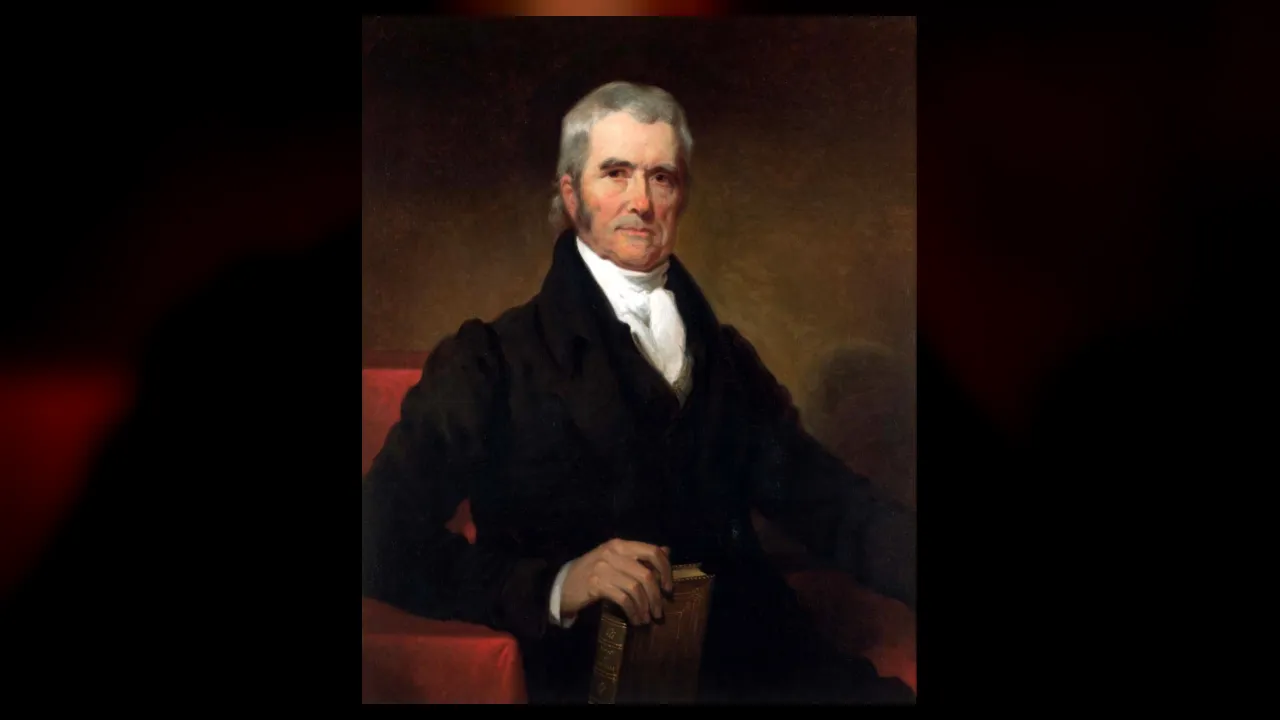
🗺️ Region / CapitalFauquier County & Richmond, Virginia & Washington, D.C.
📜 Key MilestoneMarbury v. Madison (Judicial Review) & McCulloch v. Maryland
⚡ Historical SparkTransformed the U.S. Supreme Court into an equal third branch of government
🤯 Mind-Blowing Fact • Grade 1
When the famous Liberty Bell in Philadelphia cracked according to popular tradition in July 1835, it was ringing quietly in memory of Chief Justice John Marshall!
✨ Word Sparks (Grade 1 Glossary)
Tap 🔊 to hear
gavel
A small wooden hammer a judge taps for order
Chief Justice
The head judge leading the U.S. Supreme Court
referee
A fair official who makes sure everyone follows rules
🪝
Who makes sure new laws follow the rules of the U.S. Constitution?
1
Growing Up on Virginia's Frontier
Tap, tap! Hear the judge's wooden ? Growing up in a log cabin in Virginia with fourteen brothers and sisters, young John loved books and outdoor games!
2
Referee of the Constitution
President John Adams chose him to lead the Supreme Court as . Wearing a plain black robe, he served for thirty-four long years!
3
Three Equal Branches
Like a fair sports , Marshall showed that the Supreme Court checks whether laws follow the Constitution—making courts strong and fair!
1. In which state did Chief Justice John Marshall grow up and build his home?
2. What important job did John Marshall show the U.S. Supreme Court must do?
🤯 Mind-Blowing Fact • Grade 2
Serving thirty-four years from 1801 to 1835 under six different U.S. presidents, Virginian John Marshall remains the longest-serving Chief Justice in all of American history!
✨ Word Sparks (Grade 2 Glossary)
Tap 🔊 to hear
judicial
Relating to courts, judges, and interpreting laws
modest
Simple and humble without showing off
supreme law
The highest rulebook—the Constitution—that everyone obeys
🪝
Why did Chief Justice John Marshall wear a simple plain black robe instead of fancy red-and-fur British judge robes?
1
Valley Forge Soldier From Virginia
Shiver, crunch! Freezing snow covered Valley Forge during the Revolutionary War, yet cheerful young Captain John Marshall from Virginia organized footraces in his socks to keep George Washington's cold soldiers smiling! Seeing thirteen colonies struggle together made him love a strong, united America.
2
A Plain Black Robe for a Republic
After studying law at the College of William & Mary in Williamsburg and practicing in Richmond, Virginia, Marshall was appointed Chief Justice in 1801. Choosing a black robe instead of colorful European robes, he encouraged all the justices to work together politely.
3
Judicial Review: Checking the Rules
In an 1803 case called Marbury v. Madison, Marshall wrote that the Constitution is the highest law of the land—and the Supreme Court must strike down any law that breaks it!
1. Why do U.S. Supreme Court Justices today all wear simple black robes?
2. How long did John Marshall serve as Chief Justice of the United States?
🤯 Mind-Blowing Fact • Grade 3
Down-to-earth Chief Justice John Marshall loved walking through Richmond's market carrying his own basket of groceries—once politely carrying a heavy turkey all the way home for a young stranger who had no idea he was the Chief Justice of the United States!
✨ Word Sparks (Grade 3 Glossary)
Tap 🔊 to hear
judicial review
Court power to overturn laws violating the Constitution
co-equal
Sharing equal constitutional rank with the other branches
interstate
Crossing or trading between two or more states
🪝
Why did the U.S. Supreme Court once have to meet inside a tiny basement room of the Capitol before John Marshall made it famous?
1
Shaped at Valley Forge and Williamsburg
Imagine the nation's highest court being so overlooked in 1800 that architects forgot to build it its own building! Raised in Fauquier County, Virginia, John Marshall fought bravely in George Washington's Continental Army at Brandywine, Germantown, and snowy Valley Forge before studying law under George Wythe at William & Mary.
2
Richmond Lawyer and Statesman
Settling in Richmond, Virginia, Marshall argued stoutly at Virginia's 1788 convention to ratify the U.S. Constitution. After serving as a diplomat to France, a U.S. Congressman, and President John Adams's Secretary of State, he became fourth Chief Justice in January 1801.
3
Marbury v. Madison and Judicial Review
Before Marshall, nobody was completely sure what happened if Congress passed a law conflicting with the Constitution. In Marbury v. Madison (1803), Marshall wrote clearly: 'It is emphatically the province and duty of the judicial department to say what the law is'—establishing !
4
Strengthening One United Nation
In later landmark cases like McCulloch v. Maryland (1819) and Gibbons v. Ogden (1824), Marshall protected Congress's constitutional powers and trade across rivers—turning the Supreme Court into a third branch of government.
1. Which landmark 1803 Supreme Court case written by John Marshall established the principle of judicial review?
2. At which Virginia college did young John Marshall study law under Professor George Wythe?
🤯 Mind-Blowing Fact • Grade 4
Rather than living separately across Washington, D.C., John Marshall and the other Supreme Court Justices lived together like college roommates in the same boardinghouse during court sessions so they could talk over constitutional questions peacefully after dinner!
✨ Word Sparks (Grade 4 Glossary)
Tap 🔊 to hear
federalism
Sharing constitutional powers between national and state governments
collegial
Working together respectfully as friendly, equal teammates
void
Having zero legal force; canceled out
🪝
How did Virginia's John Marshall turn a weak, overlooked court into the constitutional guardian of American government?
1
From Virginia's Frontier to Valley Forge
Growing up near the Blue Ridge foothills in Fauquier County, Virginia, as the eldest of fifteen children, John Marshall learned self-reliance early. Joining Virginia's Culpeper Minutemen and the Continental Army, he endured the bitter 1777–1778 winter at Valley Forge—recalling years later that he entered the army a Virginian and left it an American convinced of the need for effective national government.
2
Defending Ratification and Entering National Life
After attending George Wythe's pioneering law lectures at the College of William & Mary in 1780, Marshall built a thriving legal practice in Richmond, Virginia. At Virginia's dramatic June 1788 ratifying convention, he partnered with James Madison to answer Patrick Henry's objections, specifically defending Article III's federal courts. Following diplomatic service in France ('Millions for defense, but not one cent for tribute!'), election to Congress, and service as Secretary of State, President John Adams appointed him Chief Justice in early 1801.
3
Uniting the Court and Marbury v. Madison
Previously, Supreme Court justices issued separate 'seriatim' opinions, leaving rulings muddled, and three Chief Justices had resigned in just eleven years. Marshall persuaded fellow justices to board together softly in one Washington tavern, discuss cases collegially, and speak in a single clear Opinion of the Court. In Marbury v. Madison (1803), navigating a tense dispute with his cousin President Thomas Jefferson, Marshall established judicial review—affirming that any statute repugnant to the written Constitution is .
4
McCulloch, Gibbons, and National Commerce
Across thirty-four years, the Marshall Court cemented constitutional . In McCulloch v. Maryland (1819), Marshall upheld Congress's implied powers under the Necessary and Proper Clause and barred states from taxing federal institutions; in Gibbons v. Ogden (1824), he struck down state steamboat monopolies on interstate waters, opening rivers nationwide to free American commerce.
1. How did John Marshall's experience as a young Continental Army officer at Valley Forge shape his view of the Constitution?
2. What happened to river trade across America after Marshall's 1824 ruling in Gibbons v. Ogden?
🤯 Mind-Blowing Fact • Grade 5
At Virginia's June 1788 Constitutional Ratifying Convention in Richmond—fifteen years BEFORE writing Marbury v. Madison—thirty-two-year-old delegate John Marshall stood up and publicly explained that if Congress ever made a law not warranted by the Constitution, independent federal judges would declare it void!
✨ Word Sparks (Grade 5 Glossary)
Tap 🔊 to hear
seriatim
Each judge reading a separate opinion one after another
expounding
Explaining and interpreting the meaning of a text
appellate
Having authority to review decisions from lower courts
🪝
Why is Virginian John Marshall—who never served as president—honored alongside the greatest Founders as 'The Great Chief Justice'?
1
Valley Forge Nationalist and Richmond Advocate
When John Marshall took the oath as fourth Chief Justice on February 4, 1801, the Supreme Court commanded scant prestige—lacking its own building and tucked into a modest committee room beneath the Capitol. Born near Germantown in Fauquier County, Virginia, in September 1755, Marshall served four years in George Washington's Continental Line, fighting at Brandywine, Germantown, Monmouth, and Stony Point and serving as Deputy Judge Advocate during the brutal Valley Forge winter. After studying under George Wythe at William & Mary in 1780 and leading Richmond's bar, he defended Article III judicial review alongside James Madison at Virginia's 1788 ratifying convention, represented America during France's 1797–1798 XYZ Affair, served in the U.S. House, and served as John Adams's Secretary of State.
2
Institutional Revolution and Marbury v. Madison (1803)
Replacing English-style individual opinions with a unified 'Opinion of the Court,' Marshall authored 519 of the Court's 1,106 decisions across thirty-four years—forging consensus through unpretentious warmth and razor-sharp constitutional logic. In Marbury v. Madison (1803), arising from undelivered judicial commissions during the transition from Adams to Marshall's second cousin once removed, President Thomas Jefferson, Marshall sidestepped partisan confrontation while establishing an enduring constitutional bedrock: because a written Constitution is paramount law, courts must invalidate legislative acts that contravene it ('It is emphatically the province and duty of the judicial department to say what the law is').
3
Implied Powers and National Supremacy
In McCulloch v. Maryland (1819), Marshall produced his masterwork of constitutional interpretation, reminding Americans that 'we must never forget that it is a constitution we are '—designed to endure through ages to come. Upholding Congress's implied authority under the Necessary and Proper Clause to charter the Second Bank of the United States ('Let the end be legitimate, let it be within the scope of the constitution, and all means which are appropriate... are constitutional') and striking down Maryland's discriminatory tax under the Supremacy Clause ('the power to tax involves the power to destroy'), Marshall secured federal operational independence.
4
Commercial Integration and Judicial Independence
Similarly, in Cohens v. Virginia (1821), Marshall upheld Supreme Court review over state court rulings involving federal constitutional questions; in Dartmouth College v. Woodward (1819) and Fletcher v. Peck (1810), he protected Article I's Contract Clause, fostering reliable investment; and in Gibbons v. Ogden (1824), he defined interstate 'commerce' broadly to include navigation, dismantling state steamboat monopolies and creating a continent-wide common market.
5
Indigenous Law and Complex Virginia Legacy
In his later 'Marshall Trilogy'—culminating in Worcester v. Georgia (1832)—Marshall recognized the Cherokee Nation as a distinct political community within whose boundaries state laws had no legal force, though executive resistance prevented enforcement. Historians also note the stark contradiction of his private life in Richmond: even while writing public jurisprudence grounding liberty in law and supporting the American Colonization Society, Marshall owned enslaved people throughout his adult life. Dying in Philadelphia in July 1835 after thirty-four transformative years on the bench—plus authoring a five-volume biography of George Washington—Marshall left the Supreme Court a truly co-equal guardian of constitutional order.